If one day, the forest could speak, perhaps its voice would not echo like the wind through the trees, but would be as gentle as a mother's whisper.
The forest would tell us that it is not just trees, but also rivers, white clouds, the earth, and all living creatures sharing the same breath.
The forest would say: “Look at me with the eyes of systems thinking, and you will see that even the smallest leaf helps regulate this world”.
The forest teaches us a simple lesson: nothing in nature exists in isolation.
A drop of water seeps into the earth, becoming an underground stream that nourishes the trees.
A grain of pollen carried by the wind brings about a season of sweet fruit.
A fallen tree trunk becomes a source of life for hundreds of tiny creatures.
And humans, too, are a link in that chain.
We have long been accustomed to viewing forests in terms of hectares, cubic meters of timber, or the number of species. But systems thinking reminds us to see the forest through its relationships. The forest does not just “have” biodiversity—it “is” biodiversity, a place where intricate connections exist between tree and tree, between people and nature, between today and tomorrow.
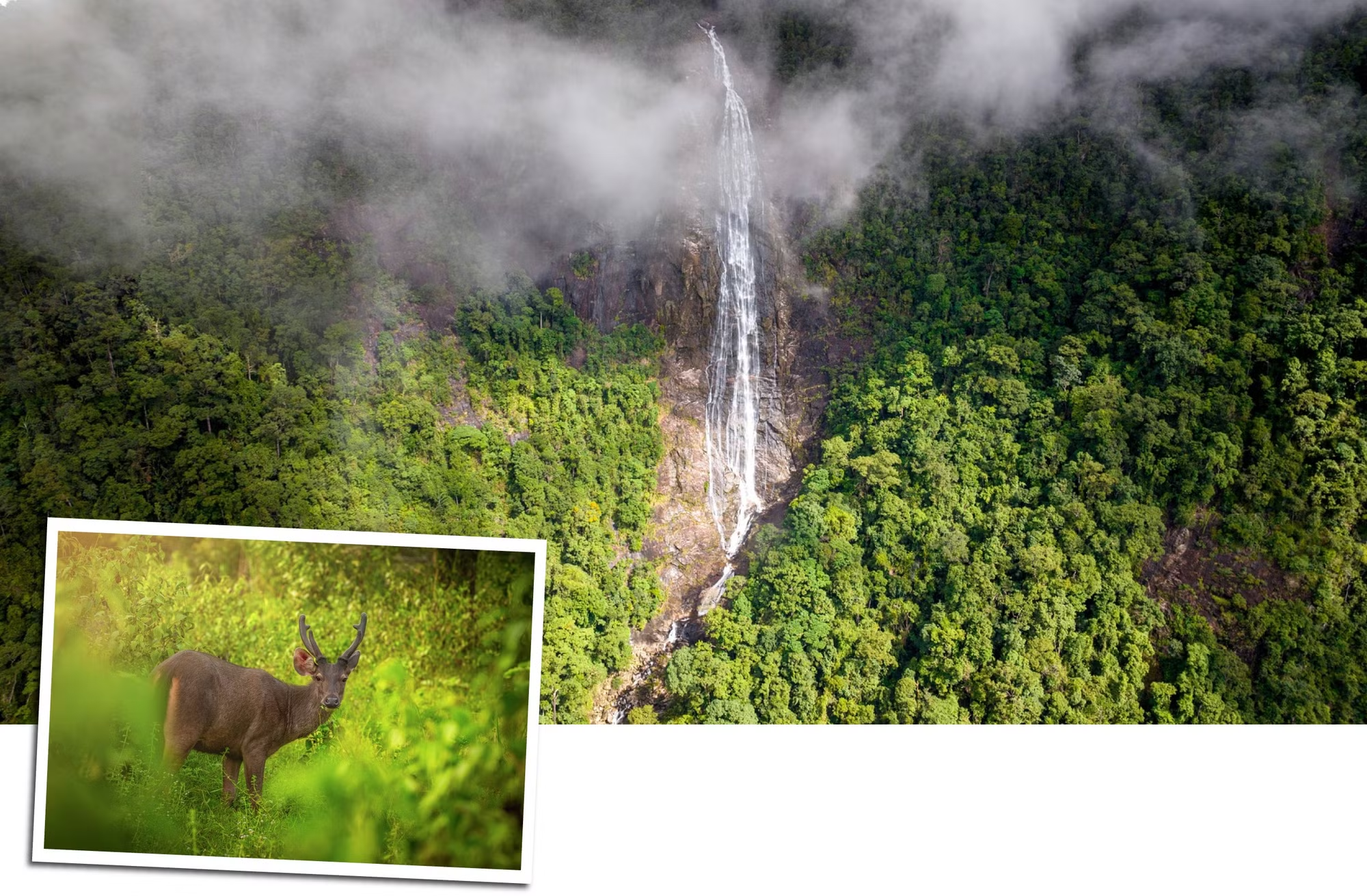
Protecting the forest is not just about preventing deforestation. It is about ensuring water sources do not run dry, the climate remains temperate, indigenous communities have sustainable livelihoods, and children in the lowlands can still breathe clean air.
Every small action—pausing when you hear the sound of a chainsaw, picking up a cigarette butt beneath the pines, replanting a native tree—contributes to this flow. For in the system of life, no action is too small.
There are newly planted forests, green but monotonous.
There are old forests, sparse but holding a thousand years of wisdom.
Forest development is not just about “replanting,” but about restoring the relationship between humans and nature.
A truly living forest is one with a diversity of tree species, canopies, streams, sounds, and people who know how to listen. That is why, in many places, the approach has shifted from “forest management” to “co-management,” allowing local people, businesses, scientists, and authorities to participate together, sharing both responsibilities and benefits.
Ecological forests, mangrove forests, cultural forests—all are “open systems” where economy and ecology develop together, and culture and environment shine side by side.
In the forest, no species governs another, yet every species has its role. Humans can learn from this how to manage development with a systems mindset:

When policies “breathe” with nature, when management listens to the voice of the forest, and when people see themselves as stewards of this life, that is systems thinking in action.
Looking at the forest, we see ourselves.
There are times when the forest is exhausted by exploitation, just as people are when they only know how to “take” and forget to “give.” Sometimes, the forest closes its canopy, shutting out the light, like our minds when we fear change. But when the forest opens its canopy to welcome rain, wind, and birds, it becomes a happy ecosystem.
Humans are the same: only when we open our hearts, connect, and live in harmony with our surroundings do we truly grow within our own system.
The forest is a mirror of humanity.
Protecting the forest is not a movement,
It is a way of life—one of understanding and compassion.
It is about cherishing every drop of water, every leaf, every villager carrying firewood along old forest trails.
It is understanding that the forest is not far away; it is within us, in how we consume, in how we see the world.
Systems thinking teaches us that a tree may live thanks to the soil, but a forest only thrives through connection.
And so it is with people. Amid the fractures of development, let us seek reconnection, like the silent roots of trees embracing each other beneath the earth.