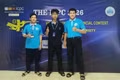
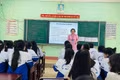
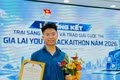
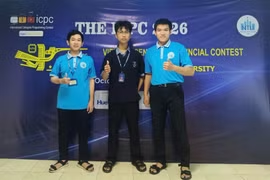
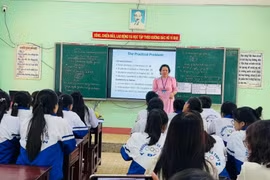
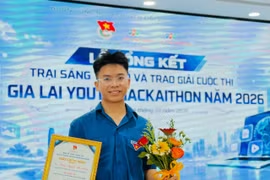
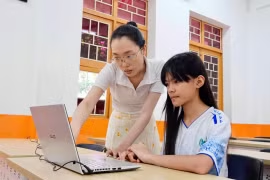
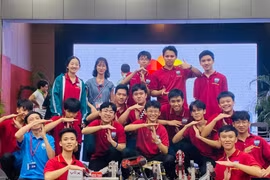
The 2026 Gia Lai Province Youth Informatics Contest concluded on June 4 at Quy Nhon University after two days of competition, showcasing strong programming performance and a range of student-developed technology projects aimed at solving real-world problems.
According to the judging panel, this year’s contest demonstrated notable improvements in professional quality across multiple categories. In Group A, the programming category for primary school students, 14 contestants scored 400 points or higher and 27 scored above 300 points.
In Group B for lower secondary students, seven contestants achieved at least 300 points, while 34 scored more than 200 points. Judges noted that the narrow score margins among top contestants reflected both intense competition and a high overall standard.
In Group C1, the programming category for specialized upper secondary schools, two teams scored more than 400 points, six exceeded 300 points and 10 surpassed 200 points. In Group C2 for non-specialized upper secondary students, seven contestants achieved at least 400 points and 14 scored over 300 points.
The first prize in Group C1 was awarded to Phạm Minh Quân and Nguyễn Thanh Bình, students from Hung Vuong Specialized High School.
Quân said the specialized category required advanced algorithmic thinking and the ability to apply complex algorithms under pressure. Contestants were tasked with solving five problems within two hours and 30 minutes.
“We spent about a month practicing together, discussing approaches to different types of problems and developing strategies for optimal teamwork under time constraints”, Quân said. “Before the contest, we agreed to divide tasks based on each person’s strengths, and for the more difficult problems, we would collaborate to find the most effective solutions”.
While the programming categories focused on information technology skills, Groups M1 and M2 tested logical and mathematical reasoning.
Cao Phong, a fifth-grade student at Ngo May Primary School and winner of first prize in Group M1, said extensive preparation played a key role in his success.
“I often look for logical math problems online to become familiar with different types of questions,” Phong said. “This type of math requires not only knowledge of formulas but also observation, analysis and the ability to identify patterns.”
The contest also featured creative product categories for primary, lower secondary and upper secondary students, where teams presented and defended their projects directly before judges.
Participants introduced products incorporating artificial intelligence, sensor technology, image recognition and real-time data processing to address issues including support for people with disabilities, skill development for children with autism, flood and disaster warnings, alerts for children left in vehicles and school management solutions.
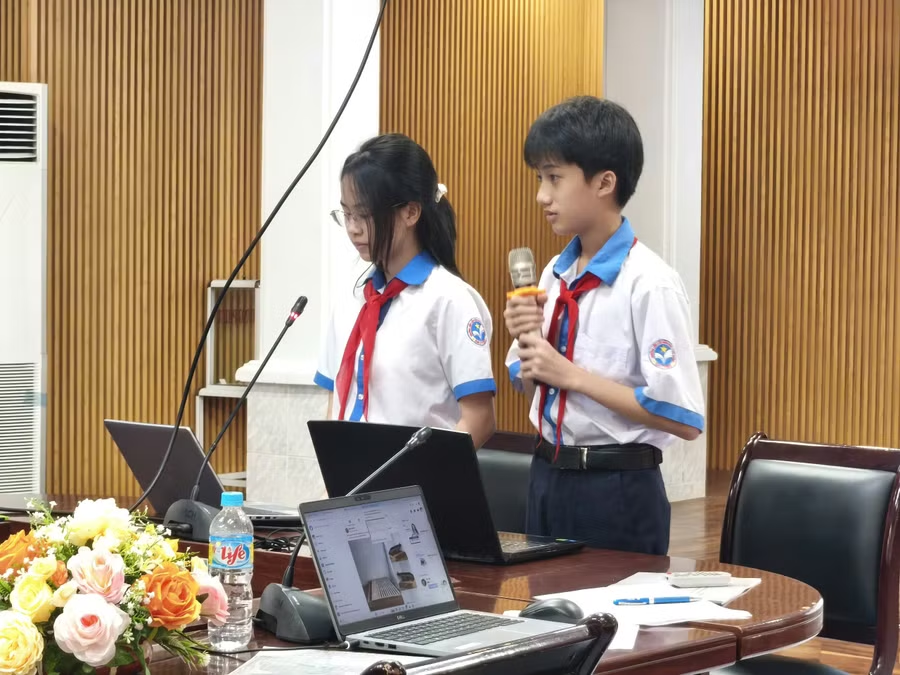
The only project to receive first prize among the creative product categories was “Learning Traffic Safety Laws,” developed by Nguyễn Lân Nhật and Nguyễn Thanh Hà, students at Sao Viet Primary-Secondary-High School.
Nhật said the project was inspired by concerns that many students lack sufficient knowledge and practical skills related to road safety.
The team created a website featuring video lessons, interactive quizzes, real-life traffic scenarios and educational games designed to help students learn traffic laws in a more engaging way.
“We spent about 10 months completing the website”, Nhật said. “In addition to creating content and learning programming ourselves, we received support from teachers and professional guidance from local traffic police to ensure accuracy”.
Nguyễn Lân Nhật and Nguyễn Thanh Hà present their product to the judging panel. Photo: Provided by Organizers
According to Nhật, the website has already been used in several school activities and has received positive feedback from students, encouraging the team to continue developing the platform.
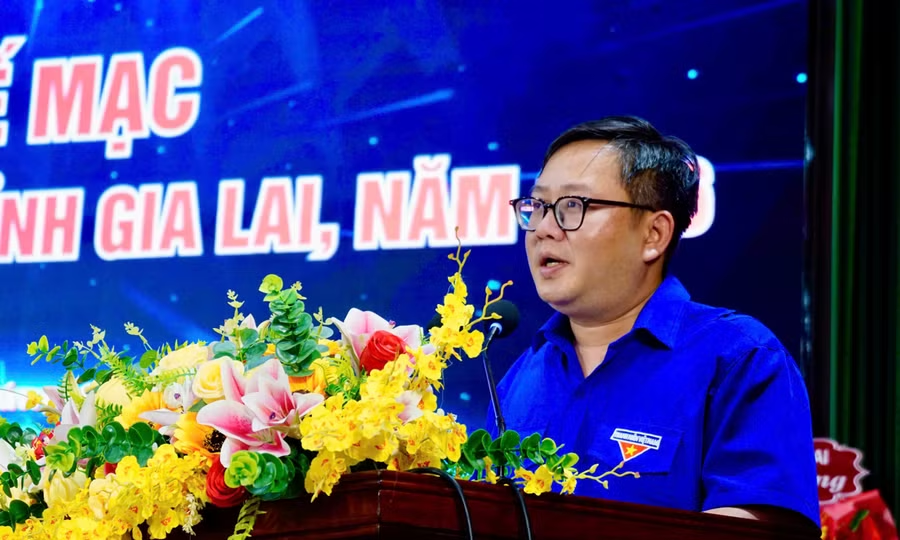
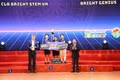
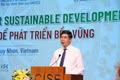
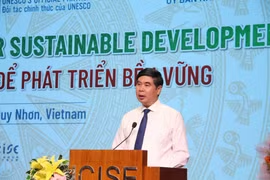
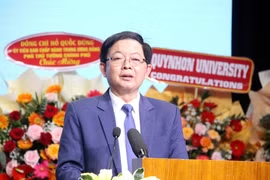
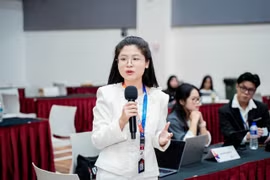
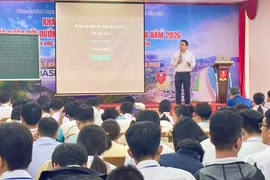
Nguyễn Chí Hiếu speaks at the contest’s closing ceremony. Photo: D.L
“The contest not only provides an environment for students to interact, learn, and unleash their creativity, but also helps discover and nurture those with talent in informatics, logical thinking, and technological innovation. This is a practical activity to build a high-quality young workforce, meeting the demands of digital transformation and the province’s development needs in the coming period,” emphasized Nguyễn Chí Hiếu, Deputy Secretary of the Provincial Youth Union and Head of the contest organizing committee.
At the end of the contest, the organizers awarded 7 first prizes, 18 second prizes, 20 third prizes, and 27 consolation prizes to individuals and teams across 9 categories.
In the programming section, first prize in Group A went to Lương Văn Quyến (class 5D, Nguyễn Thị Minh Khai Primary School, Chư Prông Commune); Group B to Đỗ An Dương (class 9A1, Hoai Huong Secondary School, Hoai Nhon Dong Ward); Group C1 to the team of Phạm Minh Quân (class 11C3) and Nguyễn Thanh Bình (class 11C8), Hung Vuong Specialized High School, Dien Hong Ward; and Group C2 to Vũ Thành Luân (class 11A8, Quang Trung High School No. 1, Tay Son Commune).
In the logical and algorithmic math section, first prize in Group M1 went to Cao Phong (class 5D, Ngo May Primary School, Quy Nhon Nam Ward); Group M2 to Nguyễn Đăng Khôi (class 9A2, Phuoc Thanh Secondary School, Tuy Phuoc Tay Commune).
In the creative product section, first prize in Group D2 went to the team of Nguyễn Lân Nhật (class 8A4) and Nguyễn Thanh Hà (class 8A4), Sao Viet Primary, Secondary, and High School, Pleiku Ward. No first prizes were awarded in Groups D1 and D3.
After the contest, the organizers will select top-performing contestants for further training and participation in regional and national competitions.
More than 50 delegates from 20 countries and territories are attending the 45th International Conference on Physics in Collision in Gia Lai province, marking the event’s return to the International Center for Interdisciplinary Science and Education (ICISE) after 10 years.
Schools in Gia Lai province are expanding opportunities for students to use English through clubs, presentations, bilingual programmes and community classes, supporting a provincial effort to gradually make it a second language in schools.
As the rainy season draws to a close and warmer sunshine returns in late September, thin veils of mist begin to drift across the Pleiku plateau in Gia Lai province, transforming roads, fields and mountain slopes into a dreamlike landscape.
Gia Lai is strengthening trust and safety in cyberspace by bringing KOLs, community administrators, content creators and authorities together to promote accurate information and positive values online.
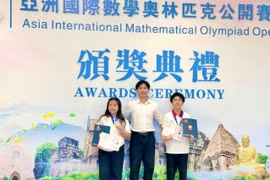
Two students from Asia Pacific International School Gia Lai (APC Gia Lai) won gold and silver medals at the international finals of the Asia International Mathematical Olympiad (AIMO) 2026, following years of dedicated study and competition.
Nguyễn Hồng Quân, a 12C3A student at Hùng Vương High School for the Gifted in Gia Lai, has achieved a perfect score of 1,600 on the SAT, earning 800 points in both Math and Reading & Writing.
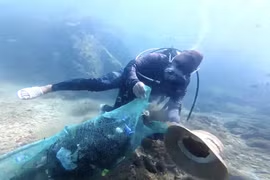
Coral coverage at Bai Dua has risen from 62% to 75.6%, while coverage at Hon Kho Nho has increased from 36% to 44.3%, as residents of Nhon Hai have spent more than a decade protecting coral reefs, cleaning marine debris and monitoring aquatic resources.
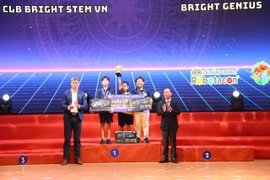
Twenty-three high-performing teams have been selected to represent Vietnam at international World Robot Olympiad (WRO) competitions after three days of competition at the ROBOTACON WRO 2026 national finals in Gia Lai.
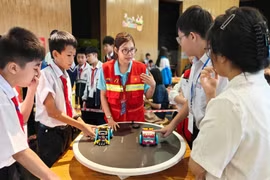
Forty-nine teams from Gia Lai have qualified for the national finals of the ROBOTACON WRO 2026 Robotics Talent Competition after a provincial contest that drew 107 teams from 73 educational institutions.
(GLO) – Two students from Gia Lai have excelled by winning the first and second runner-up titles at the 22nd elite maths challenge cup (EMCC) 2026, an international mathematics competition held in Malaysia. This achievement further highlights the impressive performance of Gia Lai students.
For more than a decade, Trần Duy Nhất and Võ Thanh Hưng have remained committed to voluntary blood donation, each giving blood more than 30 times in an effort to save lives and encourage others to contribute.
The International Hackathon on Quantum Computing for Social Good (QC4SG 2026) opened on July 24 at the International Center for Interdisciplinary Science and Education (ICISE), bringing together young researchers, scientists and technology entrepreneurs to develop solutions for challenges.
Hundreds of residents, students and science enthusiasts attended two free public lectures on astronomy and space at the Center for Science Discovery and Innovation in Quy Nhon Nam Ward, Gia Lai Province, on Saturday as part of the 2026 International Community Astronomy Week.
A free community summer program in Gia Lai is providing young people with practical opportunities to develop physical fitness, creative thinking and digital skills through classes in Vovinam martial arts, graphic design and artificial intelligence applications.
Two students from Vietnam's Gia Lai province secured top honors at the Singapore International Mathematical Olympiad Challenge (SIMOC) 2026, with one earning a gold medal and one of the competition's highest overall distinctions.
VCCA 2026, Control Automation Digital Transformation, technology transfer, smart automation, artificial intelligence, AI, Internet of Things, IoT, robotics, smart manufacturing, digital transformation, innovation.
Gia Lai will host a week-long series of international quantum technology events from July 23 to 29 under the Gia Lai Quantum Year programme, bringing together scientists, businesses and innovators from Vietnam and to strengthen collaboration and accelerate the application of quantum technologies.
Artificial intelligence may be transforming education and everyday life, but understanding the mathematics behind the technology is essential to using it effectively, educators and students at Vietnam’s 2026 Mathematics Summer School say.
Major Lê Đức Lâm, a 38-year-old officer with the Advisory Division of the Provincial Police Department, has made voluntary blood donation a part of his life for nearly two decades.
Pleiku Traditional Medicine and Rehabilitation Hospital is strengthening its treatment capacity through specialist training and technology transfer from higher-level hospitals, allowing more patients to access advanced traditional medicine and rehabilitation services locally.
A mother and calf killer whale pair has been spotted hunting close to the shore off Vung Boi in An Luong Commune, Gia Lai Province, attracting large numbers of residents, tourists and wildlife enthusiasts over the past two days.
Doctors at Hoang Anh Gia Lai University of Medicine and Pharmacy Hospital have successfully performed the province's first Frey procedure to treat a patient with chronic pancreatitis caused by pancreatic duct stones, marking a milestone in the local adoption of advanced surgical techniques.
The International Community Astronomy Week 2026 will be held from July 24 to 26 at the Center for Science Discovery and Innovation in Quy Nhon Nam Ward, Gia Lai Province, under the theme "Gateway to the Stars".
Võ Đăng Tuệ, a Class 12A2 student at Chi Lăng High School in Gia Lai province, has emerged as the top scorer in Vietnam’s national high school graduation examination for the A0T subject group, crediting his achievement to a study approach focused on deep understanding.