The unit has been removing mines and unexploded ordnance from forests, mountains and former battlefields in eastern Gia Lai Province and Quang Ngai Province, where remnants of war continue to pose risks to residents and agricultural activities.
Since August 2025, Platoon 1 of Engineer Brigade 7 has been conducting clearance operations in Bong Son Ward after previously participating in similar missions in An Vinh and An Toan communes. The brigade currently deploys three platoons for mine-clearance duties across the region.
Working under intense heat and challenging terrain, soldiers equipped with protective gear and metal detectors move methodically through areas once heavily affected by bombardment. Every signal detected underground is carefully examined, reflecting the strict safety standards required in a profession where mistakes can be fatal.
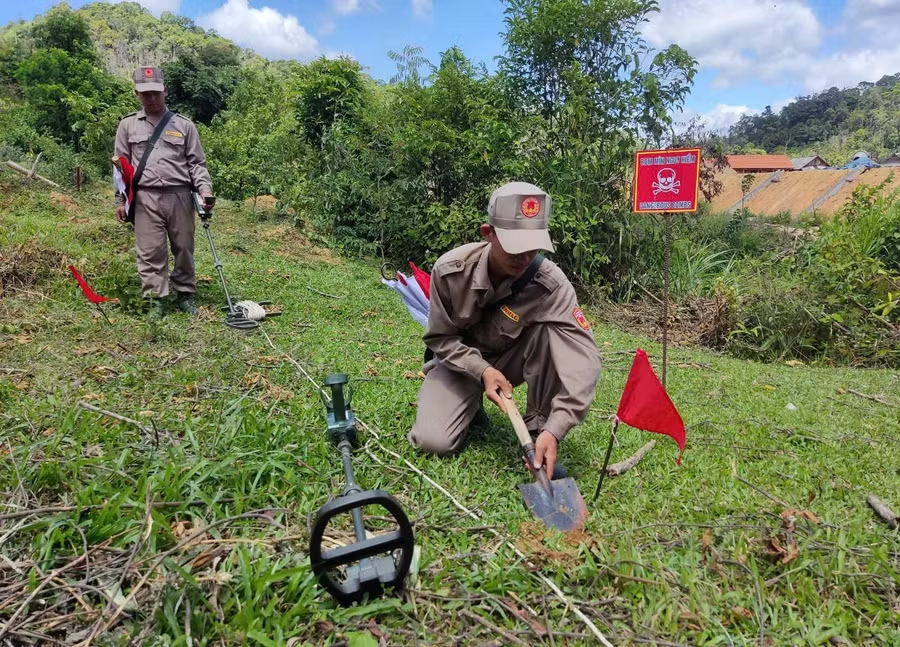
First Lieutenant Trần Tiến Dũng, commander of Platoon 1, said personnel assigned to mine-clearance missions undergo rigorous selection and training. Soldiers must complete specialized engineering education, obtain mine-clearance certification and receive additional instruction from the Vietnam National Mine Action Center before being deployed to the field.
Dũng said the greatest challenge is the unpredictability of unexploded ordnance, some of which still contain active detonation mechanisms despite having remained underground for decades.
“Unexploded ordnance is highly unpredictable. Even a small piece of metal could be part of a detonation system. Therefore, every action must be absolutely precise, there is no room for guesswork”, he said.
Major Professional Soldier Hoàng Công Kế, a veteran member of Platoon 1 with more than a decade of experience, recalled discovering a 230-kilogram bomb in An Tuong Commune. The heavily corroded device required painstaking excavation and repeated risk assessments before it could be safely handled.
He also highlighted the dangers posed by phosphorus munitions, which can ignite immediately when exposed to air. Such devices often require rapid isolation and, in many cases, on-site disposal to prevent fires and ensure public safety.

Beyond operational risks, soldiers face extended deployments in remote areas where communication with family members is often limited by weak mobile phone coverage. Severe weather, difficult forest terrain and temporary field accommodations add to the challenges of the mission.
Despite the hardships, members of the brigade continue their work under strict military discipline. According to Corporal Phạm Văn Phương, the unit also regularly participates in community outreach and legal education activities, helping strengthen ties with local residents.
Engineer Brigade 7 has been conducting mine-clearance operations in eastern parts of the province since 2022. After completing Phase I between 2022 and 2024, the unit is now carrying out Phase II.
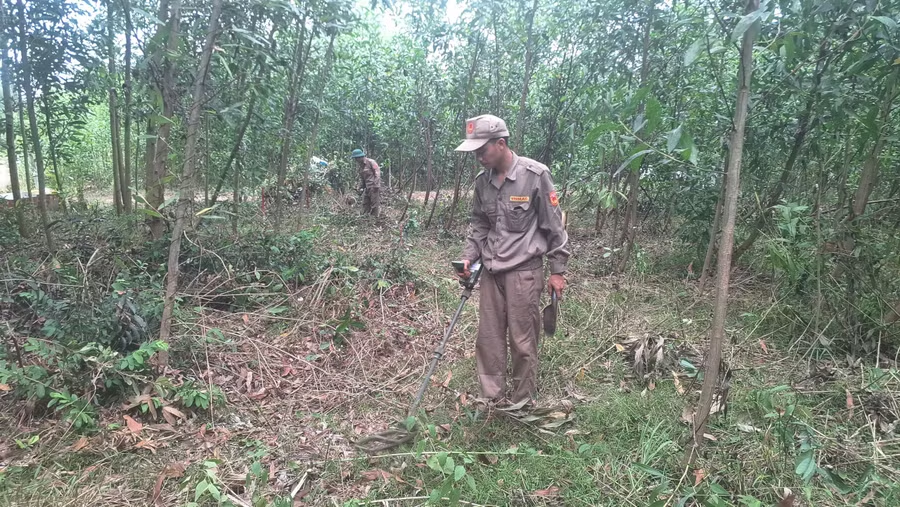
In Bong Son Ward alone, engineering teams have surveyed and cleared approximately 220 hectares during the second phase. Of that area, 32 hectares were found to contain unexploded ordnance, while 188 hectares have been declared safe. The operation has recovered a range of explosive remnants, including cluster munitions, artillery shells, mortar rounds, grenades and M79 ammunition.
In An Toan Commune, a former battlefield, nearly 180 hectares of land have been cleared to a depth of 0.3 meters to support agricultural production. Teams recovered nearly 200 explosive devices during the operation.
The former Gia Vuc airfield area in Hamlet 1 remains one of the most heavily contaminated locations. Clearance teams recovered 63 explosive devices across more than 72 hectares. The brigade has also conducted deeper clearance to a depth of three meters over nine hectares to facilitate the construction of flood-resistant housing and a medical station.
Authorities have since received multiple cleared sites, including land designated for 40 flood-resistant houses and four medical stations, allowing communities to safely expand housing and public services.
Lieutenant Colonel Hoàng Mạnh Hùng, Political Commissar of Engineer Brigade 7, described the work as both highly dangerous and socially significant.
“Mine clearance is not only a military task but also a responsibility to the people,” Hùng said. “Every meter of land made safe is another piece of security restored, contributing to local socio-economic development.”
Local authorities say the impact is already visible. Đinh Văn Nghin, Chairman of the An Toan Commune People’s Committee, said residents now feel more confident cultivating land that was previously considered hazardous.
“The soldiers work very seriously and methodically. More importantly, they help people feel secure to farm their own land”, Nghin said.
Although the war ended long ago, the battle against its remnants continues beneath the soil of Bong Son Ward and An Toan Commune. As Engineer Brigade 7 clears unexploded ordnance from former conflict zones, land once regarded as dangerous is gradually being returned to safe and productive use, bringing renewed opportunities for local communities.