For many settlers, the journey to Gia Lai province marked the beginning of a life defined by hardship, resilience and hope. Armed with little more than determination, they cleared forests, cultivated barren hills and gradually built stable livelihoods in unfamiliar territory.
In 1977, Lê Phước Tuấn, then in his early 20s, joined more than 100 young people from Vinh Hà commune in Thừa Thiên Huế province, now Hue, to establish a new life in Gia Lai’s rugged highlands.
Recalling the journey, Tuấn said the group traveled for more than half a day along narrow red dirt roads after arriving at what is now the center of Chư Sê district before reaching their destination in what was then part of Chư Prông district.
The settlers struggled to adapt to unfamiliar soil and climate conditions, while shortages of food, drinking water, transportation and basic infrastructure made life especially difficult. Crop failures were common, and many people eventually abandoned the area and returned home.
Local authorities responded by planning residential areas, allocating production land and mobilizing youth unions, women’s associations and militia forces to support residents in clearing land, building houses and stabilizing their livelihoods.
“Difficulties such as lack of electricity, roads and water were gradually resolved thanks to consistent leadership and direction,” Tuấn said. “The Party’s leadership and the involvement of the entire political system gave us the confidence to stay and build new villages”.
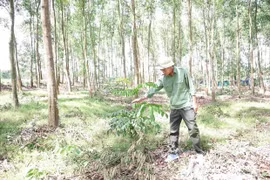
For Phan Văn Chạo, a former soldier from Hải Dương province, the memory of arriving in Gia Lai remains vivid decades later. Seeking space to pursue agricultural ambitions he could not realize in his crowded hometown, Chạo moved to the province determined to reclaim the land through sheer persistence.
“At dusk, my legs trembled as I stood on this vast land,” he recalled.
With little more than farming tools and military discipline, Chạo spent months clearing wild roots and leveling land by hand. Living in a temporary field hut illuminated by an oil lamp each night, he eventually reclaimed one hectare of fertile land and planted his first coffee trees.
When the coffee plants began to grow successfully, Chạo realized the land was suitable for long-term cultivation. He expanded his farm over time and later brought his wife and children from Hải Dương to settle permanently in Gia Lai in 1995.
Elsewhere, residents from Tây Sơn district in the former Bình Định province also answered the Party and State’s call to establish new lives in the revolutionary base area of Đak Sơmei.
Upon arrival, many were shocked by the harsh conditions, including dense forests, lack of roads and electricity, and widespread malaria.
According to local resident Thứa, families initially relied on short-term crops such as cassava, corn and sweet potatoes to secure food supplies. With support from local Party committees and authorities, they later transitioned to long-term industrial crops including coffee, pepper and fruit trees, helping improve household incomes and living standards.
Nearly 35 years ago, Bùi Thị Tinh, from the Mường ethnic group, moved with dozens of families from the former Hòa Bình province to the border area of Ia Lâu commune under the new economic zone program.
After receiving temporary housing and allocations of residential and production land, the families began rebuilding their lives despite difficult conditions during the harsh Central Highlands dry season.
“The scorching heat, leafless forests and lack of water made it difficult for crops to grow,” Tinh recalled.
At times, families considered returning to their hometowns. However, encouraged by the region’s fertile land potential, they stayed and gradually focused on wet rice cultivation, expanded reclaimed land areas and applied technical advances to improve productivity.
Over the years, infrastructure development, irrigation projects and support policies for housing, seeds, livestock and production land helped stabilize communities across the region.
Today, many former settlers say the hardships of the early years have been replaced by stable livelihoods, improved living conditions and educational opportunities for future generations.
For those who once arrived in Gia Lai carrying memories of distant hometowns, the once-foreign land has gradually become a true home, built through perseverance, solidarity and years of labor.
For those who once arrived in Gia Lai carrying memories of distant hometowns, the once-foreign land has gradually become a true home, built through perseverance, solidarity and years of labor.