

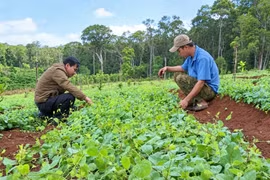
Gia Lai aims to expand medicinal plant cultivation from nearly 1,500 hectares currently to more than 7,486 hectares by 2030, with a focus on growing herbs under forest canopies while conserving natural resources and supporting local livelihoods.
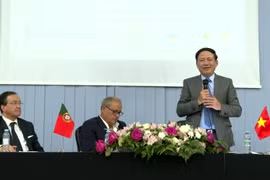
Gia Lai Province is seeking to expand investment, trade and tourism cooperation with Portuguese businesses, as it stepped up economic engagement with the city of Guarda following the signing of a cooperation agreement between the two local authorities.

Localities across Gia Lai province are turning to livestreaming to promote specialty and OCOP products, helping producers reach wider markets while building skills in online marketing, sales and customer engagement.
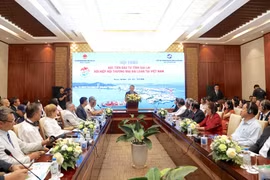
Gia Lai province is seeking to expand investment and trade cooperation with Taiwanese businesses, with a focus on manufacturing, technology, agriculture, renewable energy, logistics and tourism.
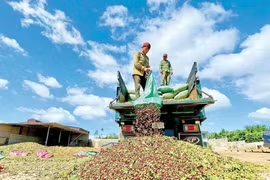
Gia Lai is stepping up efforts to expand markets for agricultural products and build stable production-processing-consumption chains, as authorities seek to reduce reliance on seasonal sales across nearly 977,000 hectares of agricultural land.
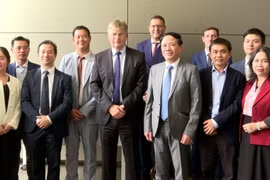
Gia Lai Province and France’s Normandy region have agreed to explore stronger cooperation in investment, trade, tourism, renewable energy, education, science and technology during a working visit by a Gia Lai delegation.
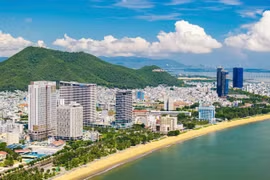
Gia Lai is simultaneously revising its provincial master plan and the master plans for four major urban centers as it seeks to create a more interconnected development network spanning coastal, highland and border areas.
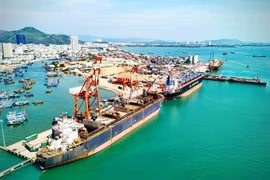
Gia Lai is stepping up investment in transport and logistics infrastructure to position itself as a key logistics hub for Vietnam’s Central Highlands, linking major agricultural production zones with border gates, seaports and international markets.
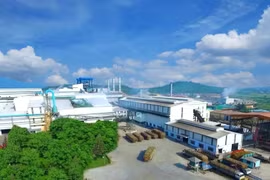
Gia Lai is seeking to increase the value of its agricultural sector by expanding deep processing, strengthening production linkages and building closed value chains, as the province looks to retain more value within its major raw material areas.
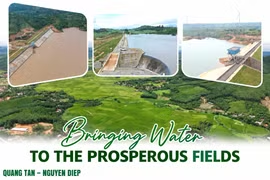
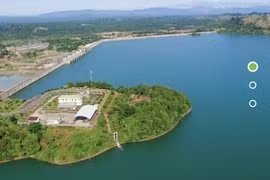
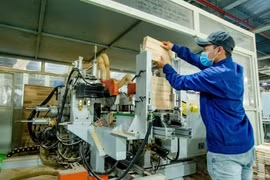
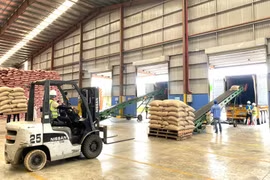
(GLO) – Following the merger, Gia Lai is better positioned to reorganize its economic landscape, linking raw material production with processing, logistics, commerce, and market access.
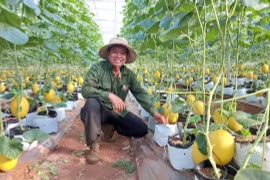
Vietnam’s Gia Lai province is expanding high-tech farming, certified production and processing to raise the value of key agricultural products and meet stricter domestic and export market requirements.
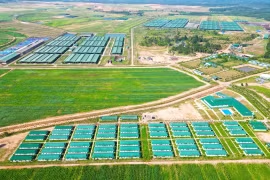
Gia Lai aims to generate more than $17 billion in export turnover between 2026 and 2030, as the province seeks to help businesses and cooperatives expand internationally, strengthen brands and secure positions in global supply chains.
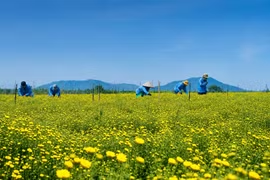
Young people returning to Gia Lai are finding new ways to increase the value of local agricultural products, combining technology, processing skills, market experience and storytelling to bring products closer to consumers.
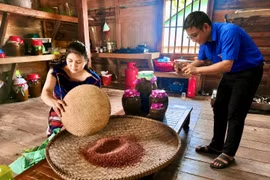
A Facebook-based digital marketplace launched in Đak Pơ is helping local farmers and small traders reach customers beyond the commune, with young people providing hands-on support to promote agricultural products and local specialties online.
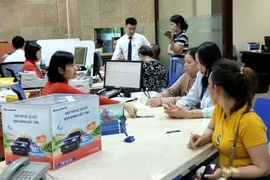
Banks in Gia Lai are rolling out large-scale credit packages and cutting lending rates by up to 2 percentage points a year as they seek to improve access to capital for businesses and households.
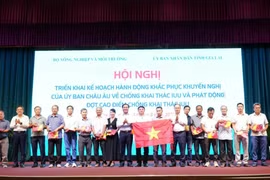
Gia Lai is stepping up enforcement against illegal, unreported and unregulated (IUU) fishing, tightening vessel controls, electronic monitoring and seafood traceability as authorities seek to have the “yellow card” warning lifted in 2026, towards a more transparent and sustainable fisheries sector.
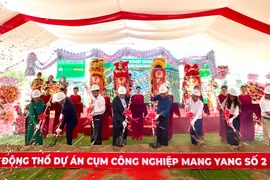
Hoang Anh Gia Lai Joint Stock Company broke ground on the VND 400 billion (about $15.3 million) Mang Yang No. 2 Industrial Cluster in Hra commune on August 12, a 74.5-hectare project expected to create stable jobs for more than 4,500 workers.
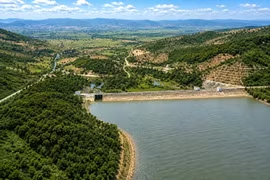
Gia Lai is planning a major expansion and upgrade of irrigation infrastructure in its western region, where only 8.94% of agricultural land currently has access to proactive irrigation and the annual water shortfall exceeds 1.234 billion cubic metres.
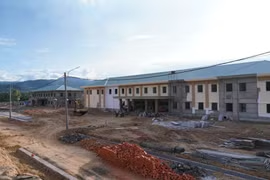
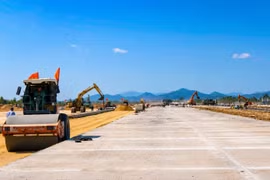
The construction of Runway No. 2 and associated airfield facilities at Phu Cat Airport has entered its final stage, with contractors working around the clock to complete the project on schedule while maintaining stringent quality standards ahead of commissioning.
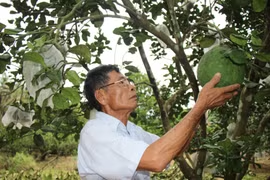
Gia Lai province is restructuring its agricultural sector by replacing fragmented local branding with regional-scale agricultural brands linked to specialized production areas and integrated value chains, aiming to improve competitiveness, attract investment and expand export opportunities.
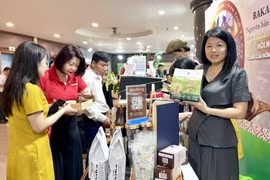
Agricultural producers in Gia Lai are strengthening quality, traceability and supply chain management as they seek greater access to Vietnam’s modern retail networks, where requirements on consistency and long-term supply remain major barriers despite the province’s strong agricultural base.
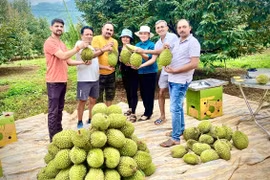
After leaving his position as director of an agricultural enterprise in Ho Chi Minh City, Nguyễn Chất Sâm returned to Ia Ly commune to pursue organic farming, transforming degraded former rubber plantations into a 15-hectare durian farm that now generates about US$267,000 in annual profit.
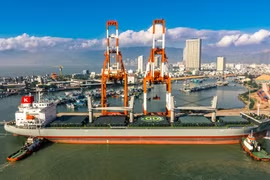
Gia Lai is reshaping its foreign direct investment (FDI) strategy by prioritising high-tech, environmentally friendly projects with strong spillover effects over investment volume, as the province seeks to improve growth quality and strengthen its role in global supply chains.
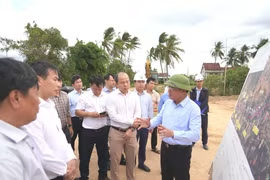
Gia Lai authorities have ordered faster construction and site clearance across several major transport projects, setting firm deadlines for an expressway, a new airport runway and a coastal road as the province seeks to strengthen regional connectivity and support economic development.