(GLO) - After more than two decades of nurturing her literary dreams, poet Ngô Thanh Vân has published five poetry collections, two short story collections and two essay collections.
For her, literature only comes alive when it touches the heart, turning into a love that sings, her greatest wish is to accompany readers through the most simple and sincere things.
Poet Ngô Thanh Vân. Photo provided by Ngô Thanh Vân
You began writing at an early age. Were those years with “Gia đình Áo trắng” your most radiant literary springtime?
- I started writing poetry in high school, though my early works were clumsy. At university, I joined the literature club at the Youth Cultural House, which helped me grow more confident with my words. I began sending manuscripts to newspapers, and seeing them published, along with receiving royalties, gave me motivation.
That period also allowed me to meet many established writers and poets, as well as peers of my generation. One of the most influential was writer Đoàn Thạch Biền, whose encouragement inspired me greatly.
Later, when I moved from the bustling city to the Central Highlands, his support helped me remain connected to friends and colleagues of the Áo trắng anthology. In Pleiku, we formed the Gia đình Áo trắng Pleiku, continuing to write and nurture literature together.
Your collection “Qua miền nhớ” came before “Mười hai tháng sáu,” but the latter, named after your birthday, is considered your most personal work. Why?
- “Mười hai tháng sáu” is my favorite collection. June 12 is also my birthday, so the title became a personal memento, a brand of my own quietly built through words.
With this work, I experimented with a new writing style, different from “Qua miền nhớ.” To my surprise, it was warmly received by fellow writers.
The language, themes, and imagery revealed another side of me, different from the gentle image people usually see. Even the book cover still impresses me today. That freedom to evolve is what I carry forward in my creative journey.
Poet Ngô Thanh Vân (fourth from the right) with fellow writers in Hanoi. Photo provided by Ngô Thanh Vân
In “Vân môi say phố,” readers say the city in your prose captures every shade of emotion. Was that your intention?
- Yes. “Vân môi say phố” is one of three books I dedicate to Pleiku, along with “Miền sương tản phố” and “Nồng nẫu bazan”, a poetry collection I plan to release later this year.
I wanted to record every corner of this city out of deep affection. My stories evoke nostalgia for Pleiku in the 1980s and 1990s, when I was growing up.
Hardship was common, not only in my family, and I hope readers find their own memories reflected there. Pleiku’s changing seasons stir countless emotions. For me, it is a place people always long to return to.
After eight years, you returned with the poetry collection “Vân không.” What does this comeback mean to you?
- “Vân không” marks my return after eight years without publishing poetry. Those years were full of upheaval—success, failure, joy, and hardship. They shaped me and gave me serenity, which I now express through poetry.
The title means a tranquil cloud drifting freely across the sky. I remind myself to keep moving, slowly if needed, just never stopping.
At the book launch in Hanoi, held alongside my adoptive father and poet Lê Thuận Nghĩa, we shared a theme: “The Flow of Words Between Father and Daughter.” Our voices may differ, but they resonate in a shared passion for poetry.
Poet Ngô Thanh Vân (center) at her book launch in Hanoi. Photo provided by Ngô Thanh Vân
For this book launch, my adoptive father—a fellow poet, a physician who has always cared for my health, and a revered father figure—chose the capital as the venue, making it a beautiful memory for his birthday. Living and working in Germany, having his first book launch in Hanoi was deeply meaningful for him. It was also special for me, a daughter of the highlands returning to the capital to present my latest work.
With the theme “The Flow of Words Between Father and Daughter,” our two poetic voices—two generations—are different, yet share a resonance and connection. The meeting point is the voice of the soul, of poetry, and a shared passion for creativity distilled over time. Poets hope to touch readers’ hearts with the simplest, most sincere things.
As Vice President of the Gia Lai Provincial Association of Literature and Arts, you also nurture young writers. How do you see the literary future of the Central Highlands?
- The search for young literary talents is always our concern. Literature is a flowing stream, with each generation enriching the cultural soil.
While the artistic path is deeply personal, creating supportive conditions allows seeds to sprout and grow strong.
Through creative workshops with students and ethnic minority writers, I have witnessed their passion.
Many still turn to books and write their own stories sincerely and innocently. I only hope they keep this love alive. In time, new voices may rise from the basalt soil of our land, carrying forward the cultural heritage of the Central Highlands.
Thank you for this engaging conversation. Wishing you good health, happiness, and boundless creativity.
Poet Ngô Thanh Vân (born 1981) is Vice President of the Gia Lai provincial Association of Literature and Arts, a member of the Vietnam Writers’ Association, and of the Association of Literature and Arts of Vietnam’s Ethnic Minorities.
Her works include five poetry collections (Qua miền nhớ, Mười hai tháng sáu, Phác thảo đêm, Nằm nghe lá thở, Vân không), two short story collections (Thì thầm với anh, Đất khách), and two essay collections (Miền sương tản phố, Vân môi say phố).
She has received multiple awards, including the Young Author Award from the Vietnam Union of Literature and Arts Associations (2009) and the Gia Lai Literature and Arts Award (2005–2015).
Three Bryde’s whales spotted hunting off Vũng Bồi in Gia Lai have highlighted the ecological richness of the Đề Gi estuary while underscoring the fishing communities’ longstanding culture of respecting and protecting the sea.
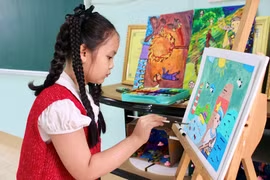
Dương Kim Thiên An, a second-grade student at Nguyen Van Troi Primary School in Gia Lai Province, has won four national art awards in 2026, marking a promising start to her journey in painting.
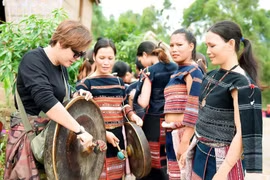
Traditional culture is being brought closer to children in Gia Lai through hands-on activities that allow them to experience gong music, xoang dances and hát bội art rather than simply learn about them through lessons.
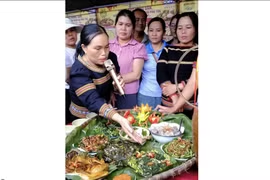
Bitterness is the defining taste of traditional Jrai cuisine in Phu Tuc, where forest leaves, bitter vegetables and distinctive cooking methods have shaped dishes closely tied to the community’s way of life.
Gia Lai is seeking to shift its approach to culture from preservation alone towards sustainable promotion of heritage values, with provincial leaders calling for cultural resources to be transformed into distinctive products that support socio-economic development.
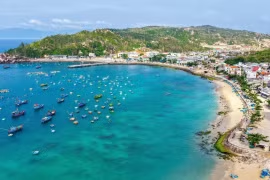
Gia Lai has significant potential to turn its centuries-old connections between the Central Highlands and the sea into a new source of economic growth, with maritime heritage, tourism and cultural industries forming part of an integrated development strategy.
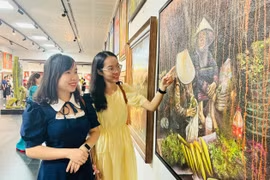
Gia Lai artists have emerged as leading contributors to the 30th Regional Fine Arts Exhibition for Region V - South Central and Central Highlands, accounting for three of the nine award-winning artists and the largest number of works submitted by any participating locality.
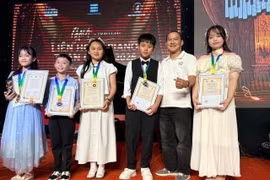
Two young pianists from Gia Lai won gold medals at the finals of the 2026 National Piano Festival, held in Buon Ma Thuot Ward, Dak Lak Province, from August 4 to 9.
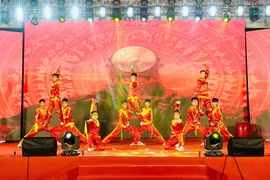
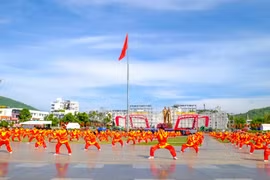
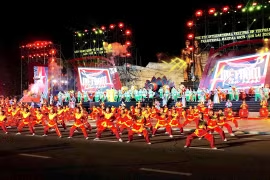
Hundreds of martial artists gathered at Nguyen Tat Thanh Square in Quy Nhon Ward on Sunday to perform synchronized demonstrations of Vietnamese traditional martial arts as part of the 9th International Vietnamese Traditional Martial Arts Festival - Gia Lai 2026.
(GLO) – Foreign Trade University beauty queen Le Phuong Nghi (an alumna of Hung Vuong High School for the Gifted, Gia Lai province) has officially advanced to the preliminary round of the Miss Vietnam 2026 pageant.
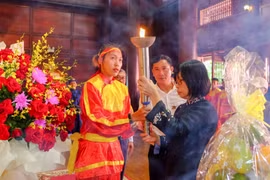
The 9th International Vietnamese Traditional Martial Arts Festival officially began on Sunday with an incense offering ceremony and a sacred flame procession, bringing together martial arts delegations from across the country and overseas for the opening of the 4-day cultural and sporting event.
The 9th International Vietnamese Traditional Martial Arts Festival officially opened on Sunday at Nguyen Tat Thanh Square in Quy Nhon Ward, bringing together martial arts masters, practitioners from Vietnam and abroad in a celebration of traditional martial arts and its international presence.
Nearly 20 artists from across Gia Lai Province are taking part in a 10-day lacquer painting workshop, where they are learning traditional techniques, exchanging creative ideas and deepening their appreciation for one of Vietnam's most enduring artistic mediums.
The FLC Quy Nhon Flower Festival 2026 will be held from Aug. 15 to Sept. 15 at the FLC Quy Nhon Resort Complex as part of the National Tourism Year - Gia Lai 2026, organized by FLC Group Joint Stock Company in coordination with the provincial People's Committee.
The HV Music Club of Hung Vuong High School for the Gifted held its ninth annual minishow, titled "Thăng" (Ascend), on the evening of July 21 in Pleiku Ward, bringing together student performers and guest artists in an event that also supports the club's annual charitable activities.
Musician Trần Kim Vân has been awarded a Certificate of Merit for his outstanding contributions at the 2026 National Three-Region Folk Singing and Instrumental Festival.
Phu Tuc Commune in Gia Lai Province will host its first Ethnic Minority Cultural and Sports Festival alongside an Agricultural Market introducing local OCOP products on August 8, marking the first anniversary of the commune's establishment.
After a demanding first day of challenges on Cù Lao Xanh island, the artists of the reality show “Say Hi Rực Rỡ” turned their attention to preparing dinner, creating a mix of humorous moments and relaxing experiences against the island’s coastal backdrop.
Summer activities organised by Youth Union and Young Pioneer organisations across Gia Lai province are combining recreation with practical education, offering children opportunities to develop life skills, learn about the law and explore traditional culture through a range of interactive programmes.
Public art troupes from Gia Lai won two gold medals, six silver medals and two certificates of merit at the 2026 National Three-Region Folk Singing and Instrumental Performance Festival, which concluded in Hue City on Tuesday.
Hidden beneath the dense forest canopy of the Bích Kê mountain range, the Phú Hà ancient stone rampart is emerging as an important archaeological site that researchers believe dates to the early 19th century and once served as a storage and collection point for agricultural goods.
Students in Gia Lai province are using digital technology, QR codes, audiobooks and online libraries to promote reading and expand access to books, as the 2026 Provincial Reading Culture Ambassador Contest encourages contestants to combine traditional reading with digital innovation.
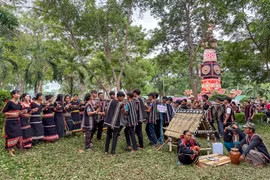
As rapid urban development continues, two centuries-old Jrai villages, Ơp in Pleiku Ward and Pleiku Roh in Diên Hồng Ward, continue to safeguard their cultural identity, preserving traditions, communal life and heritage despite expanding roads, new residential areas and growing urbanisation.