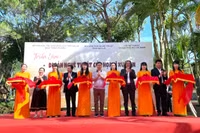
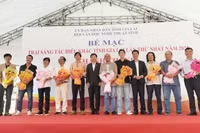
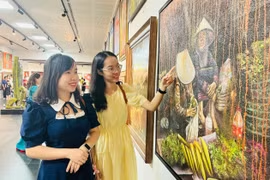
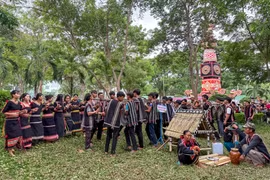
The event gathered provincial officials, representatives of museums nationwide, and artists and researchers to discuss the preservation, collection and study of the influential painter’s work.
Speakers highlighted Xu Man’s defining role in modern Vietnamese fine arts and the cultural identity of the Central Highlands. Born in 1925 in Đê Krăl village (now Plei Bông, Ayun commune), Xu Man grew up in a poor Bahnar family and joined the revolutionary movement in 1954.

From the 1960s, he worked across the Central Highlands before being sent to study at the Vietnam College of Fine Arts in Hanoi, where he met President Hồ Chí Minh, an enduring source of inspiration for his later paintings.
Professor-Dr. and sculptor Nguyễn Xuân Tiên, Chairman of the Ho Chi Minh City Fine Arts Association, described Xu Man’s works as epic in tone, rich in Bahnar identity and deeply reflective of the emotions and aspirations of the Central Highlands people.

Xu Man produced thousands of oil, lacquer and gouache works, many depicting village life, community rituals, combat spirit and President Hồ Chí Minh among Central Highlands communities. Notable works include President Hồ Chí Minh with the Love of the Central Highlands, Festival Day in the Central Highlands, and Dawn over the Central Highlands Mountains and Forests.
Xu Man received major national awards, including A Prizes at the 1976 and 1980 National Fine Arts Exhibitions. He was the first Central Highlands artist to receive the State Prize for Literature and Arts in fine arts. His works are held in the Vietnam Fine Arts Museum, Ho Chi Minh City Fine Arts Museum, regional museums and private collections within Vietnam and abroad.

According to Mr. Nguyễn Hoàng Long of the Vietnam Fine Arts Museum, the museum preserves 16 of Xu Man’s works, characterized by simplified forms, symbolic lines, bold contrasts and a strong communal rhythm. His paintings featuring President Hồ Chí Minh were described as “pages of memory” blending personal emotion with the devotion of Central Highlands communities.
The Military Zone 5 Museum in Da Nang preserves one of Xu Man’s significant works, The People of the Central Highlands Uprising to Seize Power during the August Revolution of 1945. Painted in 1980 and donated in 1982, the oil-on-canvas piece portrays the revolutionary spirit of local ethnic groups. Lieutenant Colonel Trần Thị Anh Thư said Xu Man’s art serves as “silent lessons” fostering patriotism and proposed using his works for educational programs, traveling exhibitions and digital promotion.

Artist Siu Quý, Standing Vice Chairman of the Ho Chi Minh City Fine Arts Association and a former student of Xu Man, welcomed the recognition of Xu Man’s house in Plei Bông as a provincial-level historical site in June 2025.
He proposed naming a road after the painter and developing cultural tourism services linked to his heritage, including recreating his working space, displaying replicas of iconic works, and offering local crafts and culinary experiences.

Deputy Director of the Department of Culture, Sports and Tourism Lê Thị Thu Hương thanked participants for their proposals, saying the department would act within its authority and seek provincial guidance for broader initiatives.
She also recommended integrating Xu Man’s life and career into local education programs to strengthen public awareness of the “leading figure of Central Highlands fine arts”.