His pursuit is not simply an academic career but a sustained effort to illuminate the historical and cultural foundations of Bình Định (now Gia Lai province), a region known for its martial and literary traditions that still hold a largely untapped Han-Nom archive.
In a conversation with Gia Lai Newspaper, Radio, and Television, Dr. Hải reflected on his academic journey and the enduring commitment that has shaped his work.
Meeting Dr. Hải at his home, surrounded by books stacked floor to ceiling, one immediately notices his calm, deliberate manner, traits typical of scholars immersed in ancient texts.
His path, he recalled, began in primary school, where he studied at institutions linked to the Chinese community in Quy Nhơn, including Sùng Nhơn (now Tran Hung Dao Primary School), Phúc Kiến, and Nhân Thảo (now Tran Quoc Tuan Primary School).
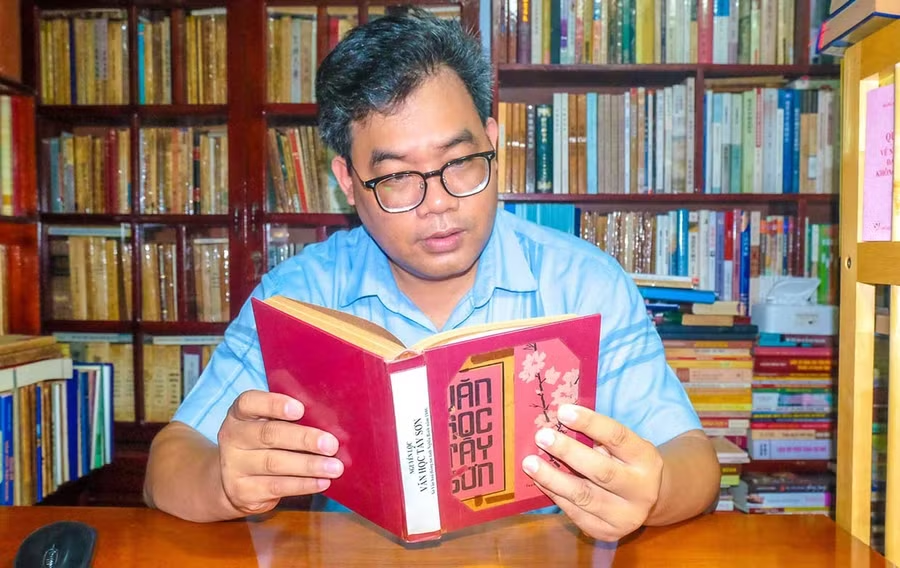
* You describe your journey into Han-Nom research as a “fortuitous encounter.” Could you elaborate?
– As a child, I did not fully understand it. I simply felt drawn to the characters and the cultural environment at those schools. It was not until university that this interest became a serious direction.
I majored in Literature with a focus on Medieval Vietnamese Literature at Quy Nhơn University of Education (now Quy Nhơn University).
The programme included extensive coursework in Chinese and Han-Nom, which provided a solid foundation. More importantly, I was guided by my professors, especially Mr. Huỳnh Chương Hưng, who deeply influenced my academic path.
* Would you say that Mr. Huỳnh Chương Hưng ignited your passion?
– He imparted not only knowledge but also professionalism. He taught me to approach Han-Nom materials with rigour, respect, and persistence. In October 2001, he gave me a copy of “Luận ngữ tinh hoa,” collected during a field trip, and encouraged me to translate it.
At the time, I had no computer, so I handwrote more than 50 pages in my notebook. I worked continuously and completed it in May 2002. That experience convinced me I could pursue Han-Nom studies long term.
In his final year of university, Dr. Hải had to choose between writing a thesis on folklore or entering the more demanding field of Han-Nom. He chose the latter.
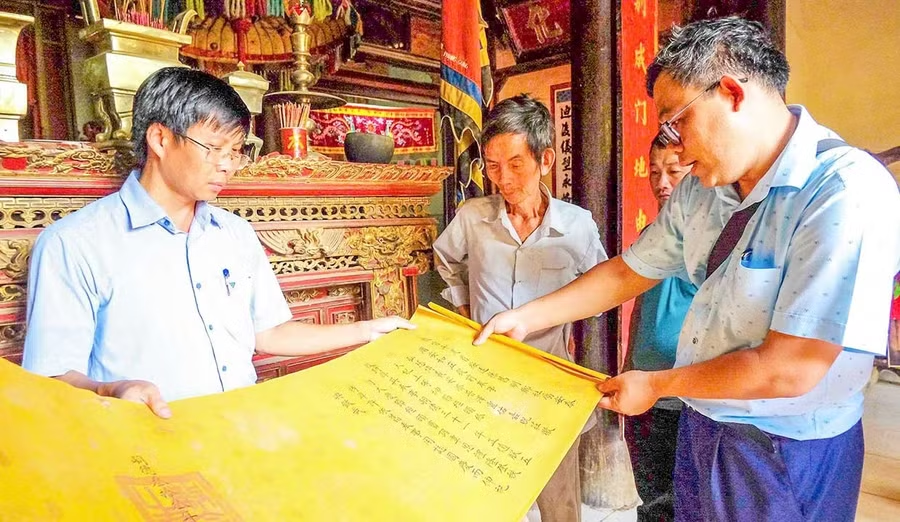
In his final university years, Dr. Võ Minh Hải faced a crossroads: to write his thesis on folklore or to venture into the more challenging and less-traveled field of Han-Nom studies. He chose the difficult path.
* That must have been a difficult decision?
– Initially, I planned a folklore thesis under the guidance of Mr. Trần Xuân Toàn. But I felt compelled to explore Han-Nom more deeply. I wrote my thesis on the cultural significance of “East–West” in medieval Vietnamese literature.
It received an excellent rating, enabling me to graduate with honours and stay on as a lecturer from November 2003, at the age of 22. At that point, my academic record included only my thesis and a translation, both related to Han-Nom.
From 2009, I contributed to compiling the textbook “Selected Han Texts.” In 2012, I received third prize in the Ministry of Education and Training’s Young Scientific Talent Awards for my project “Han-Nom Philology: Theory and Application.”
* You have said that Han-Nom is a profession of silence. Why?
– It is a field that cannot be rushed and does not seek public attention. Progress requires patience and quiet accumulation. Between 2012 and 2020, I conducted extensive fieldwork and collected materials in Bình Định (now Gia Lai) and other South Central provinces such as Quảng Ngãi, Quảng Nam (now Da Nang City), and Khánh Hòa. That period laid the groundwork for my later publications.
His subsequent works include: The Language of Truyện Kiều from a Cultural Perspective (2020); Han-Nom Funeral Orations of Bình Định (2021); Han-Nom Literature of South Central Vietnam: Features and Characteristics (chief editor, 2022); Luận ngữ tinh hoa by Nguyễn Phúc Ưng Trình (2024); Studies and Essays on Han-Nom Authors of Bình Định (2025); Cultural Language in Tây Sơn Era Literature (2025); and Examination Culture and the Bình Định Examination Hall (2025). He is currently collaborating with the Gia Lai Provincial Historical Archives Center on translations of imperial edicts and Han-Nom documents.
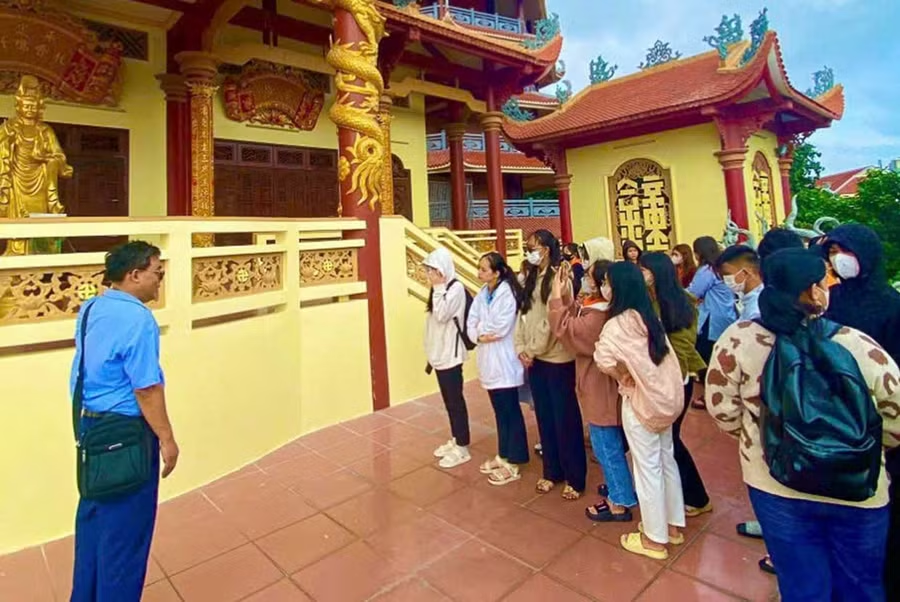
Currently, Dr. Võ Minh Hải is working closely with the Gia Lai Provincial Historical Archives Center on the translation of imperial edicts and Han-Nom documents.
* You are devoting much effort to exploring the Han-Nom heritage of Bình Định?
– Bình Định holds an extensive repository of Han-Nom materials, from imperial edicts and funeral orations to genealogies, traditional theatre scripts, and works of noted scholars.
Without timely surveys and digitisation, many could be lost within a few years. My long-term objective is to build a systematic corpus of Bình Định’s Han-Nom literature, covering major figures such as Đào Tấn, Nguyễn Diêu, Hồ Sĩ Tạo, and Đào Phan Duân, as well as lesser-known authors.
To demonstrate that Bình Định is a land of both martial and literary excellence, rhetoric is not enough; documentation is essential. We need to survey, digitise, build open-access databases, organise conferences, and publish thematic research, similar to the systematic approaches used in Huế and Quảng Nam.
* What keeps you committed to this “less-travelled road”?
– It is more than passion; it is a responsibility to my native land. Each generation must honour the previous one, critically inherit, and continue unfinished work. Han-Nom is demanding, slow, and often unacknowledged, but without researchers, this cultural treasure will remain untapped. I chose this path not for distinction but because it needs someone to follow it.
Dr. Hải is continuing research on Han-Nom philology, the village culture of South Central Vietnam through Han-Nom sources, and the preservation of Han-Nom heritage.
His forthcoming works include: Đồ Bàn Thành Ký by Nguyễn Văn Hiển; Bình Định through Nguyễn Dynasty Documents; Imperial Edicts of Bình Định; Bình Định Confucian Temples; Han-Nom Writings around Hoàng Đế Citadel; and Genealogies of Bình Định Clans through Han-Nom Materials.
* Thank you for the conversation!
– Dr. Võ Minh Hải, born in 1981, hails from Bình Dương township, Phù Mỹ district, Bình Định province (now Bình Dương commune, Gia Lai province).
– Graduated with a Bachelor of Arts in Literature from Quy Nhơn University of Education in 2003, a Master’s in Literature in 2008 from Quy Nhơn University, and a PhD in Vietnamese Language and Culture in 2015 from Ho Chi Minh City University of Education.
– Recipient of the 2012 Young Scientific Talent Award from the Ministry of Education and Training; B Prize – Đào Tấn – Xuân Diệu Award of Bình Định province in 2022; B Prize from the Vietnam Union of Literature and Arts Associations in 2021.
– Currently a member of research groups on Han-Nom studies; Vietnamese intellectual history (led by the Institute of Han-Nom Studies and the Institute of Philosophy); research on Hoàng Đế Citadel (led by Quy Nhơn University); and research on place names and culture (led by the Gia Lai Union of Science and Technology Associations).