Long valued for beauty and durability, the village’s woven baskets are now promoted as signature souvenirs at major tourism events within and beyond Gia Lai Province.
The craft is passed down through generations, and nearly all 240 households in the village practice weaving, producing everything from traditional baskets to miniature stilt houses for visitors.

Rinh learned weaving at age 12 or 13 under his uncle’s guidance and says the most demanding step is splitting bamboo strips with precision to produce uniform strands. Basket patterns are inspired by traditional brocade motifs, including eight-pointed suns, diamond shapes and ornate borders.

Ngơm Thung is especially known for its double-layered baskets: an outer patterned layer tightly pressed over a finer inner layer, creating enhanced durability. Some designs feature concealed openings positioned against the wearer’s back for added protection of the contents.
Seeking to innovate beyond tradition, Rinh has expanded into weaving vases, trays, storage boxes and backpack models. One of his new dried-flower vases draws inspiration from fish baskets once worn by Jrai farmers in the rice fields. Natural dyes sourced from forest bark and vegetable leaves create orange and green hues for decorative items such as small round lidded boxes used for jewelry.

Orders from inside and outside the province help his family earn a stable living. In peak months, Rinh makes more than 10 million VND (about USD 400); on average, he earns 5-6 million VND (USD 200-240) per month, supplemented by income from farming. His two eldest children have also become proficient weavers, and his skills have led to teaching invitations from the provincial Department of Culture, Sports and Tourism.
Museum experts say his creativity has grown remarkably in recent years. Nguyễn Thị An of the Pleiku Museum noted that while he once produced mainly traditional items, he now showcases diverse, unique designs. The museum has invited him to multiple provincial programs and to the first Central Highlands Ethnic Culture, Sports and Tourism Festival in Kon Tum in 2023.

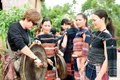
Visitors who experience weaving under his guidance say his passion is evident. Lê Thị Kiều Dung, from Pleiku Ward, said she was surprised to weave a small pen holder in just two hours with his help.
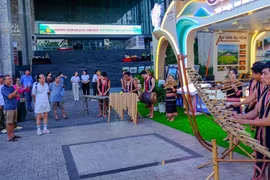
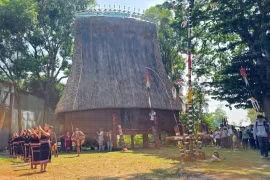
In October 2025, Rinh presented both traditional crafts and large-scale models—including a communal house replica and carved wooden statues—at the 16th International Trade Fair for Decorative, Household, and Gift Items in Ho Chi Minh City. He says he hopes to continue creating new designs so more people can discover Jrai cultural heritage.