1. She was the new teacher at our school. There was something special about her—delicate as morning dew, yet a knight at heart, as a colleague and former classmate confided. She could easily unsettle those around her, sometimes innocent and pure, other times strong and resolute.
“…A stranger, pacing up and down. Thank goodness for you, life is still so lovely…”—I often sang that line after she joined our school.
She lived in the dormitory, playful and prone to tears. My colleagues and I called her the quintessential crybaby, always needing help with big and small matters alike. From carrying water and cooking rice to late-night trips to teach literacy classes, even escorting her to the restroom with a flashlight. She was the “puppy” of the dorm. Any guy who made the “puppy” cry, I would soothe with my guitar: “You are like a rosebud, I hope you never grow cold…”
“—With singing like that, it’s a wonder girls don’t fall for you. How come you still don’t have a girlfriend?”
“—Because I’m waiting…”
“—Waiting for whom?”
“—A certain… ‘puppy.’”
As soon as I said it, I flashed a mysterious smile and kept playing. Watching her blush like a ripe plum, my hands wandered across the keys.
“—What kind of woman do you like?”
“—I don’t know…”
“—What if I told you I like a cold guy… like you?”
“—Are you confessing to me???”
Before I could finish, she giggled and ran off. She was teasing me again, giving me hope—silly me…
2. After fifteen years in the profession, I thought nothing could move me—until I met her. My first impression was of a “puppy” playing teacher, but soon I was filled with admiration. Beneath that childish appearance and demeanor was someone entirely different. Modern, progressive. Rather break than bend. She looked naïve, but her depths were unfathomable. She was like a supernatural novel, pulling the reader from page to page—spooky, yet impossible to put down. The more I discovered, the more captivated I became. She appeared like a bright star, dispelling the gloom of our mountain village. Since meeting her, I could think of nothing else. She dominated my every thought.
The leap from thinking to loving was as thin as a sheet of paper. I fell for her without even realizing it. Deeply, painfully. But I kept it hidden. My rule was that she could never outshine me. Thirty years old, the pampered son of a well-off city family (relocated for unspeakable reasons), now principal of a secondary school, and, to be honest, only the word “handsome” could do me justice. I was good-looking, talented, entitled to a bit of swagger. With the other teachers, I was always cold; whenever I snapped, they’d pale and wilt. They were disappointed, but not angry—they admired me. I even thought I needed a cold heart to keep my distance. It’s no exaggeration to say that with just a wink, any of them would willingly “follow me anywhere, through thick and thin.”
But not her. Sometimes she was so close, other times so far. Mysterious, unpredictable. Lively, yet elusive. She left me feeling powerless. No, my pride wouldn’t let a talented man like me lose to a “puppy,” even if she was an “iso” puppy.
3. The day after she started teaching, I scheduled a class observation. I did it to put the new teacher in her place. A city girl teaching in the countryside—surely just for show! A rookie couldn’t possibly match my years of experience; I knew I’d win. By tradition, new teachers get two weeks to settle in before being observed, but her demeanor wouldn’t let me wait. I preferred the “strike first” approach.
To my astonishment, she was no longer a “puppy” but had completely transformed. Poised, confident. She drew everyone in and ended the lesson gently. Dry facts became engaging and accessible. The students were excited, the observers enthralled. Everything was on point. She guided each section of the lesson with precision and logic. Her teaching was highly effective. Was she born to be a teacher? Her movements, tone, words, and problem-solving—all exuded the spirit of a true educator. She had the soul of someone who could ignite passion in others.
She was outstanding—I was genuinely impressed. Somehow, my arrogance began to crack. But to love someone better than myself? Women only need to be beautiful. Too talented is inconvenient—a senior colleague, twice divorced, once warned me. Confused, conflicted, I was torn between giving up and moving forward…
4. When winter came, I decided to form a flood and storm response team, and her name was on the list. Some objected, saying she was a woman—why include her? I replied, the school was short-staffed, and the other female teachers had young children. She would handle logistics for the team. I was only following her own request. Truthfully, it suited me just fine.
I remembered previous years, when heavy rains forced the men to stay at school overnight. It was dull and lonely. But that was before she arrived. Now, she still lived in the dorm (right next to the school). During the rainy season, the roads were cut off, so she couldn’t go home anyway. Besides, I enjoyed talking to her outside the office. What could be better than strumming my guitar as the rain poured down, while she sang softly, “…you are like a heady wine, leading me into dreams, you are like a pink silk ribbon, whispering to me…”
5. For three days straight, the rain poured down in torrents. It was relentless, unceasing. Water flooded the roads, the schoolyard, crept up the first, then the second step, threatening to enter the buildings. The water rose quickly—first to the ankles, then halfway up the calves, to the knees, the waist. It inundated the wild fields full of mimosa thorns, flooded homes, and seeped into the classrooms perched precariously on the hill.
She, my colleagues, and I struggled through the floodwaters. She stood shivering in the water, lips blue. I shouted, “Go back!” but she insisted on following us to the riverside hamlet.
While we were busy evacuating people and belongings onto canoes, she bent down to retrieve floating books and notebooks. She kept bending, kept gathering them from the muddy water. The soaked pages, the blurred words, the ink bleeding across the white paper. My heart ached, and I yelled:
“—Leave it, come on! Give me your hand, I’ll pull you up.”
“—But the notebooks, the books, the bags…”
“—Worry about your life first, why save the books?”
But she didn’t listen. Or maybe she heard but ignored me. The rain kept falling, her face pale, her hands blue in the water. But none of that could stop her—she clung to those muddy pages, lips pressed tight, trembling but determined.
I was right there with her, but suddenly froze. Something had paralyzed me—or was it that I felt something inside me shatter? The flood didn’t just sweep away vehicles, cattle, and books; at that moment, the water swirling around her washed away my complacency and selfishness. I couldn’t stand still any longer. From the high bank, I plunged into the water to help her.
“—Miss, our house is flooded, my parents are trapped in the fields…”
Without thinking, she waded toward the cry for help. I rushed after her, the water nearly chest-high. The student’s house was by the stream, which ran past a small hill where our little school stood—the school that had just welcomed a skilled, devoted teacher from the lowlands. After two days and nights of rain, the stream was no longer a stream, but a raging, muddy monster, roaring and ready to swallow everything.
She was cold, shivering, but still called out to her student, her voice breaking:
“—Don’t be afraid, hold on tight, stay right there. I’m coming!”
She rushed toward the stream, and I managed to grab her hand:
“—Are you crazy? Wait for the rescue team!”
“—If you were the only one your student was counting on, could you calmly wait for rescue? I hate the words ‘if only.’”
I was speechless, my face flushed at her gentle words, as if I’d been slapped awake. Her face was wet and pale, but her eyes suddenly shone with a strange light. That light pierced straight into my heart. I was afraid, moved, and deeply in awe.
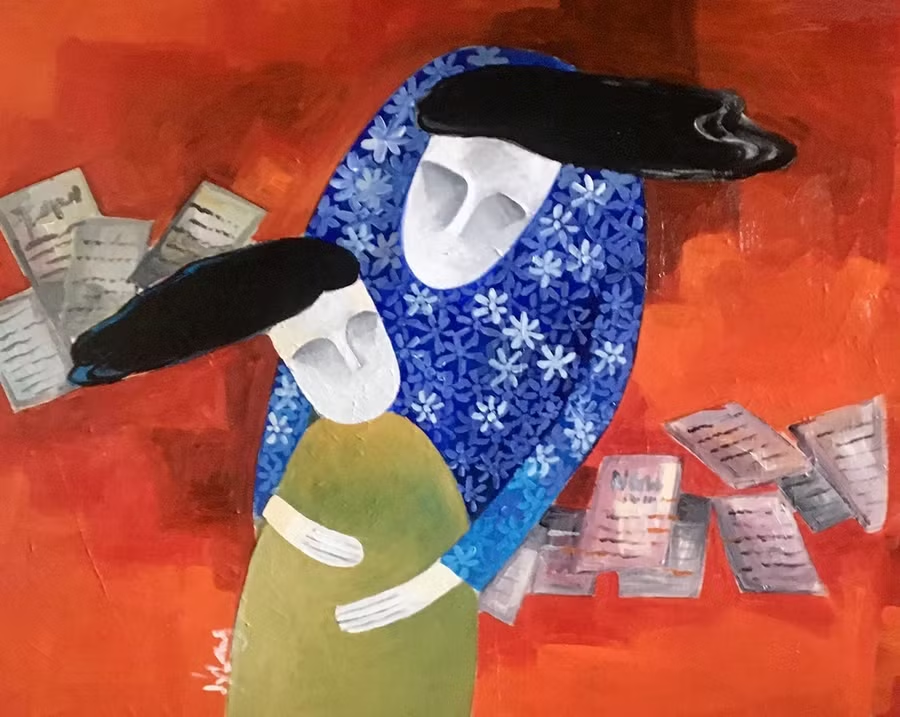
I plunged into the water with her. My hand gripped hers tightly. Together, we crossed the raging stream to the small riverside house—water already halfway up the walls. The three of us—teacher, student, and I—clung to a styrofoam box, chilled to the bone. Bringing the student back to the school for shelter, seeing her shivering with cold, she hugged the child tightly to her chest as if it were her own daughter.
The students were safe, many villagers had been brought here and were safe. Looking at her, I knew she was exhausted—even I, a man, was out of breath, let alone a teacher “as fragile as morning dew.” Yet she insisted on joining the rescue team again.
“—Stay at the school with the children!”
“—There’s one more student, I know where she lives, but you and the others don’t.”
“—That place is near the river, we know. The current will be strong, we could be swept away.”
“—Then we’ll sink together!”
She left me speechless again. “Sink together”—those two words sounded like a vow, or perhaps fate itself. I looked at her, through the white curtain of rain, and saw a small woman with extraordinary courage. She was trembling, but her eyes never wavered. Amid the raging flood, I suddenly felt a bright faith ignite within me—that people like her, like so many teachers in these mountain villages or elsewhere across the country, are the lanterns in the storm. Even if extinguished, they burn with all the fire in their hearts.
6. The next morning, the water gradually receded.
The schoolyard was still littered with desks, books, and debris. But on the steps, I saw her drying each notebook, smoothing every wrinkled page as tenderly as if she were stroking a child’s hair.
I walked by, silent as if I saw nothing. Perhaps, from that day on, I truly understood why I loved her—not for her eyes, her smile, or her voice, but because in her heart was a light that no flood, no mud, no storm could ever extinguish.
(Source: baolamdong.vn)