The Brưng scarf, woven by artisans in Kgiang village, Tơ Tung commune, became the first brocade item in Gia Lai to receive a three-star OCOP certification in 2023.
A year later, the “Jrai ơi” scarf produced by a community tourism cooperative in Ia Ly commune achieved the same rating, underscoring a broader push to standardise production while safeguarding cultural identity.

Local authorities and artisans say the recognition has strengthened branding, improved incomes and helped sustain a centuries-old craft at risk of decline.
From household craft to certified product
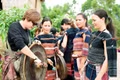
The Brưng scarf is produced by Đinh Thị Hái, 39, in Kgiang village. The daughter of Meritorious Artisan Đinh Thị Hiền, widely regarded as Tơ Tung’s most skilled brocade weaver, Hái began learning the craft at 15 and mastered it within a year.
Recognising the commercial potential of traditional brocade, she registered a household business in 2020, gradually expanding from skirts and shirts to handbags, wallets and scarves.
In 2023, Trần Thị Bích Ngọc, an official at the Tơ Tung commune People’s Council and People’s Committee Office, worked with Kgiang artisans, including Hái and Hiền, to standardise production processes and develop a business plan that balanced commercialisation with cultural preservation. The Brưng scarf emerged from that effort.
Ngọc said traditional items such as loincloths, blankets and baby carriers carry high cultural value but are time-consuming and costly to produce, limiting buyers to relatively affluent families. Artisans were encouraged to create smaller, practical products that retained aesthetic appeal while broadening market access.

Natural fibres, intricate motifs
According to Hiền, Brưng is the oldest, most intricate and most technically demanding motif in traditional Bahnar brocade. “Those who can weave Brưng can master all other patterns,” she said.
Each Brưng scarf measures 150 by 50 centimetres and sells for between VND700,000 and VND1 million (about $28–$40). The scarves are woven entirely from natural cotton fibres and dyed with plant-based and natural materials.
Trum leaves and roasted snail shells produce black, tơ nung plants yield red, and kơ trơng tubers create yellow, while the natural white of cotton is preserved. The dominant black background is accented by diamond and eight-pointed sun motifs distinctive to the craft.
The production process is labour-intensive. After harvest, cotton is sun-dried for a month to ensure even blooming. Seeds are removed, fibres spun, dyed and dried before weaving begins. Each scarf requires about 5 kilograms of cotton.
Following OCOP certification, the Brưng Brocade Weaving Club was established in Kgiang village in 2023. The club now has 15 members and has maintained steady operations over the past three years.
Expanding markets through cooperation
A similar model has taken shape in Ia Ly commune. H’Uyên Niê, 40, a member of the Mnông ethnic group born in Đắk Lắk province, founded the Ia Mơ Nông Brocade Weaving Club in August 2019 after observing that many women quietly maintained weaving traditions but lacked access to markets and development strategies.
Previously, brocade was used mainly for festivals and community events. Handmade and costly, the products struggled to reach beyond a small customer base despite their cultural value.
“If we only keep the craft within the village, brocade is at risk of fading away, especially as younger generations show less interest,” H’Uyên said.
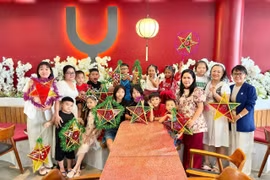
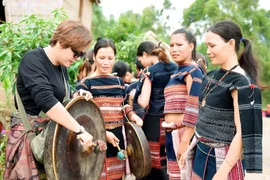
She later established the Kép Village Community Tourism Cooperative Group, integrating cultural preservation with economic development. The group now comprises 74 artisans, including weavers, basket makers, wood carvers and a gong team.
In November 2024, the cooperative’s “Jrai ơi” brocade product received three-star OCOP certification.

An invitation woven in thread
“Jrai ơi” — an affectionate village call — is reflected in scarves measuring 1.8 to 2 metres long and about 0.4 metres wide. Woven from natural cotton fibres, they feature the signature red, black, green and white colours of Jrai brocade.
Motifs depict everyday life: young men and women at festivals, xoang dances, rice pounding and corn planting.
Artisan Rơ Châm Phảih, 55, said cooperative membership has expanded market reach. “Not only domestic tourists, but also international visitors are fond of the ‘Jrai ơi’ scarf,” she said.
Preserving a cultural space
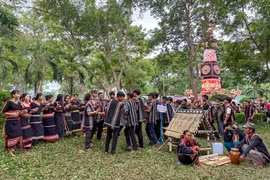
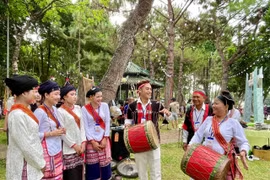
From cotton cultivation and harvesting to dyeing and weaving, Bahnar and Jrai brocade follows time-honoured methods that reflect close ties with nature and strong community cohesion.
Artisans say each scarf represents the cumulative effort of numerous meticulous steps — a depth of craftsmanship that industrial production cannot replicate. Through OCOP certification and cooperative models, they aim not only to preserve tradition but also to secure sustainable livelihoods and ensure that the cultural identity embedded in every thread endures.
- At the end of 2020, the brocade handbag produced by Glar Agricultural and Brocade Weaving Cooperative (formerly in Glar commune, now Đak Đoa commune) was recognized as a 3-star OCOP product.
This milestone has elevated brocade products, expanded markets, and created jobs and increased incomes for local women.
Glar brocade handbags are highly durable, with precise stitching and clear, harmonious patterns that retain the traditional Bahnar identity while meeting modern usage needs. Designs have been improved for compactness and convenience, winning over customers from many regions.
- “I am very happy that brocade and the traditional weaving craft of village women have contributed to the creation of brocade handbags. Since this product achieved 3-star OCOP status, we have been even more motivated to weave better and preserve the craft,” shared artisan Mlốp (Dôr 2 village, Đak Đoa commune), who has nearly 50 years of experience in brocade weaving.