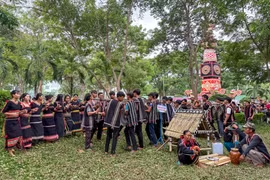
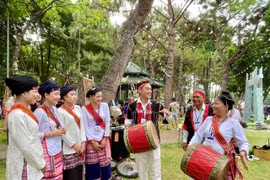
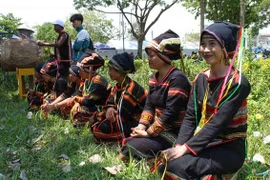
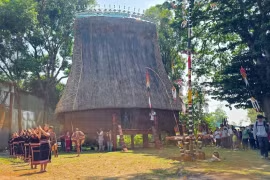
Home to numerous ethnic communities that have lived there for generations, the province is positioning itself as a dynamic and prosperous region anchored in a distinctive and deeply layered cultural foundation.
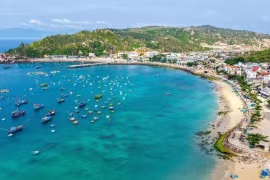
The newly expanded Gia Lai encompasses a terrain that links forests and seas, offering extensive development space across plateaus, hills, rivers, plains and islands. Three major river systems originate in the Central Highlands and flow east and west across the province.
To the west, rivers and streams converge into the Sê San River before crossing into Cambodia and joining the Mekong. To the east, waterways feed into the Ba River, which empties into the East Sea at the Da Dien estuary, and the Kon River, which rises in Kon Tum and flows through An Lão, Vĩnh Thạnh, Tây Sơn and Vân Canh before reaching Thi Nai Lagoon and the sea. Beyond their economic and environmental significance, these rivers hold cultural and historical value as part of Vietnam’s national heritage.
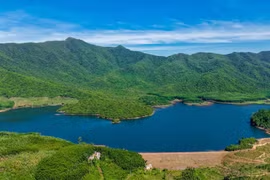
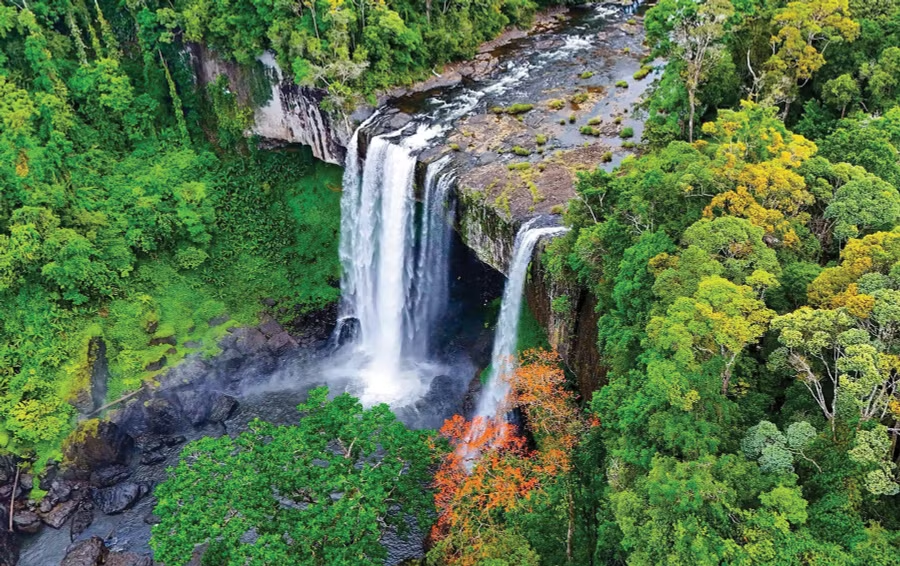
In western Gia Lai, dozens of volcanic craters remain, including Hàm Rồng and Chư Đrăng. The most prominent is the deep crater forming the emerald Biển Hồ (Sea Lake), set amid dense forests. Volcanic activity thousands of years ago created the fertile red basaltic Pleiku plateau, among the most productive in Vietnam.
The An Khê basin, with an average elevation of 400 metres, lies between the plateau and the plains, midway between the political and economic centres of Pleiku and Quy Nhơn.
Crossing An Khê Pass eastward, the terrain opens into a narrow coastal plain averaging 10 metres above sea level, stretching from Cù Mông Pass to Bình Đê Pass. Formed by alluvial deposits from the Kon, Lại Giang and La Tinh rivers, the plain is fragmented by mountain ranges extending into the sea.
This geography underpins a long and layered history. The area was home to the Sa Huỳnh culture community around 2,500 years ago, later became the capital of the Champa Kingdom between the 9th and 12th centuries, and subsequently served as the imperial city of Emperor Thái Đức - Nguyễn Nhạc. Few regions reflect such a dense accumulation of cultural strata.
Today, Gia Lai hosts numerous prehistoric archaeological sites of national and international significance. Several have been recognised as national relics and are being nominated for UNESCO World Heritage status.
Among the oldest is the An Khê Early Paleolithic industry, discovered in Cửu An commune and the An Bình and An Khê wards by Vietnamese and Russian archaeologists. The collection of rudimentary chipped stone tools is considered the opening chapter of Vietnamese and Asian history. Key sites, including Rộc Tưng and Gò Đá, have been designated special national relics by the Prime Minister, with ten stone tools recognised as national treasures.
During the late Neolithic to early Metal Age, the Biển Hồ culture emerged on the Pleiku plateau. Communities settled along rivers and lakes, using fully polished stone hoes and axes for agriculture and producing diverse ceramics for storage, cooking and ritual purposes. Large jars were used as coffins, while smaller vessels served burial and ceremonial functions.
On the coastal plains, the Pre-Sa Huỳnh cultural community developed at sites such as Truông Xe, Gò Lồi, Gò Diệu and Gò Cây Thị. The later Sa Huỳnh culture, represented by the Động Cườm cluster, advanced agriculture alongside bronze casting and pottery-making. With maritime expertise, Sa Huỳnh communities expanded trade networks with coastal southern China, southern Thailand and island communities across Southeast Asia, contributing to the regional Sa Huỳnh–Kalay ceramic complex.
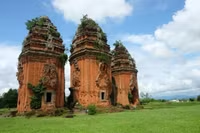
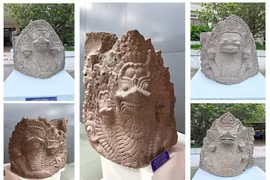
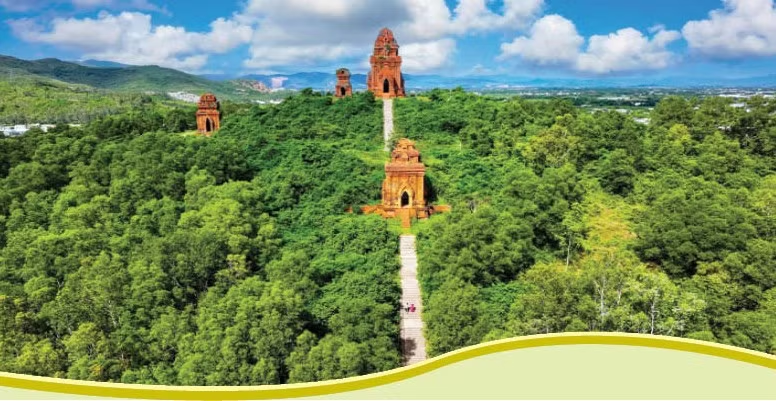
The province’s protohistoric heritage is further marked by Champa culture. Early Cham tower architecture includes Bang Kreng Tower in Krông Pa and An Phú Tower in Pleiku, where a golden Kamandalu vessel was discovered. Archaeologists regard the Cham towers in Gia Lai as representing the pinnacle of architectural and sculptural art.
Dương Long Tower, built during the reign of King Jaya Indravarman, blends Khmer and Champa styles and is considered one of the most beautiful Cham towers in Vietnam. It has been recognised as a special national relic.
In 2022, the Prime Minister designated Tây Sơn thượng đạo, the area where the Tây Sơn brothers launched their uprising, as a special national relic. Together with Tây Sơn hạ đạo, it now forms a unified Tây Sơn heritage system known domestically and internationally as one of the most distinctive cultural resources from Vietnam’s ancient and medieval history.
According to incomplete statistics, Gia Lai has more than 100 inventoried relics, including 17 national-level relics and four special national relics, supported by museums, traditional festivals, intangible heritage and craft villages.
Provincial authorities view this cultural wealth as a strategic asset in the era of the knowledge economy and digital technology. Beyond preservation, heritage is increasingly framed as a “soft asset” capable of generating high added value and supporting sustainable development for both the province and the nation as it enters a new phase of growth.