Across the province, educators are increasingly adopting child-centred approaches that emphasise experiential learning, creativity and practical skills.
At Hà Tây Kindergarten in Kon Hơng Leh village, Ia Khươl commune, a lesson for the Lá 1 class, for children aged five to six, unfolds in a lively classroom atmosphere. Under teachers’ guidance, pupils practise recognising letters, writing basic strokes and improving pronunciation to meet Vietnamese language standards.
Teachers say innovative teaching techniques are helping lessons become more engaging and accessible for children.
“Teachers continuously adapt their methods to put children at the centre of learning,” said Võ Thị Thanh Tâm, homeroom teacher of the Lá 1 class. “We combine pictures, real objects and familiar items from the Bahnar community to make lessons more vivid and relatable”.

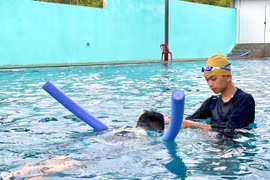
Learning activities are integrated with games, music, art and outdoor play so that children can learn through experience while developing initiative and creativity.
Parents say the changes have brought clear results. Đaoh, 32, from Kon Băh village, said his daughter has made noticeable progress since attending the school.
“My daughter, who is in the Lá class, can now speak and write Vietnamese quite fluently”, he said. “She uses both Vietnamese and Bahnar in daily communication. Seeing her progress makes our family feel reassured about sending her to school”.
For the 2025-2026 academic year, Hà Tây Kindergarten has 376 pupils, most of them from the Bahnar ethnic group. The school operates eight classes at its main campus and three combined classes in surrounding villages.
Improving the quality of care and education has been identified as a central priority. Teachers regularly incorporate experiential activities, music, art and outdoor play into lessons to create an interactive learning environment that also strengthens Vietnamese language skills among ethnic minority children.
Siu H’Loan, the school’s vice principal, said that alongside upgrading facilities, the school has prioritised professional training for teachers and encouraged the use of information technology in classrooms. Efforts are also being made to improve nutrition, care and educational quality in line with local conditions.

Similar efforts are underway at Phong Lan Kindergarten in Quy Nhơn ward, where modern teaching models have been introduced to enhance educational outcomes.
The school currently has 453 pupils participating in programmes based on international education approaches such as STEM and STEAM, Montessori and Reggio Emilia. Activities emphasise life skills, physical education and collaborative group learning.
Teaching themes linked to major holidays are combined with creative experiential activities to encourage children’s curiosity, exploration and holistic development.
Principal Nguyễn Thị Lệ Thu said teachers begin each academic year by developing detailed lesson plans tailored to each age group and adapt them to the needs of individual classes. Regular professional training sessions are also organised to help educators improve their teaching skills and respond to ongoing education reforms.
According to the provincial Department of Education and Training, Gia Lai currently has 472 kindergartens and preschools with 4,667 classes serving 143,137 children.
By the end of the first semester of the 2025–2026 school year, all preschool institutions in the province had developed education plans tailored to local conditions and children’s developmental needs.
Support policies for disadvantaged children have also been implemented, prioritising ethnic minority students and those living in remote, mountainous and especially difficult areas.
The education sector is promoting a “Happy Schools, Child-Centred” model through a range of initiatives, including creating friendly learning environments, strengthening nutrition and physical activity, applying STEM and STEAM approaches, introducing social-emotional learning, improving Vietnamese language skills for ethnic minority children and providing early exposure to English.
All schools have also introduced codes of conduct and worked to create green, clean, safe and welcoming learning environments while strengthening cooperation between families, schools and communities.
Phạm Văn Nam, Director of the provincial Department of Education and Training, said the sector will continue to innovate teaching content and methods while improving care, nutrition and educational quality, particularly at non-public institutions, while ensuring the safety of children in all activities.
Authorities are also developing new policies to submit to the provincial People’s Committee aimed at improving education in ethnic minority areas. By 2030, the province hopes children in remote communities will have access to semi-boarding schooling and receive additional meal support beyond existing national policies.
Officials say these initiatives form part of broader efforts to advance comprehensive education reform and build a sustainable foundation for future generations.