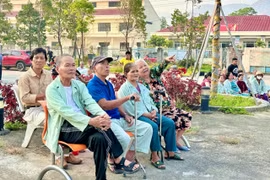
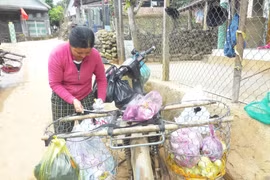
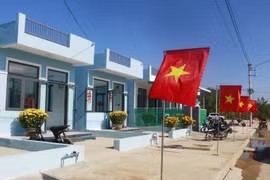
In Ia Rbol commune, where ethnic minorities account for 92% of the population, education has become a defining cultural foundation. Among the clearest examples is the household of Rcom H’Kliơng, whose simple guiding principle, “No matter how hard life gets, our children must go to school”, has inspired neighbours for decades.
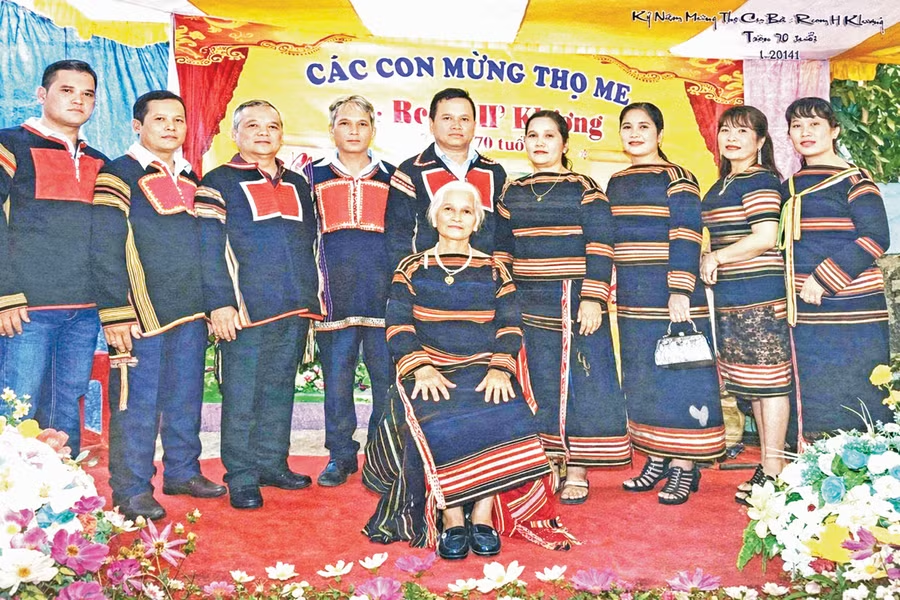
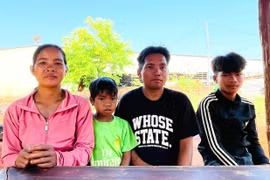
Now 76, Mrs. H’Kliơng prepares her modest home each Tet as nine children, now working across sectors including medicine, education, public service, and the armed forces, return to celebrate. Their achievements, her family says, were built not from material abundance but from the perseverance of a Jrai couple determined to lift their children out of hardship.
Her son Rcom Jen, Deputy Director of the provincial industry and trade department, said increasing administrative demands make his annual return home more meaningful. “Tet is the most precious occasion for us to gather,” he said.
The value of learning resonates similarly with the H’re ethnic community in Pleiku ward, where sisters Đinh Thị Thùy Trang, Đinh Y Quyên, and Đinh Ta Bi continue their father’s legacy of medical service. Their late father, Dr. Đinh Văn Quy, taught that medicine is “an ethical commitment tied to serving the community.”
Y Quyên, recently named 3rd Runner-up at Miss Grand Vietnam 2025, is pursuing dermatology at Can Tho University of Medicine and Pharmacy while preparing to reunite with her family for Tet. Her sisters—one a doctor, the other a former beauty pageant finalist—combine professional work with social outreach aimed at encouraging ethnic minority youth to pursue education.
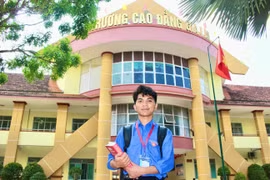
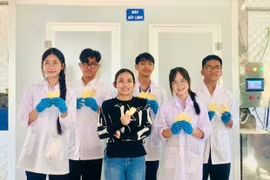
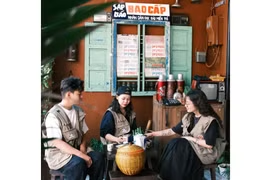
Newer generations are also applying knowledge to local development. Đinh Lê Tuấn Anh, from the mountainous district of An Lão district, returned home after his studies to co-found a youth cooperative producing cinnamon incense and herbal teas. The products have earned OCOP recognition and created jobs for local residents, linking economic growth with forest conservation.
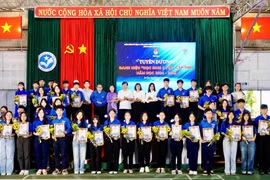
“His success shows how ethnic minority youth can be a driving force, not just beneficiaries of policy,” said Nhan Thị Hằng Nga, Standing Vice Chairwoman of the Gia Lai Study Promotion Association. She noted that families who value education provide the strongest foundation for sustainable community learning.
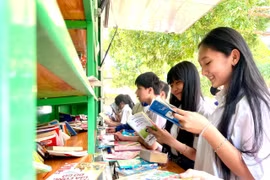
Across villages and generations, from parents quietly supporting their children to young professionals returning home with new skills, education remains the enduring source of transformation, the most beautiful spring in the lives of Vietnam’s ethnic minority communities.