Ongoing conflict in the Middle East is disrupting global maritime transport, extending delivery times and increasing logistics costs for exporters in Vietnam’s Central Highlands province of Gia Lai.
Some local companies have already faced delays in fulfilling export orders as shipping routes are adjusted to avoid areas affected by regional tensions.
In response, the provincial Department of Industry and Trade is introducing measures aimed at helping businesses adapt to shifting market conditions and maintain export growth momentum in 2026.
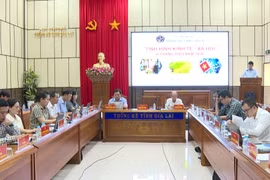
A reporter from Gia Lai Newspaper and Radio & Television spoke with Nguyễn Đình Kha, Deputy Director of the provincial Department of Industry and Trade, about the impact on local exporters and the steps being taken to mitigate risks.
Overview of exports to the Middle East
*Could you provide an overview of Gia Lai’s current exports to the Middle East and the extent to which local businesses depend on this market?
Mr. Nguyễn Đình Kha. Photo: Provided by the interviewee
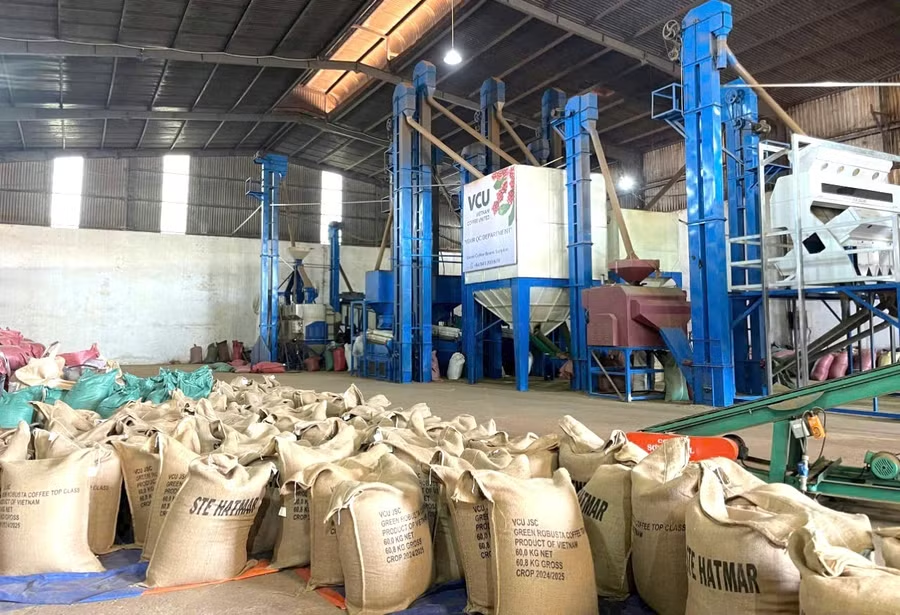
- At present, 20 enterprises in Gia Lai export goods to the Middle East. Key export products include coffee, cassava and cassava products, ores and other minerals, plastic products, textiles and garments, wood products, machinery and equipment, among others.
In 2025, the province’s export turnover to the Middle East is estimated at 24.315 million USD, accounting for about 0.7% of Gia Lai’s total export value.
Exports are mainly concentrated in several markets. Israel is the largest, with 16.415 million USD, followed by the United Arab Emirates with 3.358 million USD, Turkey with 1.323 million USD, and Saudi Arabia with 0.983 million USD.
* How is the conflict in the Middle East affecting delivery schedules and export costs for businesses, especially for shipments using routes through this region?
- According to reports from exporting enterprises in the province, recent tensions in the Middle East have affected international maritime transport activities.
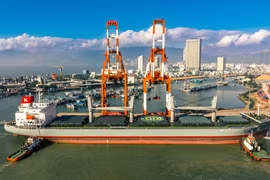
Several major shipping lines, including CMA CGM, Maersk and Hapag-Lloyd, have adjusted their routes to ensure maritime safety. Instead of following traditional routes, many vessels now detour around the Cape of Good Hope, significantly increasing travel distance.
These route changes have extended delivery times and pushed up logistics costs, including fuel expenses, marine insurance and other surcharges.
Some businesses estimate that logistics costs for export orders have risen by 15–25% compared with previous levels. In some cases, goods must remain longer at transshipment ports, generating additional warehousing costs and affecting contractual delivery schedules.
However, since the province’s direct exports to the Middle East account for only a small share of overall trade, the broader impact on Gia Lai’s export activities remains limited.
Local businesses are also working closely with transport and logistics partners to adjust shipping plans and select suitable routes to ensure that export contracts are fulfilled on time.
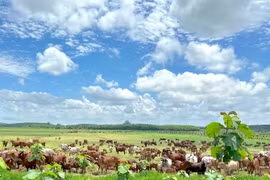
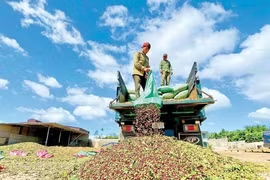
Coffee is one of Gia Lai’s export products to the Middle East. Photo: V.T
Long-term risks from geopolitical tensions
*In the long term, how might geopolitical fluctuations in the Middle East affect the export activities of local businesses?
- Prolonged instability in the Middle East could indirectly affect exports through fluctuations in global energy prices and logistics costs.
When oil and fuel prices rise, transportation costs for both sea and air freight typically increase. This can raise the cost of exporting goods to major markets such as the United States and the European Union.
At the same time, international shipping routes may need to be adjusted to avoid conflict zones. Such changes could lengthen transit times and increase expenses for fuel, marine insurance and warehousing.
These factors may ultimately raise the cost of exported products, affecting their competitiveness in international markets and indirectly impacting exports to key trading partners.
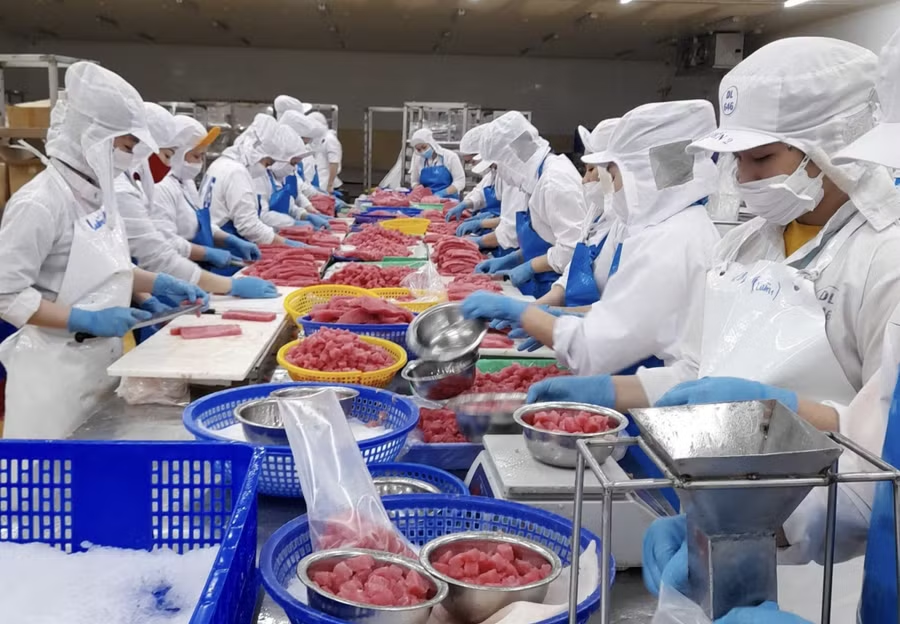
An Hải Seafood Co., Ltd. (Quy Nhơn Đông Ward) participates in seafood exports to the Middle East. Photo: Provided by the company
Measures to sustain export growth
*In light of these developments, what measures is the Department of Industry and Trade implementing to support businesses and ensure the province’s export growth target for 2026?
- To proactively respond to international developments, particularly the effects of conflict in the Middle East, the Department is implementing several measures to help maintain the province’s export growth target for 2026.
First, businesses are being encouraged to diversify export markets and supply sources. Companies are advised to seek markets with similar demand in order to reduce risks if exports to certain markets, such as Israel, Iran or other Middle Eastern countries, encounter difficulties.
Enterprises are also urged to develop long-term contingency plans for similar disruptions in the future.
During negotiations and the signing of international sales contracts, companies should pay close attention to clauses related to logistics, transportation, delivery and insurance in order to limit potential risks. Businesses are also encouraged to purchase comprehensive cargo insurance to minimize potential losses.
In addition, the Department is strengthening coordination with relevant ministries and agencies to provide timely updates on import-export activities, international transport developments, freight rate fluctuations, logistics surcharges and geopolitical factors that may affect business operations.
Authorities are advising enterprises to develop proactive response plans to reduce the risk of supply chain disruptions.
The Department will also continue working closely with units under the Ministry of Industry and Trade, including the Import-Export Department, the Trade Promotion Agency and the Department of Foreign Market Development, as well as Vietnam’s overseas trade offices, to help businesses secure new orders and expand into potential export markets.
Through these measures, Gia Lai aims to maintain export growth in 2026. The Provincial People’s Council has set a target of 3.1 billion USD, with an ambition to reach 3.5 billion USD, while helping businesses strengthen their ability to adapt to increasingly complex global trade conditions.
Gia Lai province is seeking to expand investment and trade cooperation with Taiwanese businesses, with a focus on manufacturing, technology, agriculture, renewable energy, logistics and tourism.
Gia Lai is stepping up efforts to expand markets for agricultural products and build stable production-processing-consumption chains, as authorities seek to reduce reliance on seasonal sales across nearly 977,000 hectares of agricultural land.
Gia Lai Province and France’s Normandy region have agreed to explore stronger cooperation in investment, trade, tourism, renewable energy, education, science and technology during a working visit by a Gia Lai delegation.
Gia Lai is simultaneously revising its provincial master plan and the master plans for four major urban centers as it seeks to create a more interconnected development network spanning coastal, highland and border areas.
Gia Lai is stepping up investment in transport and logistics infrastructure to position itself as a key logistics hub for Vietnam’s Central Highlands, linking major agricultural production zones with border gates, seaports and international markets.
Gia Lai is seeking to increase the value of its agricultural sector by expanding deep processing, strengthening production linkages and building closed value chains, as the province looks to retain more value within its major raw material areas.
Gia Lai is accelerating investment in irrigation infrastructure to secure water supplies amid increasingly complex climate change, while improving agricultural productivity and developing concentrated raw material production zones.
The Gia Lai Provincial People’s Committee has approved the investment policy for the Sê San 4 Hydropower Plant Expansion Project, with Vietnam Electricity (EVN) selected as the investor for the 120MW project.
Vietnam’s Phu Tai Joint Stock Company plans to invest $950,000 to establish a subsidiary in Texas, United States, to expand its trading and distribution of stone and wooden furniture products.
Young people returning to Gia Lai are finding new ways to increase the value of local agricultural products, combining technology, processing skills, market experience and storytelling to bring products closer to consumers.
A Facebook-based digital marketplace launched in Đak Pơ is helping local farmers and small traders reach customers beyond the commune, with young people providing hands-on support to promote agricultural products and local specialties online.
Banks in Gia Lai are rolling out large-scale credit packages and cutting lending rates by up to 2 percentage points a year as they seek to improve access to capital for businesses and households.
Gia Lai is stepping up enforcement against illegal, unreported and unregulated (IUU) fishing, tightening vessel controls, electronic monitoring and seafood traceability as authorities seek to have the “yellow card” warning lifted in 2026, towards a more transparent and sustainable fisheries sector.
Hoang Anh Gia Lai Joint Stock Company broke ground on the VND 400 billion (about $15.3 million) Mang Yang No. 2 Industrial Cluster in Hra commune on August 12, a 74.5-hectare project expected to create stable jobs for more than 4,500 workers.
Gia Lai is planning a major expansion and upgrade of irrigation infrastructure in its western region, where only 8.94% of agricultural land currently has access to proactive irrigation and the annual water shortfall exceeds 1.234 billion cubic metres.
Gia Lai province is stepping up efforts to accelerate public investment disbursement after spending more than VND 9.322 trillion by the end of July 2026, as authorities seek to address delays affecting major projects and hold agencies accountable for meeting spending targets.
Industrial promotion programs are accelerating technology upgrades among rural businesses, cooperatives and production facilities, helping them improve product quality, strengthen brands and increase the value of locally made goods.
Gia Lai has sharply reduced administrative processing times for businesses, cutting company registration to a matter of hours and halving the time required for land allocation and leasing, as authorities seek to lower costs, accelerate investment projects and strengthen private sector growth.
After leaving his position as director of an agricultural enterprise in Ho Chi Minh City, Nguyễn Chất Sâm returned to Ia Ly commune to pursue organic farming, transforming degraded former rubber plantations into a 15-hectare durian farm that now generates about US$267,000 in annual profit.
Gia Lai is reshaping its foreign direct investment (FDI) strategy by prioritising high-tech, environmentally friendly projects with strong spillover effects over investment volume, as the province seeks to improve growth quality and strengthen its role in global supply chains.
Gia Lai authorities have ordered faster construction and site clearance across several major transport projects, setting firm deadlines for an expressway, a new airport runway and a coastal road as the province seeks to strengthen regional connectivity and support economic development.
Gia Lai is stepping up the use of artificial intelligence and digital technologies to promote destinations, preserve cultural heritage and improve visitor experiences, as authorities seek to strengthen the competitiveness of the local tourism industry.
Authorities in Gia Lai province are intensifying oversight of durian production as the region enters its peak harvest season, aiming to ensure products meet increasingly stringent export requirements on traceability, food safety and quality.
Gia Lai province's economy expanded 8.21% in the first six months of 2026 from a year earlier, with industry, construction and services driving growth despite ongoing economic challenges, provincial officials said on Tuesday.