However, to date, only about 12% of cultivated land has adopted advanced and water-saving irrigation methods.
Reducing Costs, Protecting Resources
The expansion of agricultural production has sharply increased water demand, while natural conditions are no longer as favorable as before, making the efficient use of water resources more urgent than ever.
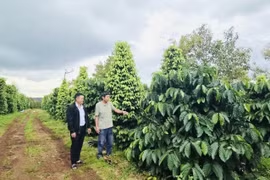
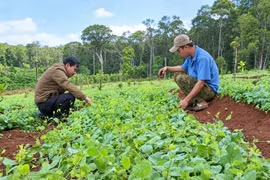
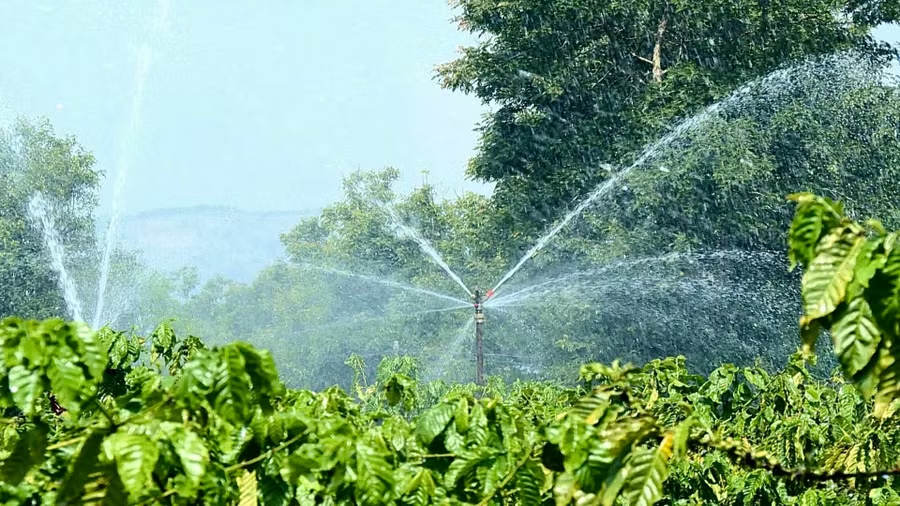
In many coffee-growing regions, the image of farmers dragging hoses to water each tree is gradually being replaced by automatic sprinkler irrigation systems. This not only reduces cost pressures but also reflects a growing awareness of the value of water resources.
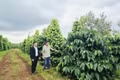
Mr. Byin (Cham Bom village, Ia Bang commune) shared that with 3 hectares of coffee, he used to worry about water shortages every irrigation season. Manual watering was both labor-intensive and consumed a large amount of water. After proactively researching and installing an automatic sprinkler system, irrigation has become more economical and easier—he only needs to set the operating time.
Similarly, Mr. Nguyễn Tất Tiến (Hop Thanh village, Ia Grai commune) invested over 80 million VND to complete a sprinkler system for his 2-hectare coffee farm right from the time he replanted his garden. Although the initial cost was significant, the results have been clear: reduced water usage, lower labor costs, and more uniform crop growth.
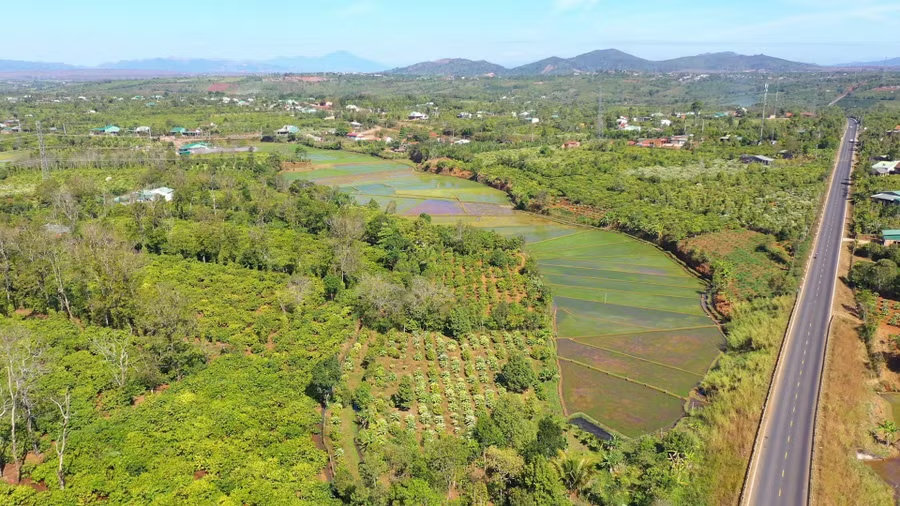
According to many farmers, sprinkler irrigation helps distribute water evenly and allows it to seep gradually, minimizing losses compared to traditional methods. Each irrigation cycle can save about 30% of water, while crop growth is even more robust.
When hundreds or thousands of hectares each reduce water use by 30%, the total savings can reach millions of cubic meters. This helps prevent groundwater depletion, preserves soil structure, and avoids erosion since water is not applied forcefully. Fertile soil retains water better, creating a beneficial cycle.
Proactive Production Through Technology
The shift toward water-saving irrigation is gradually taking shape in many localities. Mr. Siu Hnit, Chairman of the Ia Hrung Commune Farmers’ Association, noted that residents have begun adopting methods such as drip and sprinkler irrigation.
These methods significantly reduce water usage while also saving on electricity and labor costs. As electricity, fuel, and labor costs rise, optimizing expenses has become a key factor in ensuring profitability.
More importantly, there is a need to shift from experience-based irrigation to scientifically calculated watering, based on soil moisture and crop growth needs, rather than the old mindset of “watering just to be sure.”
By the end of 2025, the province will have 88,768 hectares of crops using advanced and water-saving irrigation methods, an increase of 1,405 hectares compared to the previous year, mainly focused on key crops such as coffee, pepper, sugarcane, tobacco, and fruit trees.
Although the trend of transition has begun, progress remains slow as most areas still rely on traditional irrigation methods, posing risks of water waste and reduced production efficiency.
According to Mr. Biện Văn Hảo, Vice Chairman of the Ia Phi Commune People’s Committee, in increasingly harsh dry seasons, water-saving irrigation is the right direction, especially for coffee, which is highly dependent on water.
Based on the effectiveness seen in local farms that have adopted water-saving irrigation, he believes not every household can switch immediately, but if farmers delay, they will become increasingly vulnerable to climate risks.
Mr. Huỳnh Thành Ngọc, Founder and CEO of the “Người chiến sĩ nông dân” (Farmer Warriors) project, which is implementing various programs to support the transition to organic farming, pointed out that the main barriers are not only the initial investment costs but also entrenched farming habits.
In the context of increasingly evident climate change and dwindling water resources, saving irrigation water is no longer an option but a mandatory requirement.
Practical experience shows that water-saving irrigation models can reduce water use by 20-40%, while also cutting electricity, labor, and fertilizer costs.
Notably, drip irrigation systems combined with fertigation are opening up new cultivation approaches, as nutrients are supplied evenly, plants absorb them more efficiently, and growth remains stable even during prolonged heatwaves.