Gia Lai targets sustainable livestock investment with strong environmental safeguard
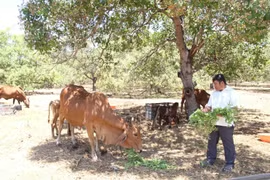
Gia Lai has become a major destination for large-scale livestock investment projects in recent years, particularly in the western part of the province.
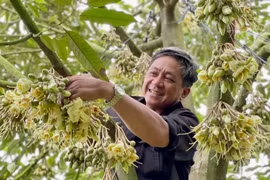
In April 2026, the Gia Lai Provincial People’s Committee issued Document No. 3861/UBND-KGVX, authorising the use of the geographical name “Gia Lai” for registration of the certification trademark “Gia Lai durian”.
More than four decades after waves of post-reunification migration, Vietnam’s Central Highlands province of Gia Lai has transformed from sparsely cultivated land into a major agricultural production hub, driven by settlers who built new lives on basalt soil.
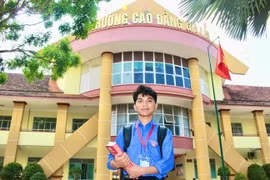
Đinh Văn Châu, a Bahnar student at Gia Lai College, has emerged as a standout example of resilience, overcoming family tragedy, chronic illness and financial hardship to achieve academic and extracurricular success.
Gia Lai’s cropping sector led the province’s agricultural growth in the first quarter of 2026, supported by expanded cultivation areas, rising output and strengthened export-oriented production.
Amid prolonged heatwaves during the dry season in the western region of Gia Lai province, water-saving irrigation is no longer just an option but has become an essential requirement in agricultural production.
Organic agriculture movement is gaining momentum as the Huỳnh Thành Ngọc-led “farmer warriors” project demonstrates that soil-first farming can improve yields, restore ecosystems and strengthen farmer livelihoods.
Communities in western Gia Lai are accelerating efforts to restore farming and rebuild homes after late-2025 storms and floods devastated thousands of hectares of crops, damaged livestock production, and repeatedly inundated residential areas.
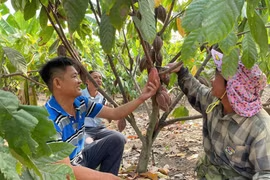
The once-barren commune of Pờ Tó is emerging as a new cocoa hub after successful trials by Trọng Đức Cocoa Co., Ltd., drawing interest from Japan’s Bourbon Corporation and promising higher incomes for local ethnic minority farmers.
The annual spring harvest of teng leng flowers and young leaves continues to sustain the culinary heritage of the Jrai people in Gia Lai province, where villagers gather the wild plant each year from January to mid-March.
Gia Lai province is accelerating safe vegetable production to secure supplies for the Lunar New Year (Tet), as farmers recover from late-2025 floods and respond to rising consumer demand for high-quality, clean produce.
Gia Lai Province is rapidly overhauling its crop structure as climate change, rising production costs, and unstable agricultural markets push local authorities and farmers toward more profitable and sustainable models.
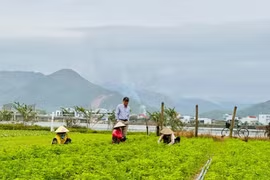
An Binh Ward is emerging as one of the largest vegetable-producing areas in western Gia Lai, as hundreds of households adopt safe cultivation practices that have raised incomes and diversified crops.
Despite offering competitive pay, businesses across Gia Lai province are struggling to recruit enough seasonal workers ahead of the Lunar New Year, as agriculture and other higher-paying jobs draw labor away.
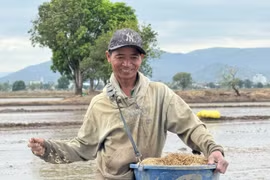
Farmers in the lower Ayun River region of Gia Lai province have begun sowing the 2025-2026 winter–spring rice crop, capitalising on what they describe as the most favourable cultivation window of the year, with lower risks from storms and natural disasters.
On barren white sand once deemed desolate and unproductive, farmer Nguyễn Xuân Ánh has methodically built a nearly 10-hectare integrated farm, generating an average annual profit of 500–700 million VND (approximately USD 20,000–28,000).
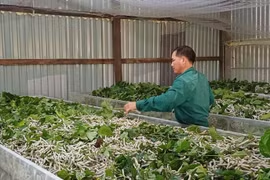
Mulberry cultivation and silkworm farming are emerging as a reliable livelihood for thousands of households in western Gia Lai province, as production–consumption linkages help farmers reduce risks and steadily improve living standards.
The Gia Lai Provincial Farmers’ Association on December 31 convened its first Congress of delegates for the 2025–2030 term, marking a new phase in mobilising farmers and advancing sustainable agricultural development in Vietnam’s Central Highlands.
The Gia Lai Provincial People’s Council has approved two key resolutions aimed at directly supporting the livelihoods of farmers and fishermen, as part of 65 resolutions passed at its fifth session held from December 8–9 during the 2021–2026 term.
PetroVietnam Ca Mau Fertilizer Joint Stock Company on December 13 inaugurated and unveiled the nameplate of its Ca Mau fertilizer plant – Binh Dinh Facility at Long My Industrial Park in Quy Nhon Tay Ward.
Gia Lai province is accelerating the standardisation of agricultural production by expanding planting area codes and packaging facility codes, a move aimed at meeting increasingly stringent export requirements and securing stable access to global markets.
The Department of Science and Technology of Gia Lai Province convened a workshop on December 12 to review progress under the 2020-2025 Project on Deployment, Application, and Management of the Traceability System (Project 100), and to outline priorities for the 2026-2030 period.
Vietnamese Prime Minister Pham Minh Chinh on Tuesday urged that national development policies place farmers at the center, treat agriculture as a driving force, and view rural areas as a critical foundation, during a 2025 dialogue with farmers held in Hanoi.
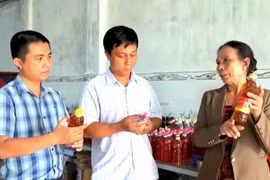
Gia Lai province is witnessing rapid shifts in agricultural production and market reach as the “One Commune, One Product” (OCOP) program drives producers to scale up, adopt value-chain models, and invest in processing technologies.