Nguyễn Văn Hùng, born in 1986, and his wife relocated their mulberry and sericulture operations from Lâm Đồng province to Gia Lai in 2022, after land constraints limited further expansion at home.
After surveying local conditions, Hùng concluded that the Gia Lai plateau offered suitable soil and climate, along with ample land for long-term, large-scale planning.

The couple purchased 10 hectares in KDang commune, investing in water-saving irrigation, technical facilities, a silkworm farm, a silk reeling workshop and staff housing. From this centralized model, Hùng founded the Gia Lai Silkworm Cooperative, building a closed production chain in partnership with local farmers.
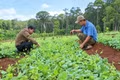
Hùng said the cooperative aims to manage the entire process, from inputs to guaranteed outputs, to give farmers confidence to invest. By mid-2024, he began providing hands-on technical guidance in Ia Lâu and Ia Mơ communes, where many households were already growing mulberry but struggled with limited expertise. To date, the cooperative has supported more than 2,500 households across western districts of the province.

The cooperative now supplies more than 3,000 boxes of silkworm eggs each month and purchases all harvested cocoons at about 210,000 VND per kilogram (around USD 8.6). Its silk reeling workshop and silkworm farm employ more than 120 unskilled workers, with monthly incomes ranging from 7 to 10 million VND (approximately USD 285–410).
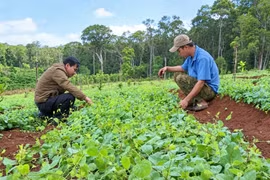
Local farmer Lê Văn Thảo, born in 1972 from Dư Keo Hamlet in Ia Ko commune, said his family began mulberry cultivation and silkworm farming in 2022. With support from the cooperative in terms of breeds, technical guidance and stable purchasing, he said the family felt secure in expanding production.

In mid-2025, Hùng established Hùng Linh Gia Lai Silk Company, which now manages 40 hectares of mulberry plantations, operates seven purchasing points, a silk reeling workshop and a silkworm farm. The company plans to plant an additional 50 hectares, install four more silk reeling machine lines, and further expand production linkages tied to product consumption.
Elsewhere in Ia Hrú commune, Hoàng Thị Mai, born in 1986, turned to mulberry cultivation after repeated failures with pepper, sugarcane and cattle farming. After learning sericulture techniques in Lâm Đồng province, her family now manages 5.6 hectares of mulberry, raises five boxes of silkworms per cycle with two cycles per month, and provides jobs for local workers.

Similarly, Lê Văn Dương, born in 1983, shifted from unsuccessful pepper and coffee farming to mulberry and silkworm production in 2018. After mastering techniques, he expanded to two hectares by 2021, raising four to eight boxes of silkworms per month and earning about 650 million VND annually (around USD 26,500). Since 2024, he has been sharing technical knowledge and connecting new farmers with buyers.
According to Phạm Hữu Viên, Acting Head of the Economic Office of Ia Hrú commune, 256 households there are now engaged in mulberry cultivation and sericulture, covering more than 128 hectares. He said the model is becoming a local strength, helping residents transition to more effective crops, create jobs and reduce agricultural risks, with plans under way to further expand suitable production zones.