The EUDR, one of the EU’s strictest frameworks linking trade to environmental protection, requires products such as rubber, timber, coffee and cocoa to prove they do not originate from forest land converted after 31 December 2020. Suppliers must also provide plot-level traceability for all shipments to the bloc.
Gia Lai, home to extensive plantations operated by companies under the Vietnam Rubber Group (VRG), faces direct exposure to the regulation. Although the bloc is demanding, enterprises say the EU-Vietnam Free Trade Agreement offers strong incentives to meet sustainable production standards.

Recognising the early impact of the EUDR, rubber companies across the province have reviewed land legality, updated conversion timelines and created phased compliance roadmaps focused on standardising raw-material zones.
At Chu Păh Rubber One Member Limited Liability Company, about 6,200 hectares of plantations have been digitally mapped with geographic coordinates and land-use histories to verify forest-origin requirements. Workers have also been trained to log latex output for each tapping shift and link the data to individual plots, ensuring traceability down to the worker and plantation level.
Chư Sê Rubber One Member Limited Liability Company, a provincial pioneer in EUDR adaptation, manages more than 7,300 hectares that have undergone full legal reviews and digital mapping.
The company has built and operated the PEFC EUDR DDS Accountability System, based on the PEFC ST 2002-1:2024 standard, to manage risks and meet EU transparency obligations. Director Nguyễn Văn Thắng said the regulation represents a “fundamental shift” that requires restructuring from the ground up to avoid supply-chain exclusion.

Other VRG units, Chư Prông and Mang Yang Rubber companies, are undergoing similar transitions. While enterprises acknowledge the significant investment involved, they say compliance improves control over raw materials, reduces legal exposure and strengthens credibility with foreign buyers.
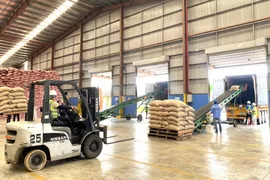
Beyond cultivation areas, firms are tightening control of collection, transport and processing, links viewed as most vulnerable to traceability gaps. Production teams now issue delivery notes and seal latex shipments with security tags from plantation to factory to prevent material mixing, said Trương Công Đạt, Head of Hòa Phú 1 Production Team.
At the processing stage, factories have introduced systems aligned with the PEFC Chain of Custody standard, enabling clear classification of inputs, verified sourcing and compliance with environmental, safety and social-responsibility requirements.
Chu Păh Rubber Company has already announced EUDR-compliant products, a milestone in its sustainable-development plan. Deputy General Director Huỳnh Văn Lanh said meeting EUDR requirements has strengthened management capabilities and created a base for pursuing additional international certifications.
Although the shift demands new technology, skilled personnel and changes in production mindset, Gia Lai’s experience shows the EUDR is evolving from a technical trade barrier into a driver of industry restructuring. By standardising raw-material areas and sealing supply-chain loops, local enterprises are positioning Gia Lai rubber more firmly within the global market.