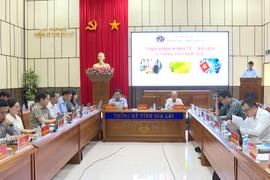
Deputy Prime Minister Nguyễn Chí Dũng, who heads the National Steering Committee for Collective Economy, has signed Decision No. 18/QĐ-BCĐQGKTTT issuing the committee’s 2026 Action Plan.
The plan identifies support for cooperatives to adopt digital tools and emerging technologies as a key task, with the goal of gradually improving productivity, product quality and market competitiveness.

According to the document, six priority tasks have been assigned to ministries, government agencies, steering committee members and local authorities.
Authorities are tasked with strengthening the role of steering committees at all levels in developing the collective economy and ensuring members take responsibility for directing and implementing cooperative development policies within their sectors and regions.
The plan also calls for accelerating the implementation of Resolution No. 20-NQ/TW and Resolution No. 09/NQ-CP, along with related programmes across ministries and provincial party committees, while increasing inspection and oversight to ensure consistent implementation throughout the political system.
Communication efforts will be expanded to promote policies supporting the collective economy and cooperatives, while raising public awareness of their role in Vietnam’s socialist-oriented market economy. Activities will also be organised to mark the 80th anniversary of Vietnam’s Cooperative Day (April 11, 1946 - April 11, 2026).
Authorities will continue reviewing and evaluating the legal framework governing the sector in order to propose improvements to laws, mechanisms and policies that promote cooperative development. The plan also emphasises reducing administrative procedures, improving the business environment and replicating effective cooperative models suited to different industries and regions.
Promoting science, technology and digital transformation in the collective economy is another central objective, with targeted support for cooperatives to access digital platforms and modern technologies.
The plan also encourages stronger partnerships between cooperatives, businesses and other economic actors, including forums to facilitate policy dialogue and networking among cooperatives, state agencies, credit institutions and other stakeholders.
Under the implementation framework, steering committee members must develop detailed action plans, oversee task execution within their ministries and sectors, and lead inspection teams monitoring cooperative development in designated localities.
The Ministry of Finance, serving as the standing agency of the steering committee, will monitor the implementation of the plan and report on progress periodically or when requested by the head of the committee.