As copyright infringement and illegal digital content distribution become increasingly sophisticated, Vietnamese authorities are stepping up efforts to strengthen intellectual property (IP) protection in the digital era.
In an interview with Gia Lai Newspaper and Radio & Television, Mr. Phan Ho Giang discussed the growing challenges of IP enforcement and the province’s strategy to improve state management and support innovation.
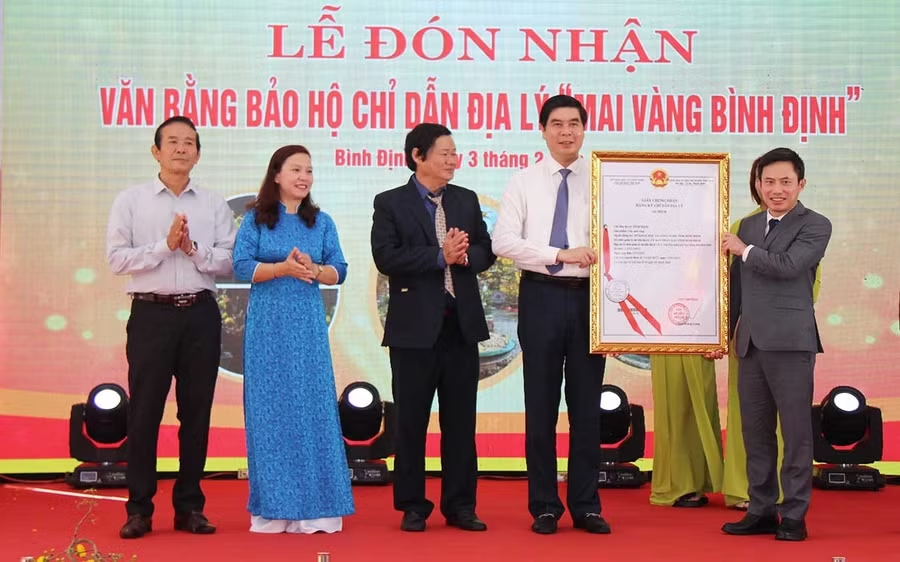
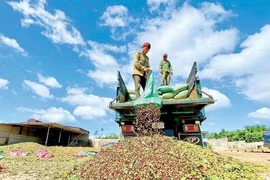
The Bình Định yellow apricot blossom has been granted geographical indication protection, helping to affirm the unique brand of the local yellow apricot. Photo: T.Lợi
*Recently, the Ministry of Public Security prosecuted several copyright infringement cases involving music and digital content. How do you assess the current situation of intellectual property rights violations?
- Violations of intellectual property rights are becoming increasingly complex, particularly in the digital environment. In the past, infringements were often small-scale and isolated, but we are now witnessing organized and large-scale exploitation, copying, and distribution of digital content for illegal profit.
Recent enforcement actions demonstrate the State’s determination to protect intellectual property rights and create a healthy environment for creativity. This is a long-term issue closely linked to the development of the digital economy, innovation, and national competitiveness.
Today, intellectual property is not only the result of creativity but is also directly connected to brand value, reputation, and the development capacity of enterprises, organizations, and individuals.
* What challenges does this situation create for state management at the local level?
Mr. Phan Hồ Giang – Deputy Director of the Department of Science and Technology. Photo: NVCC
- While recent cases mainly involve copyright and related rights, they also reflect broader pressures on intellectual property management. We need to move beyond the mindset of simply “registering for protection” and focus instead on the management and effective exploitation of intellectual property assets.
Protecting intellectual property today is not only about establishing ownership rights. It also involves commercialization, protection, and turning intellectual property into real economic value.
In the context of digital transformation, effective management requires close coordination between science and technology agencies, police, market management authorities, the cultural sector, and other relevant bodies to detect and handle violations in cyberspace and e-commerce platforms promptly.
At the same time, raising awareness among businesses and the public about the strategic role of intellectual property remains essential because it is closely tied to business activities and innovation.
* How has industrial property management been implemented in the province recently?
- The province has implemented industrial property management in a coordinated manner while closely following directives from the Government and the Provincial People’s Committee.
The Department of Science and Technology has advised the Provincial People’s Committee on implementing key directives related to strengthening the fight against intellectual property violations and improving IP rights enforcement.
The province has also introduced various programs supporting the establishment and development of intellectual property assets linked to the local economy. Each year, nearly 1,000 organizations and individuals receive consultations on intellectual property matters, while training sessions are organized for approximately 700 to 800 participants.
To date, the province has established industrial property rights for four geographical indications, 74 collective and certification marks, and more than 3,000 trademarks for products and services.
In addition, the Department has proposed policies supporting science and technology development, including intellectual property assets. Beginning in 2026, Resolution No. 10/2026/NQ-HĐND will introduce stronger support mechanisms for technological innovation, intellectual property registration, and brand development.
* In your opinion, what is the biggest challenge in protecting intellectual property rights today?
- The biggest challenge remains limited awareness among some businesses and individuals regarding the importance of intellectual property. Many organizations still do not consider intellectual property a strategic asset and therefore fail to invest adequately in registration, protection, and management.
Meanwhile, violations are becoming increasingly sophisticated, especially in digital environments and e-commerce. Assessment, evidence collection, and enforcement in cyberspace are particularly difficult because of the cross-border nature and rapid evolution of digital technology.
Businesses should develop intellectual property strategies early, including registering trademarks, industrial designs, inventions, and copyrights for their products, brands, and creative content.
At the same time, companies need to strictly manage the origin of technology, software, data, images, and content used in their operations to avoid infringing upon the rights of others. Businesses with export-oriented products should also register intellectual property protection in overseas markets to protect their brands and increase product value.
* What measures will the provincial science and technology sector prioritize in the coming period to improve IP management?
- The sector will continue strengthening communication efforts and raising awareness among businesses, cooperatives, and the public about intellectual property protection.
Authorities will also support the establishment, management, and development of intellectual property assets for key products, OCOP products, and local specialties.
In addition, the sector plans to expand the use of digital technologies for traceability and protection of intellectual property assets in online environments, improve the professional capacity of local IP personnel, and strengthen coordination with relevant agencies in inspection, supervision, and enforcement activities.
Support policies under Resolution No. 10/2026/NQ-HĐND will continue to be implemented to create favorable conditions for businesses to innovate, develop intellectual property assets, and improve competitiveness and international integration.
The Gia Lai Young Entrepreneurs Association plans to launch a supply-chain pilot for businesses serving the wood processing and export sector, aiming to help five to 10 companies secure new orders or contracts in its first year.
Gia Lai province has approved an ethanol plant investment by Quang Ngai Sugar Joint Stock Company (QNS) worth VND 1,741.844 billion (approximately US$69.7 million, using an indicative rate of VND 25,000 per US$1), with operations scheduled to begin in the third quarter of 2028.
Thinh Phat–Muyuan Gia Lai Co. Ltd. began construction on a VND 3.615 trillion ($144.6 million) pig farming and animal feed complex in Po To commune on October 11, as Gia Lai province seeks to expand industrial livestock production.
Gia Lai province held a training workshop on October 6 to help businesses develop exports and strengthen trade with Cambodia, as infrastructure gaps and limited business participation continue to constrain cross-border commerce.
Gia Lai province has approved an investment policy for a commercial and service complex in An Nhon Dong Ward, with total investment exceeding VND 12.718 billion. The investor will be selected through a land use rights auction.
Gia Lai attracted 218 new investment projects with total registered capital exceeding VND192.719 trillion ($7.41 billion) in the first nine months of 2026, setting a new record for the province, according to the provincial Investment Promotion and Support Task Force.
Gia Lai province is standardising data on coffee and durian growing areas across 61 communes and wards to improve traceability and meet export market requirements as new rules simplify the issuance of growing-area codes.
Pharmacist Võ Minh Mơ, director of Huong Que B’RÊ Co., Ltd., has built her entrepreneurial journey around cinnamon, a key agricultural product of An Lão in Gia Lai province.
Land clearance for the first 22km of the Quy Nhon–Pleiku Expressway has reached 99.5%, while construction is accelerating across the project, according to a site inspection by Gia Lai Provincial People’s Committee Chairman Pham Anh Tuan on September 27.
Gia Lai coffee brands are gaining a foothold in the United States as producers shift from exporting raw beans to processed, branded products aimed at a demanding consumer market.
Gia Lai Urban Works Joint Stock Company on September 22 broke ground on a construction waste treatment and recycling plant with an investment of more than VND 57.5 billion (about US$2.18 million), designed to process 480 tonnes of waste a day.
(GLO) – Green transformation, digitalization, enhanced connectivity, and the development of logistics chains are emerging as key requirements for Vietnam’s seaport industry. These topics are the focus of discussion at the 2026 Annual VPA Conference held in Gia Lai.
Gia Lai is stepping up efforts to attract foreign direct investment by improving infrastructure, streamlining administrative procedures and providing direct support to investors, while facilitating projects that have already received investment approval.
Import-export turnover through Le Thanh International Border Gate reached $264.362 million as of September 18, up 69% from the same period last year, according to the Provincial Economic Zone Management Board.
The People’s Committee of Gia Lai Province has approved the investment policy for a sustainable agricultural development project by Thaco Agri, with total investment capital of nearly VND 3.82 trillion ($145 million), in Po To Commune.
Gia Lai Province aims to increase annual e-commerce sales of priority products by 15-20% under a new plan designed to expand market access and narrow the digital divide in border and mountainous areas.
Gia Lai Provincial People’s Committee Chairman Pham Anh Tuan attended the Vietnam Innovation Day 2026 Forum in Berlin on September 17, highlighting opportunities for Vietnam-Germany cooperation in science, technology, innovation and the digital economy.
Gia Lai is seeking to deepen investment ties with German businesses, with a focus on agriculture, processing, technology transfer and green development, as the Vietnamese province looks to attract foreign investment.
Localities across Gia Lai province are turning to livestreaming to promote specialty and OCOP products, helping producers reach wider markets while building skills in online marketing, sales and customer engagement.
Gia Lai province is seeking to expand investment and trade cooperation with Taiwanese businesses, with a focus on manufacturing, technology, agriculture, renewable energy, logistics and tourism.
Gia Lai is stepping up efforts to expand markets for agricultural products and build stable production-processing-consumption chains, as authorities seek to reduce reliance on seasonal sales across nearly 977,000 hectares of agricultural land.
Gia Lai Province and France’s Normandy region have agreed to explore stronger cooperation in investment, trade, tourism, renewable energy, education, science and technology during a working visit by a Gia Lai delegation.
Gia Lai is simultaneously revising its provincial master plan and the master plans for four major urban centers as it seeks to create a more interconnected development network spanning coastal, highland and border areas.
Gia Lai is stepping up investment in transport and logistics infrastructure to position itself as a key logistics hub for Vietnam’s Central Highlands, linking major agricultural production zones with border gates, seaports and international markets.