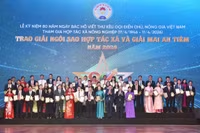
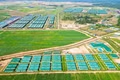
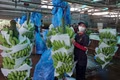
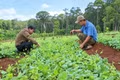
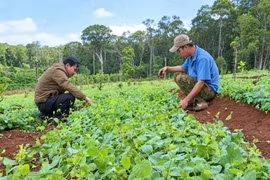
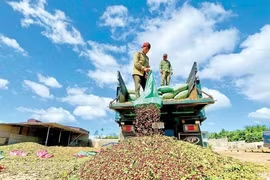
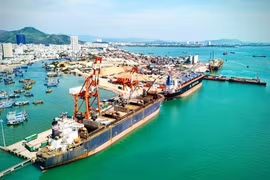
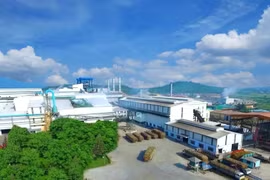
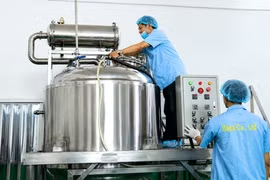
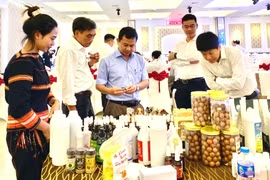
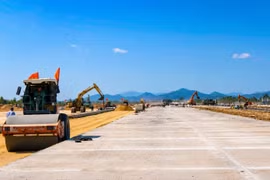
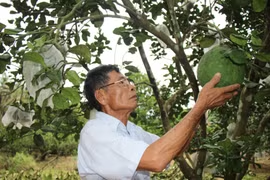
From 2024 to 2026, the Vietnam Cooperative Alliance has recognized Thuong Giang Agricultural Cooperative in Binh Khe Commune and Binh De Construction Stone Production Cooperative in North Hoai Nhon Ward as “Cooperative Stars.”
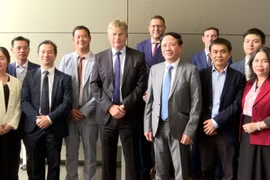
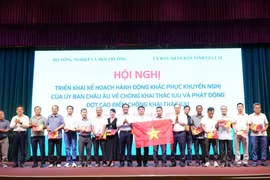
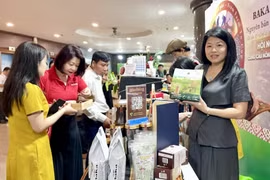
Thượng Giang Agricultural Cooperative honored as "Cooperative Star" in 2026 (April 2026). Photo: NVCC
In a conversation with reporters from Gia Lai Newspaper and Radio & Television, both cooperative leaders focused less on profits and business figures and more on the values they believe underpin long-term success: product quality, stable employment and meaningful contributions to local communities.
Behind the recognition, they said, lies a years-long commitment to building trust and creating tangible benefits for members and residents alike.
* Behind the “Cooperative Star” title are strong operational results. Could you share your cooperative’s development journey?
Mr. Nguyễn Xuân Thạch shares about maintaining the "Cooperative Star" title for three consecutive years. Photo: Hồng Thương
- Mr. Nguyễn Xuân Thạch:
Binh De Construction Stone Production Cooperative was established in 1998 and operates in several sectors, including construction stone quarrying and production, unbaked brick manufacturing, petroleum trading, and the construction of civil, industrial, transport and irrigation projects.
In 2024, the cooperative generated revenue of more than VND37 billion (approximately US$1.42 million) and profit of VND1.6 billion (approximately US$61,500). In 2025, revenue rose to VND38 billion (approximately US$1.46 million), while profit exceeded VND1.7 billion (approximately US$65,400).
- Mr. Trần Đình Thọ: Founded in 1980, Thuong Giang Agricultural Cooperative provides agricultural production services and develops value chains for seed rice, sesame and peanuts. It also supplies agricultural inputs, electricity and waste collection services.
Between 2018 and 2022, annual profits ranged from just over VND500 million (approximately US$19,200) to VND900 million (approximately US$34,600). Profit increased to VND1.3 billion (approximately US$50,000) in 2024 and reached VND1.6 billion (approximately US$61,500) in 2025.
* What are the key foundations that have enabled your cooperatives to sustain growth over the years?
- Mr. Nguyễn Xuân Thạch: The most important factor is our ability to develop and implement business strategies suited to changing conditions.
Alongside optimizing production processes to reduce costs and improve quality, Binh De Cooperative places a strong emphasis on credibility. For construction projects, we ensure materials meet required standards and that projects are completed on schedule and according to approved designs. That commitment has helped us attract new customers.
- Mr. Trần Đình Thọ: In the early years, local agricultural production faced significant challenges because of hilly terrain, poor soil quality and limited irrigation.
In response, the cooperative gradually built a system providing high-quality, traceable agricultural inputs, technical guidance and support for product marketing.
As farmers saw production costs fall and productivity improve, confidence in the cooperative steadily strengthened.
* How has support from local authorities and relevant sectors contributed to your development?
- Mr. Nguyễn Xuân Thạch: The cooperative has consistently received support from local authorities in handling legal procedures and environmental requirements. Local authorities have also facilitated our participation in a number of civil construction projects, creating additional revenue opportunities.
- Mr. Trần Đình Thọ: Support from agricultural agencies and local authorities has been essential in identifying suitable crops, guiding production transformation and implementing pilot models before wider adoption.
As a result, the cooperative has successfully developed a seed rice value chain that supplies around 80 tonnes of seed rice each year to the South Central Coastal Agricultural Science and Technology Institute.
Our sesame and peanut production linkage model also purchases between seven and eight tonnes of products annually. Meanwhile, a 50-hectare large-scale field model has helped nearly 300 households increase yields from six tonnes per hectare to 7.2 tonnes per hectare.
* Cooperative success is measured not only by financial performance but also by the jobs created for local people. How important is that role?
- Mr. Nguyễn Xuân Thạch: Since 1994, I have also served as Party Cell Secretary in the locality, and job creation has always been one of my priorities.
The cooperative currently employs 80 regular workers with monthly salaries starting from VND6 million (approximately US$230), all of whom are covered by social insurance. Another 80 contract workers receive health insurance support from the cooperative, while more than 160 workers are covered by occupational accident insurance.
We prioritize local recruitment, including recent graduates and young people who do not pursue university education, and then provide vocational and professional training opportunities.
- Mr. Trần Đình Thọ: In addition to profit-sharing based on capital contributions, access to affordable services and participation in production value chains, the cooperative creates jobs for 34 local workers.
Monthly salaries range from VND5 million (approximately US$192) to VND10 million (approximately US$385) per person.
* Economic development often goes hand in hand with social responsibility. What motivates your continued community engagement?
- Mr. Nguyễn Xuân Thạch: Each year, Binh De Cooperative allocates between VND100 million (approximately US$3,850) and VND150 million (approximately US$5,770) for welfare activities benefiting members and local residents. These include visits to sick residents, holiday and Lunar New Year gifts, support for policy beneficiary families and assistance for people affected by natural disasters.
For Hamlet 6 of An Hoa Commune, our twinned locality, the cooperative provides annual support of VND25 million (approximately US$960) to VND30 million (approximately US$1,150).
We have also contributed VND600 million (approximately US$23,100) toward the construction of the hamlet’s traditional house, along with hundreds of millions of dong for concrete roads and cemetery projects.
Mr. Trần Đình Thọ: "Reputation and quality are the foundation for the cooperative’s sustainable development." Photo: Hồng Thương
- Mr. Trần Đình Thọ: We believe our achievements are made possible by the support and trust of members and the community. Therefore, when the cooperative performs well, it has a responsibility to share those benefits.
Every year, we allocate between VND45 million (approximately US$1,730) and VND50 million (approximately US$1,920) from our welfare fund for Lunar New Year gifts, support for members facing unexpected difficulties, scholarships and Mid-Autumn Festival activities for children.
In addition, through our participation in local irrigation projects, the cooperative contributes about VND200 million (approximately US$7,690) annually toward construction costs.
* The “Cooperative Star” title is an important recognition, but what comes next?
- Mr. Nguyễn Xuân Thạch: Some of our services have delivered limited profitability in recent years, but they remain important for maintaining an integrated value chain and optimizing overall operations.
Looking ahead, the cooperative will continue its existing business activities while studying and investing in artificial sand production from stone, with the aim of increasing revenue and securing materials for local construction projects.
- Mr. Trần Đình Thọ: Thuong Giang Agricultural Cooperative will continue expanding its successful services and production value chains.
We are also working to upgrade our “Thuong Giang Peanut Oil” and “Thuong Giang Sesame Oil” products to achieve four-star OCOP status. This will help increase product value, expand market opportunities and strengthen demand for locally produced agricultural goods.
Both cooperatives have received numerous awards from the State, central ministries, and local authorities.
Bình Đê Construction Stone Production Cooperative has been awarded the Third-class Labor Order, emulation flags, and certificates of merit from the Prime Minister, the Ministry of Industry and Trade, and many other honors.
Thượng Giang Agricultural Cooperative has received certificates of merit from the Minister of Agriculture and Environment, the Vietnam Cooperative Alliance, and more than 30 times has been awarded emulation flags and certificates of merit from the Chairman of the Provincial People’s Committee for its contributions to the collective economy and patriotic emulation movements.
Gia Lai province is seeking to expand investment and trade cooperation with Taiwanese businesses, with a focus on manufacturing, technology, agriculture, renewable energy, logistics and tourism.
Gia Lai is stepping up efforts to expand markets for agricultural products and build stable production-processing-consumption chains, as authorities seek to reduce reliance on seasonal sales across nearly 977,000 hectares of agricultural land.
Gia Lai Province and France’s Normandy region have agreed to explore stronger cooperation in investment, trade, tourism, renewable energy, education, science and technology during a working visit by a Gia Lai delegation.
Gia Lai is simultaneously revising its provincial master plan and the master plans for four major urban centers as it seeks to create a more interconnected development network spanning coastal, highland and border areas.
Gia Lai is stepping up investment in transport and logistics infrastructure to position itself as a key logistics hub for Vietnam’s Central Highlands, linking major agricultural production zones with border gates, seaports and international markets.
Gia Lai is seeking to increase the value of its agricultural sector by expanding deep processing, strengthening production linkages and building closed value chains, as the province looks to retain more value within its major raw material areas.
Gia Lai is accelerating investment in irrigation infrastructure to secure water supplies amid increasingly complex climate change, while improving agricultural productivity and developing concentrated raw material production zones.
The Gia Lai Provincial People’s Committee has approved the investment policy for the Sê San 4 Hydropower Plant Expansion Project, with Vietnam Electricity (EVN) selected as the investor for the 120MW project.
Vietnam’s Phu Tai Joint Stock Company plans to invest $950,000 to establish a subsidiary in Texas, United States, to expand its trading and distribution of stone and wooden furniture products.
Young people returning to Gia Lai are finding new ways to increase the value of local agricultural products, combining technology, processing skills, market experience and storytelling to bring products closer to consumers.
A Facebook-based digital marketplace launched in Đak Pơ is helping local farmers and small traders reach customers beyond the commune, with young people providing hands-on support to promote agricultural products and local specialties online.
Banks in Gia Lai are rolling out large-scale credit packages and cutting lending rates by up to 2 percentage points a year as they seek to improve access to capital for businesses and households.
Gia Lai is stepping up enforcement against illegal, unreported and unregulated (IUU) fishing, tightening vessel controls, electronic monitoring and seafood traceability as authorities seek to have the “yellow card” warning lifted in 2026, towards a more transparent and sustainable fisheries sector.
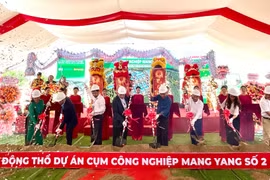
Hoang Anh Gia Lai Joint Stock Company broke ground on the VND 400 billion (about $15.3 million) Mang Yang No. 2 Industrial Cluster in Hra commune on August 12, a 74.5-hectare project expected to create stable jobs for more than 4,500 workers.
Gia Lai is planning a major expansion and upgrade of irrigation infrastructure in its western region, where only 8.94% of agricultural land currently has access to proactive irrigation and the annual water shortfall exceeds 1.234 billion cubic metres.
Gia Lai province is stepping up efforts to accelerate public investment disbursement after spending more than VND 9.322 trillion by the end of July 2026, as authorities seek to address delays affecting major projects and hold agencies accountable for meeting spending targets.
Industrial promotion programs are accelerating technology upgrades among rural businesses, cooperatives and production facilities, helping them improve product quality, strengthen brands and increase the value of locally made goods.
Gia Lai has sharply reduced administrative processing times for businesses, cutting company registration to a matter of hours and halving the time required for land allocation and leasing, as authorities seek to lower costs, accelerate investment projects and strengthen private sector growth.
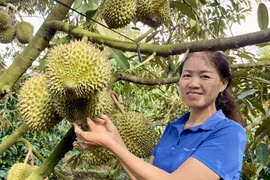
After leaving his position as director of an agricultural enterprise in Ho Chi Minh City, Nguyễn Chất Sâm returned to Ia Ly commune to pursue organic farming, transforming degraded former rubber plantations into a 15-hectare durian farm that now generates about US$267,000 in annual profit.
Gia Lai is reshaping its foreign direct investment (FDI) strategy by prioritising high-tech, environmentally friendly projects with strong spillover effects over investment volume, as the province seeks to improve growth quality and strengthen its role in global supply chains.
Gia Lai authorities have ordered faster construction and site clearance across several major transport projects, setting firm deadlines for an expressway, a new airport runway and a coastal road as the province seeks to strengthen regional connectivity and support economic development.
Gia Lai is stepping up the use of artificial intelligence and digital technologies to promote destinations, preserve cultural heritage and improve visitor experiences, as authorities seek to strengthen the competitiveness of the local tourism industry.
Authorities in Gia Lai province are intensifying oversight of durian production as the region enters its peak harvest season, aiming to ensure products meet increasingly stringent export requirements on traceability, food safety and quality.
Gia Lai province's economy expanded 8.21% in the first six months of 2026 from a year earlier, with industry, construction and services driving growth despite ongoing economic challenges, provincial officials said on Tuesday.

. Photo: NVCC")