His efforts to integrate emerging technologies into vocational education have helped narrow the gap between classroom instruction and workplace demands, enabling students to gain hands-on experience with tools and systems increasingly used by businesses.
In recognition of his contributions, Hòa received a certificate of merit from the Vietnam General Confederation of Labour in 2026 for outstanding achievements in the 2025 emulation movement. A year earlier, he and his colleagues showcased several innovations at the 2025 Creative Labour Festival organized by the confederation and were awarded a certificate of merit by the Central Committee of the Vietnam Fatherland Front for their accomplishments.
At the college, Hòa teaches Industrial Electronics and Computer Assembly and Repair while also conducting research, developing self-made training equipment, coaching students for vocational skills competitions, and delivering professional development courses for teachers from four southern provinces of Laos. He also serves as Deputy Secretary of the school’s Youth Union.
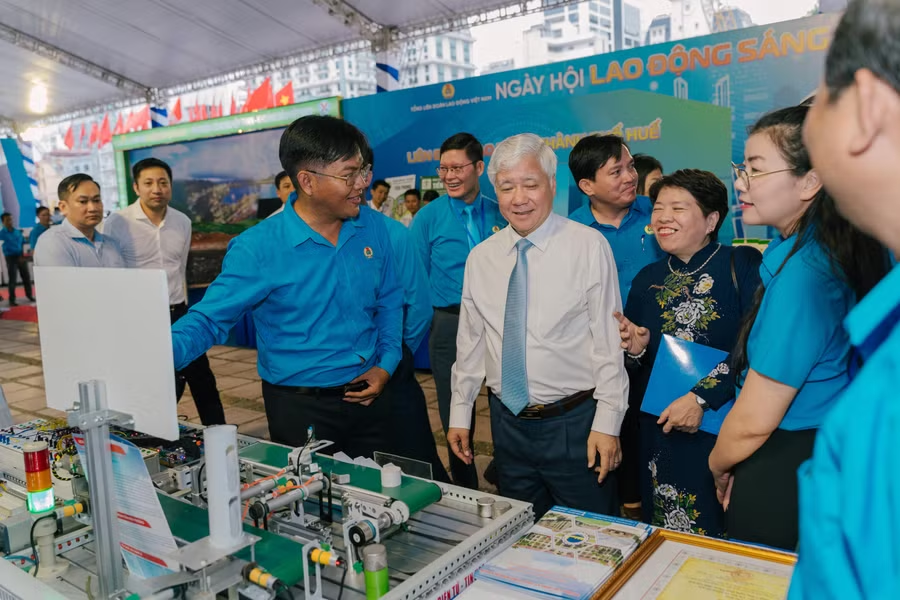
With approximately 70% of the institution’s curriculum devoted to practical training, Hòa said students need access to technologies similar to those used in industry to better understand future job requirements.
That approach has led to the creation of several training innovations, including the “Remote Programming and Monitoring Practice Table,” developed in response to the growing adoption of the Internet of Things (IoT) in manufacturing and the lack of suitable training equipment at the school.
The model allows students to practice remote control and network-based monitoring technologies while introducing concepts such as smart factories and industrial digital transformation. By directly operating the system and observing results, students can more easily grasp complex technical concepts.
Another project, the “Computer Vision and Artificial Intelligence Practice Model,” won second prize at the 2025 Provincial Self-Made Training Equipment Contest. Developed by Hòa, the model gives students practical exposure to technologies associated with the industrial revolution, including artificial intelligence, semiconductors, and automation. Students can use cameras on production lines to recognize, classify, and count products.
Hòa also developed the “PAN Generator and LCD Screen Error Tester” to support training in computer assembly and repair. The device simulates common LCD screen faults, allowing students to practice diagnosis and repair techniques while reducing equipment investment costs for the institution.
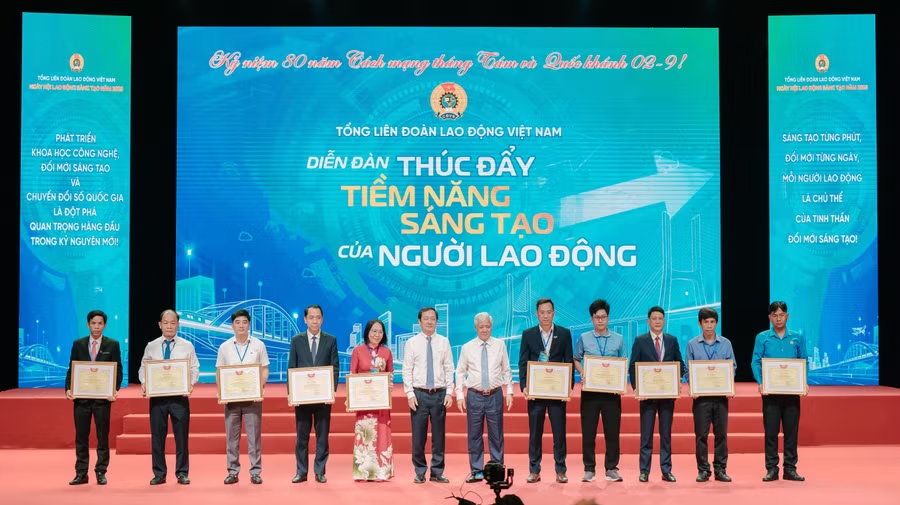
According to Hòa, innovation in vocational education does not have to begin with large-scale projects. Improvements to training models, teaching methods, and the integration of technology into lessons can all contribute to more effective learning outcomes.
Despite the benefits, he said transforming ideas into practical products presents significant challenges, including balancing advanced technologies with students’ learning capabilities, as well as constraints related to time, funding, component selection, design, and programming.
Beyond developing training equipment, Hòa actively encourages students to participate in technology competitions, scientific research projects, and innovation-focused activities to strengthen practical skills and creative thinking.
One experience that left a lasting impression was coaching a student team in a robot-building competition. Although the team did not achieve the desired result, Hòa said the students demonstrated strong self-learning abilities, creativity, and perseverance.
“That experience further convinced me that vocational students are fully capable of creating quality technological products when given proper guidance and opportunities”, he said.
Trần Hiếu Nghĩa, Head of the Faculty of Electronics and Informatics, described Hòa as a leading example within the faculty, citing his professionalism, sense of responsibility, expertise, and commitment to scientific research and educational innovation.
Nghĩa said Hòa’s ability to combine technological knowledge with a passion for teaching has helped inspire students and transform complex technical concepts into practical and accessible learning experiences.