Decree No. 180/2026/NĐ-CP on forest carbon sequestration and storage services is being viewed as a major milestone for the development of Vietnam’s forest carbon market.
With more than 1 million hectares of forested land, Gia Lai is considered well positioned to participate in this promising sector.
Reporters from Gia Lai Newspaper and Radio & Television spoke with Dr. Lai Thanh Hai, Deputy Director of the Vietnam Institute of Forest Science under the Ministry of Agriculture and Environment, about the opportunities and requirements for the province to effectively unlock the value of carbon resources from its forests.
* With more than 1 million hectares of forested land, what advantages does Gia Lai have in developing the carbon credit market?
Dr. Lai Thanh Hai. Photo: Provided by the interviewee
- As the lead of afforestation projects and a participant in several science and technology initiatives in Gia Lai since 2014, I have observed that the province has ideal natural conditions to become one of Vietnam’s leading suppliers of carbon credits, thanks to its exceptionally large forest area.
According to the Ministry of Agriculture and Environment’s 2025 national forest status report, Gia Lai currently has more than 1 million hectares of forested land. Of this, natural forests account for over 692,000 hectares, making the province home to the second-largest forest area in the South Central Coast and Central Highlands regions.
Under Decree No. 180/2026/NĐ-CP, the Gia Lai Provincial People’s Committee and local forest management boards will officially represent ownership of these carbon assets.
This provides a clear legal foundation, allowing local authorities and forest owners to confidently negotiate with multinational corporations and climate finance organizations to sign commercial agreements for carbon credit exchanges and transfers.
On May 19, 2026, the Gia Lai Provincial People’s Committee issued Decision No. 2144/QĐ-UBND establishing the Gia Lai Protection Forest Management Board under the Department of Agriculture and Environment. The move consolidated 29 existing protection forest management boards.
The streamlining of management and the establishment of a clearer legal framework have attracted numerous companies seeking cooperation in surveying and developing forest carbon credit and regenerative agriculture projects in Gia Lai.
These developments mark an important transformation in forest management, protection and development in major forest provinces such as Gia Lai, in line with the implementation of Decree No. 180/2026/NĐ-CP.
* Forest carbon credits are expected to create additional income from forests. What should be done to ensure these benefits reach those directly involved in forest protection?
- Allowing businesses to purchase forest carbon credits for emissions offsetting opens up substantial financial resources and encourages private investment in the forestry sector.
However, because much of Vietnam’s forest area is located in remote regions inhabited by ethnic minority groups and low-income communities, establishing a fair and transparent revenue-sharing mechanism is essential to avoid social inequality and ensure effective forest protection.
To prevent carbon credit revenues from being lost and to ensure that those responsible for protecting forests benefit directly, a comprehensive approach is required. This includes accelerating land and forest allocation, optimizing financial distribution mechanisms through trust funds, ensuring social safeguards and Free, Prior and Informed Consent (FPIC), and integrating biodiversity and under-canopy livelihood models.
In Gia Lai, the forestry sector is encouraging local communities to participate in forest protection contracts while developing medicinal plants, non-timber forest products and ecotourism activities beneath the forest canopy.
This approach helps create sustainable sources of income, reduces pressure from illegal logging and strengthens community incentives to protect forests.
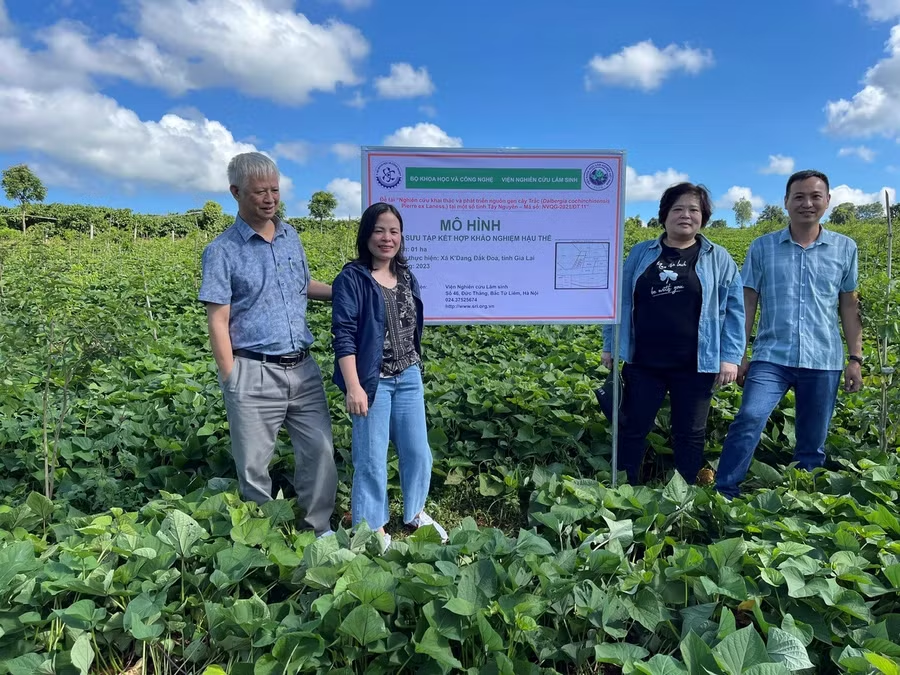
Scientists survey silvicultural pilot models to improve the database for developing the forest carbon credit market in Gia Lai. Photo: Provided by the interviewee
* What preparations are needed for the forestry sector and forest owners to participate effectively in domestic and international forest carbon markets?
- International carbon markets operate under strict scientific standards. Carbon credits are recognized only when they satisfy requirements related to additionality, permanence, prevention of carbon leakage and accurate measurement.
To participate effectively, the forestry sector and forest owners need to urgently complete forest databases, establish emissions baselines and build Measurement, Reporting and Verification (MRV) systems that meet international standards.
At the same time, management capacity must be strengthened, public-private partnerships promoted, technology transfer facilitated and emissions reduction calculations strictly controlled to avoid duplication.
To translate theoretical potential into practical outcomes, particularly in key provinces such as Gia Lai, state management agencies and local authorities should prioritize several strategic measures.
These include issuing detailed implementing guidelines, accelerating pilot projects for provincial-level forest carbon trading, prioritizing investment in data and MRV infrastructure, expanding effective benefit-sharing models and intensifying communication and capacity-building efforts at the grassroots level.
Gia Lai province is seeking to expand investment and trade cooperation with Taiwanese businesses, with a focus on manufacturing, technology, agriculture, renewable energy, logistics and tourism.
Gia Lai is stepping up efforts to expand markets for agricultural products and build stable production-processing-consumption chains, as authorities seek to reduce reliance on seasonal sales across nearly 977,000 hectares of agricultural land.
Gia Lai Province and France’s Normandy region have agreed to explore stronger cooperation in investment, trade, tourism, renewable energy, education, science and technology during a working visit by a Gia Lai delegation.
Gia Lai is simultaneously revising its provincial master plan and the master plans for four major urban centers as it seeks to create a more interconnected development network spanning coastal, highland and border areas.
Gia Lai is stepping up investment in transport and logistics infrastructure to position itself as a key logistics hub for Vietnam’s Central Highlands, linking major agricultural production zones with border gates, seaports and international markets.
Gia Lai is seeking to increase the value of its agricultural sector by expanding deep processing, strengthening production linkages and building closed value chains, as the province looks to retain more value within its major raw material areas.
Gia Lai is accelerating investment in irrigation infrastructure to secure water supplies amid increasingly complex climate change, while improving agricultural productivity and developing concentrated raw material production zones.
The Gia Lai Provincial People’s Committee has approved the investment policy for the Sê San 4 Hydropower Plant Expansion Project, with Vietnam Electricity (EVN) selected as the investor for the 120MW project.
Vietnam’s Phu Tai Joint Stock Company plans to invest $950,000 to establish a subsidiary in Texas, United States, to expand its trading and distribution of stone and wooden furniture products.
Young people returning to Gia Lai are finding new ways to increase the value of local agricultural products, combining technology, processing skills, market experience and storytelling to bring products closer to consumers.
A Facebook-based digital marketplace launched in Đak Pơ is helping local farmers and small traders reach customers beyond the commune, with young people providing hands-on support to promote agricultural products and local specialties online.
Banks in Gia Lai are rolling out large-scale credit packages and cutting lending rates by up to 2 percentage points a year as they seek to improve access to capital for businesses and households.
Gia Lai is stepping up enforcement against illegal, unreported and unregulated (IUU) fishing, tightening vessel controls, electronic monitoring and seafood traceability as authorities seek to have the “yellow card” warning lifted in 2026, towards a more transparent and sustainable fisheries sector.
Hoang Anh Gia Lai Joint Stock Company broke ground on the VND 400 billion (about $15.3 million) Mang Yang No. 2 Industrial Cluster in Hra commune on August 12, a 74.5-hectare project expected to create stable jobs for more than 4,500 workers.
Gia Lai is planning a major expansion and upgrade of irrigation infrastructure in its western region, where only 8.94% of agricultural land currently has access to proactive irrigation and the annual water shortfall exceeds 1.234 billion cubic metres.
Gia Lai province is stepping up efforts to accelerate public investment disbursement after spending more than VND 9.322 trillion by the end of July 2026, as authorities seek to address delays affecting major projects and hold agencies accountable for meeting spending targets.
Industrial promotion programs are accelerating technology upgrades among rural businesses, cooperatives and production facilities, helping them improve product quality, strengthen brands and increase the value of locally made goods.
Gia Lai has sharply reduced administrative processing times for businesses, cutting company registration to a matter of hours and halving the time required for land allocation and leasing, as authorities seek to lower costs, accelerate investment projects and strengthen private sector growth.
After leaving his position as director of an agricultural enterprise in Ho Chi Minh City, Nguyễn Chất Sâm returned to Ia Ly commune to pursue organic farming, transforming degraded former rubber plantations into a 15-hectare durian farm that now generates about US$267,000 in annual profit.
Gia Lai is reshaping its foreign direct investment (FDI) strategy by prioritising high-tech, environmentally friendly projects with strong spillover effects over investment volume, as the province seeks to improve growth quality and strengthen its role in global supply chains.
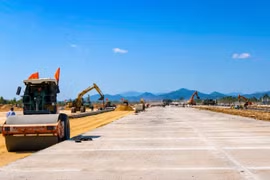
Gia Lai authorities have ordered faster construction and site clearance across several major transport projects, setting firm deadlines for an expressway, a new airport runway and a coastal road as the province seeks to strengthen regional connectivity and support economic development.
Gia Lai is stepping up the use of artificial intelligence and digital technologies to promote destinations, preserve cultural heritage and improve visitor experiences, as authorities seek to strengthen the competitiveness of the local tourism industry.
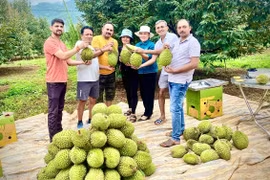
Authorities in Gia Lai province are intensifying oversight of durian production as the region enters its peak harvest season, aiming to ensure products meet increasingly stringent export requirements on traceability, food safety and quality.
Gia Lai province's economy expanded 8.21% in the first six months of 2026 from a year earlier, with industry, construction and services driving growth despite ongoing economic challenges, provincial officials said on Tuesday.