The rapid growth in electricity demand and the accelerating shift toward renewable energy are increasing pressure on Vietnam’s power system, highlighting the urgent need for large-scale energy storage solutions.
In Gia Lai province, pumped-storage hydropower is expected to play a central role in stabilizing the grid, improving renewable energy integration, and supporting long-term sustainable development.
Reporters from Gia Lai Newspaper and Radio & Television spoke with Deputy Director of the Department of Industry and Trade, Trần Thúc Kham, about the province’s strategy.
* Mr. Kham, as electricity demand rises rapidly and renewable energy accounts for a larger share of the power mix, what role does pumped-storage hydropower play in ensuring stable and proactive energy security?
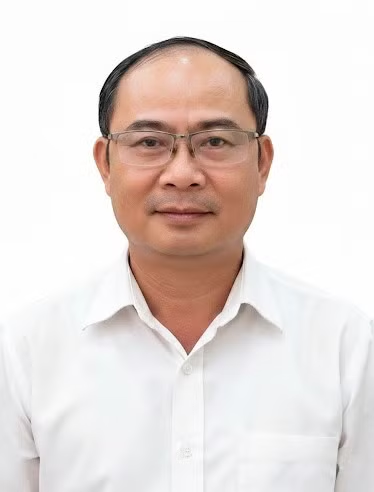
Deputy Director of the Department of Industry and Trade, Trần Thúc Kham. Photo: Hải Yến
- We are entering a period of rapidly increasing electricity demand, aligned with ambitious economic growth targets. At the same time, the energy structure is shifting strongly toward renewable sources such as wind and solar power. This transition is inevitable, but it also introduces significant fluctuations into the system.
The challenge today is not only ensuring sufficient electricity supply, but also maintaining stable and efficient system operations. In this context, pumped-storage hydropower can be considered a critical “hinge” of the power system.
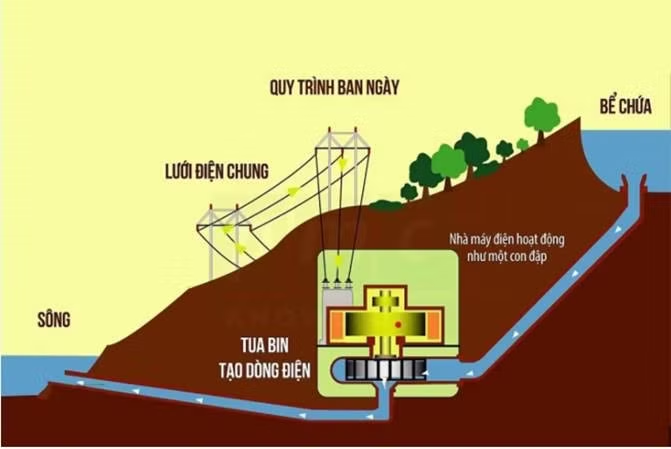
Its operating principle allows electricity to be stored on a large scale. When excess electricity is available—particularly during midday peaks in solar generation—the plant uses that power to pump water to an upper reservoir. When demand increases or renewable output declines, the stored water is released to generate electricity.
This mechanism helps maximize renewable energy use, reduce waste, and lessen dependence on conventional power sources. Pumped-storage hydropower plants can also adjust output very quickly, helping regulate frequency and stabilize voltage, which becomes increasingly important as renewable energy expands.
In that sense, pumped-storage hydropower is not simply a power plant. It is a system-regulation tool that supports proactive and sustainable energy security.
* Given Gia Lai’s strong wind and solar potential, how will pumped-storage projects support renewable energy development in the province?
- Despite the province’s significant renewable energy potential, development has faced limitations due to the grid’s absorption capacity. At times, wind and solar generation has been very high, but output could not be fully utilized because of low demand or transmission bottlenecks.
Pumped-storage hydropower can directly address this issue. With flexible operations, the system can absorb surplus electricity during off-peak hours and release it when demand rises. This reduces renewable energy curtailment and minimizes wasted electricity.
The biggest advantage is improving the grid’s ability to absorb renewable power. With stronger storage infrastructure, the province will have more capacity to attract additional renewable energy projects, particularly in areas where potential remains underdeveloped.
In addition, pumped-storage hydropower provides ancillary services such as frequency regulation, voltage control, and reserve capacity, helping maintain stable system operations despite fluctuations in renewable generation.
Over the long term, these projects will not only improve the efficiency of existing renewable plants but also establish a foundation for sustainable and well-regulated green energy development.
Operational model of the Vĩnh Thạnh Pumped-Storage Hydropower Project. Photo: ĐVCC
*The Vĩnh Thạnh Pumped-Storage Hydropower Project is the province’s first project of this kind and is currently undergoing preparatory procedures. What measures will Gia Lai take to balance energy development, environmental protection, and socio-economic benefits?
- The Vĩnh Thạnh Pumped-Storage Hydropower Project, located in Vĩnh Thạnh commune, has a planned capacity of 600 MW and a total investment of nearly VND11 trillion (approximately USD423 million). The project has already been included in the revised Power Development Plan VIII and related provincial planning frameworks.
The investor is currently finalizing appraisal documents, with construction expected to begin in 2027.
One advantage of the project is that it will utilize the existing Định Bình reservoir, helping minimize environmental impacts compared with building an entirely new facility. Its closed-loop pump-and-release cycle is also designed to avoid significant impacts on water resources.
However, our position is clear: energy development must go hand in hand with environmental protection. The project will be required to carry out comprehensive environmental impact assessments and maintain strict oversight during both construction and operations to ensure no harmful effects on ecosystems or local communities.
In socio-economic terms, the project is expected to contribute between VND320 billion and VND350 billion annually to the provincial budget (approximately USD12.3 million to USD13.5 million).
But beyond direct revenues, we believe the broader spillover effects are even more important.
The province will prioritize local employment, strengthen vocational training, and encourage local businesses to participate in the project’s service chain. Revenue generated from the project will also be reinvested into infrastructure, education, and other key sectors.
In the longer term, the project is expected to enhance Gia Lai’s competitiveness in attracting investment into renewable energy and green industries. With energy storage infrastructure in place, the province’s power system will become more flexible and more attractive to investors.
More importantly, the project reflects Gia Lai’s broader ambition to develop a synchronized green energy ecosystem that integrates power generation, storage systems, and grid infrastructure.
The objective is not only to increase the share of clean energy, but also to build a modern, secure, and highly adaptable energy system.
We are determined that Gia Lai will not only develop energy to meet immediate demand, but also create a flexible and sustainable green energy ecosystem that can support long-term growth.
The Vĩnh Thạnh Pumped-Storage Hydropower Project represents a new approach to energy development—one focused not only on electricity generation, but also on energy storage, regulation, and system optimization. This will be key to helping Gia Lai unlock its renewable energy potential and strengthen its position in the region’s green energy transition.
Thinh Phat–Muyuan Gia Lai Co. Ltd. began construction on a VND 3.615 trillion ($144.6 million) pig farming and animal feed complex in Po To commune on October 11, as Gia Lai province seeks to expand industrial livestock production.
Gia Lai province held a training workshop on October 6 to help businesses develop exports and strengthen trade with Cambodia, as infrastructure gaps and limited business participation continue to constrain cross-border commerce.
Gia Lai province has approved an investment policy for a commercial and service complex in An Nhon Dong Ward, with total investment exceeding VND 12.718 billion. The investor will be selected through a land use rights auction.
Gia Lai attracted 218 new investment projects with total registered capital exceeding VND192.719 trillion ($7.41 billion) in the first nine months of 2026, setting a new record for the province, according to the provincial Investment Promotion and Support Task Force.
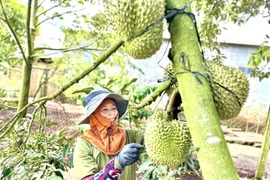
Gia Lai province is standardising data on coffee and durian growing areas across 61 communes and wards to improve traceability and meet export market requirements as new rules simplify the issuance of growing-area codes.
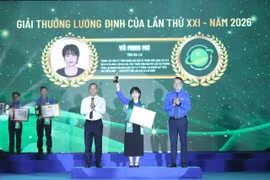
Pharmacist Võ Minh Mơ, director of Huong Que B’RÊ Co., Ltd., has built her entrepreneurial journey around cinnamon, a key agricultural product of An Lão in Gia Lai province.
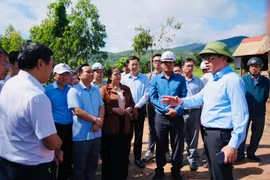
Land clearance for the first 22km of the Quy Nhon–Pleiku Expressway has reached 99.5%, while construction is accelerating across the project, according to a site inspection by Gia Lai Provincial People’s Committee Chairman Pham Anh Tuan on September 27.
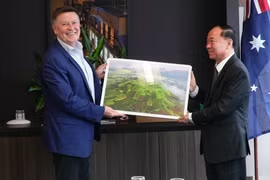
Vietnam’s Gia Lai province is seeking to deepen ties with Australian investors in renewable energy, transport infrastructure, seaports and logistics as it looks to capitalize on its expanded development space and strategic location.
Gia Lai province recorded 2,739 newly established enterprises in the first nine months of 2026, up about 19.13% from the same period last year, with total registered capital reaching VND 40,154 billion (about US$1.52 billion), an increase of approximately 135%.
(GLO) – Green transformation, digitalization, enhanced connectivity, and the development of logistics chains are emerging as key requirements for Vietnam’s seaport industry. These topics are the focus of discussion at the 2026 Annual VPA Conference held in Gia Lai.
Gia Lai is stepping up efforts to attract foreign direct investment by improving infrastructure, streamlining administrative procedures and providing direct support to investors, while facilitating projects that have already received investment approval.
Import-export turnover through Le Thanh International Border Gate reached $264.362 million as of September 18, up 69% from the same period last year, according to the Provincial Economic Zone Management Board.
The People’s Committee of Gia Lai Province has approved the investment policy for a sustainable agricultural development project by Thaco Agri, with total investment capital of nearly VND 3.82 trillion ($145 million), in Po To Commune.
Gia Lai Province aims to increase annual e-commerce sales of priority products by 15-20% under a new plan designed to expand market access and narrow the digital divide in border and mountainous areas.
Gia Lai Provincial People’s Committee Chairman Pham Anh Tuan attended the Vietnam Innovation Day 2026 Forum in Berlin on September 17, highlighting opportunities for Vietnam-Germany cooperation in science, technology, innovation and the digital economy.
Gia Lai is seeking to deepen investment ties with German businesses, with a focus on agriculture, processing, technology transfer and green development, as the Vietnamese province looks to attract foreign investment.
Gia Lai is seeking to establish a direct agricultural export route to China through the Ta Lung International Border Gate in Cao Bang province, as local authorities and businesses look to reduce logistics costs, strengthen processing capacity and increase the value of key agricultural products.
Gia Lai aims to expand medicinal plant cultivation from nearly 1,500 hectares currently to more than 7,486 hectares by 2030, with a focus on growing herbs under forest canopies while conserving natural resources and supporting local livelihoods.
Gia Lai is stepping up efforts to expand markets for agricultural products and build stable production-processing-consumption chains, as authorities seek to reduce reliance on seasonal sales across nearly 977,000 hectares of agricultural land.
Gia Lai Province and France’s Normandy region have agreed to explore stronger cooperation in investment, trade, tourism, renewable energy, education, science and technology during a working visit by a Gia Lai delegation.
Gia Lai is simultaneously revising its provincial master plan and the master plans for four major urban centers as it seeks to create a more interconnected development network spanning coastal, highland and border areas.
Gia Lai is stepping up investment in transport and logistics infrastructure to position itself as a key logistics hub for Vietnam’s Central Highlands, linking major agricultural production zones with border gates, seaports and international markets.
Gia Lai is seeking to increase the value of its agricultural sector by expanding deep processing, strengthening production linkages and building closed value chains, as the province looks to retain more value within its major raw material areas.
Gia Lai is accelerating investment in irrigation infrastructure to secure water supplies amid increasingly complex climate change, while improving agricultural productivity and developing concentrated raw material production zones.