Government Decree No. 141/2026/NĐ-CP, issued on April 29, 2026, amends and supplements provisions under earlier tax regulations governing individuals, household businesses and corporate income tax implementation.
Under the new rules, effective from January 1, 2026, individuals and household businesses with annual revenue of VND 1 billion (about USD 38,500) or less will be exempt from value-added tax (VAT) and personal income tax (PIT), doubling the previous exemption threshold. The decree also encourages these businesses to adopt electronic invoices as part of efforts to standardize business operations.

For the first time, enterprises and organizations established under Vietnamese law with annual revenue of VND 1 billion (about USD 38,500) or less will also qualify for corporate income tax exemptions, aligning the threshold with that applied to individuals and household businesses. Authorities expect the policy to encourage household businesses to transition into formal enterprises and support the creation of new companies.
The decree additionally introduces mechanisms for tax offsets and refunds for individuals, household businesses and small enterprises, helping reduce input costs and improve access to capital for production and business activities.
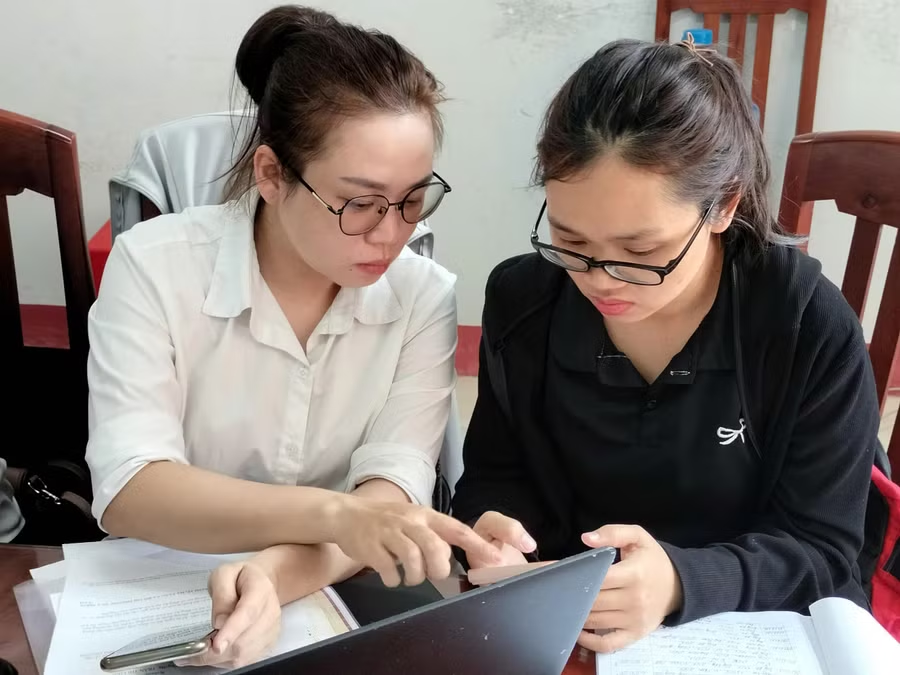
The new measures were quickly welcomed by small business owners. Phạm Trần Thu Trang, who operates a grocery store on Tô Hiến Thành Street in Quy Nhơn Nam Ward, said operating costs remain high despite modest profits.
“With annual revenue below VND 1 billion, my family is certainly eligible for VAT and PIT exemptions,” Trang said. “This helps reduce investment costs and eases our minds, as we no longer have to worry excessively about tax obligations, motivating me to continue maintaining and developing the business.”
Many small traders believe the revised threshold better reflects current business conditions and will help stabilize operations while creating room for future expansion.
Although the tax exemptions may temporarily reduce state budget revenues, authorities say the policy is designed to strengthen the private sector, regarded as a key engine of economic growth. Officials expect long-term fiscal gains as businesses expand, improve competitiveness and transition into larger operating models.
Following the decree’s issuance, the provincial Tax Department launched a series of implementation measures, including publishing guidance on its electronic portal and social media platforms to help taxpayers understand the new regulations and determine their rights and obligations.
The department is also reviewing and identifying eligible individuals, household businesses and enterprises with annual revenue of VND 1 billion or less to ensure proper application of the tax exemptions.
According to the provincial Tax Department, household businesses that previously paid taxes under the old threshold but recorded actual annual revenue of VND 1 billion or less will be entitled to tax offsets, refunds or adjustments against other state budget obligations under existing tax management regulations.
Enterprises projecting annual revenue below the threshold during a tax period will not be required to make provisional corporate income tax payments. If actual revenue later exceeds VND 1 billion, standard declaration and finalization procedures will apply, though no late payment interest will be imposed.
Businesses that already made provisional corporate income tax payments for the first quarter of 2026 but subsequently qualify for exemptions will not need to continue provisional payments in later quarters. Any overpaid taxes will be refunded or offset in accordance with tax regulations.
Nguyễn Ngọc Sơn, Deputy Head of the provincial Tax Department, said a large number of individuals, household businesses and small enterprises are expected to benefit from the new support measures.
He said tax authorities would prioritize guidance related to the decree, particularly the identification of eligible taxpayers, while continuing to use information technology systems to accelerate implementation and maximize policy benefits for small businesses.