The Department of Science and Technology has submitted the application to the Intellectual Property Office under the Ministry of Science and Technology, marking an initial step toward protecting and promoting the province’s durian industry through a formal branding strategy.
Officials and producers say the certification trademark could strengthen market recognition and consumer confidence. However, they also acknowledge that improving competitiveness will require broader reforms across production, processing and distribution.
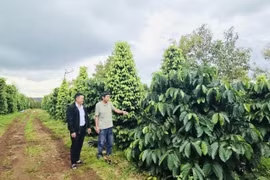
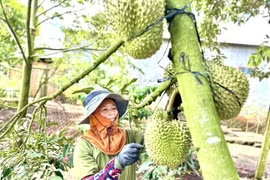
Gia Lai currently has more than 9,200 hectares of durian plantations with annual output nearing 58,000 tonnes. The province has secured 67 export planting area codes covering more than 1,539 hectares, along with six export packing facility codes capable of processing around 420 tonnes of fresh fruit per day.
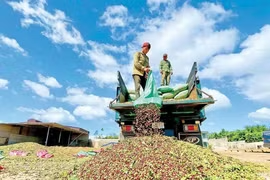
Most products are consumed domestically or exported to China as fresh fruit and frozen durian segments.
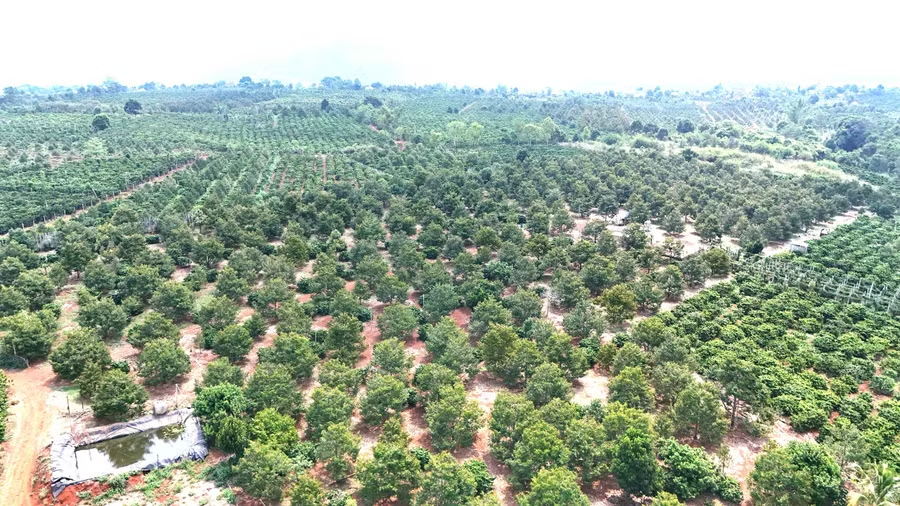
Over the past four years, durian cultivation has expanded rapidly across the province, driven by both crop conversion among farmers and investments from large companies adopting modern production management systems.
The growth has helped establish an emerging value chain, with businesses and cooperatives investing in cold storage, preliminary processing and packaging facilities near production areas to reduce reliance on traders and limit price volatility during peak harvest periods.
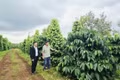
One of the largest investors is Thagrico Cao Nguyen Fruit Company Limited in Pleiku Ward, which manages nearly 1,000 hectares of GlobalGAP-certified durian plantations in Ia Tôr and Ia Púch communes.
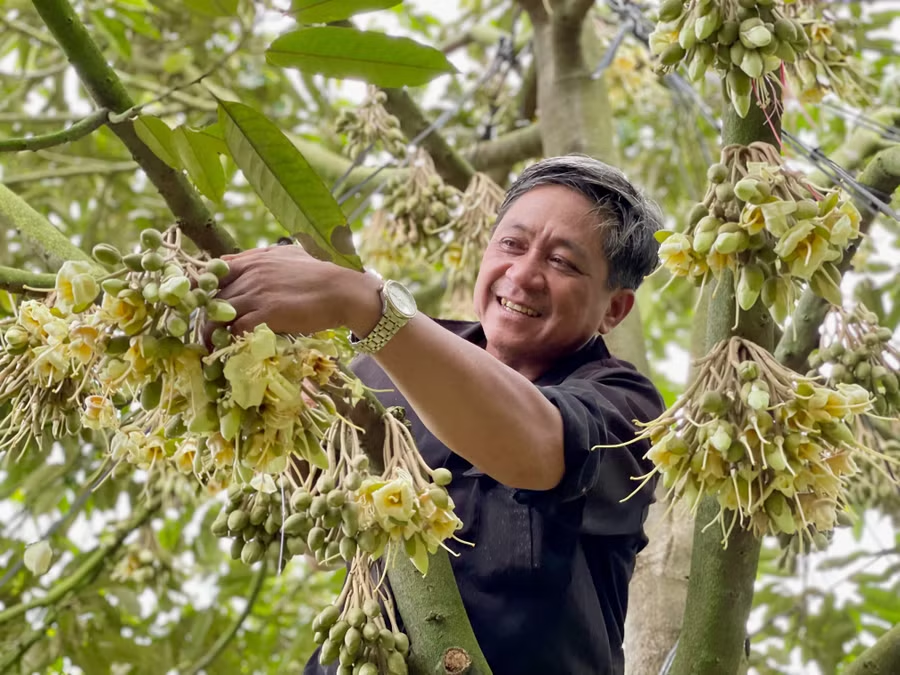
The company harvested around 1,000 tonnes from its first 100 hectares of commercial production last season. Output is projected to rise to approximately 3,000 tonnes this year, between 5,000 and 6,000 tonnes by 2027, and about 10,000 tonnes by 2030.
Around 70% of production is expected to be exported, while the remainder will be sold domestically.
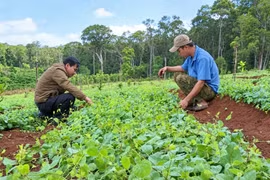
Durian cultivation has also transformed household incomes in some rural communities.
In Kon Gang commune, many farmers have shifted to durian production, with around 70% of households in Ktu village earning between 300 million and 500 million VND annually (about $11,500-$19,200). Some households report annual incomes ranging from 1 billion to 4 billion VND (about $38,400-$153,600).
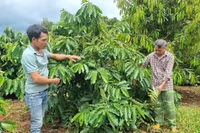
Mr. Plói, a farmer in Ktu village, said his family earns around 1 billion VND per year (about $38,400) from more than one hectare of intercropped durian.
“I learned production processes from experienced growers and researched organic techniques online, gradually reducing chemical fertilizers. With selling prices at 50,000-60,000 VND per kilogram (about $1.90-$2.30), profits far exceed those from other crops,” he said.
Alongside expanding cultivation areas, local authorities are planning specialised durian zones, developing planting area and packing facility codes, and encouraging farmers to join cooperatives and production groups to standardise farming techniques.
Currently, around 4,190 hectares of durian are produced and marketed through partnerships involving 14 enterprises, 20 cooperatives, farmer associations and farms.
Despite the rapid expansion, industry representatives warn that fragmented production and uneven technical capacity remain major challenges.
Mr. Vũ Cao Luyện, head of the Phú Vinh Hamlet Farmers’ Association in Ia Tôr commune, said differences in cultivation skills have led to inconsistent productivity among growers.
He said reorganising production through cooperatives and standardised farming processes had become increasingly urgent.
Authorities view the “Gia Lai Durian” certification trademark as both a legal instrument and a long-term market strategy.
Under a geographical zoning plan approved by the provincial government, concentrated durian-growing areas are mainly located in western Gia Lai, where natural conditions are considered suitable for large-scale cultivation.
Industry participants say the effectiveness of the certification brand will depend on maintaining product quality, traceability and long-term reputation rather than simply obtaining legal recognition.
Weak linkages between producers and distributors continue to reduce the sector’s added value, with many farmers still relying on spot sales to traders or exporters without long-term purchasing contracts.
Mr. Trần Công Tự, a farmer in Tân Bình Hamlet of Đak Đoa commune, said some growers remained vulnerable to unstable purchasing arrangements.
“Last durian season, a company provided labels and promised to buy at high prices but made no concrete commitments. When the peak season arrived, they didn’t return to purchase, leaving farmers in a passive position,” he said.
Mr. Nguyễn Văn Lập, chairman of Minh Phát Farms Cooperative in Chư Prông commune, said the certification trademark could help establish Gia Lai’s agricultural identity and encourage producers to comply with higher standards.
He noted that durian products in other regions had gained significant market value after building recognised brands, while Gia Lai durian remained relatively undervalued despite comparable quality.
“Through partnerships with export enterprises, I’ve found that although Gia Lai started developing durian later than other regions, this is actually an advantage for selecting new varieties and applying scientific and technical advances to boost yield and product quality,” he said.
According to Đoàn Ngọc Có, deputy director of the Department of Agriculture and Environment, durian has become one of Vietnam’s major export commodities, particularly following the launch of official exports to China.
However, he said the sector also faces growing pressure from technical trade barriers in importing markets, including stricter requirements on traceability, phytosanitary controls, pesticide residue limits and post-harvest standards.
The provincial agriculture sector is now promoting awareness campaigns and technical guidance for farmers, cooperatives and enterprises on production standards, planting area codes and supply chain coordination as Gia Lai seeks to expand into new export markets.