Gia Lai has become a major destination for large-scale livestock investment projects in recent years, particularly in the western part of the province.
While the expansion has accelerated agricultural restructuring and economic growth, it has also increased pressure on environmental management and sustainable development.
Reporters from Gia Lai Newspaper and Radio & Television spoke with Mr. Cao Thanh Thuong, Director of the Department of Agriculture and Environment, about the province’s strategy for balancing livestock development with environmental protection.
*How has the livestock sector contributed to Gia Lai’s agricultural economy?
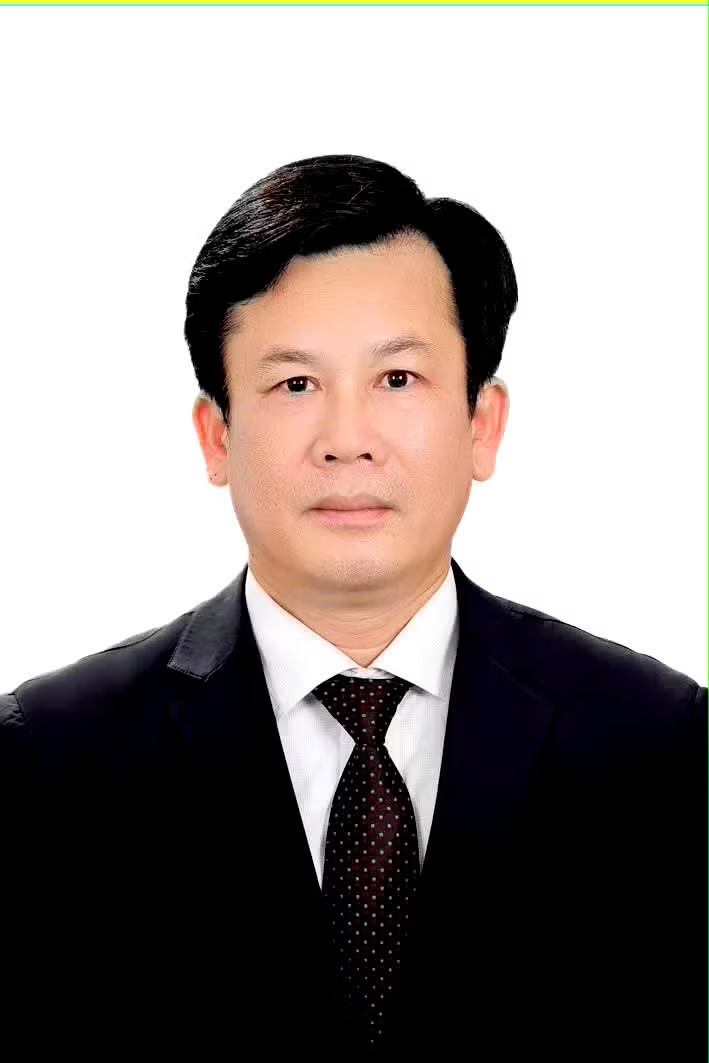
Director of the Department of Agriculture and Environment Cao Thanh Thuong. Photo: T.L
- In recent years, livestock farming has made a significant contribution to the growth of the province’s agriculture, forestry and fisheries sectors.
Following the implementation of the Livestock Development Strategy for 2021-2030, with a vision to 2045, the province introduced an action plan that has delivered many positive results.
Between 2020 and 2025, the livestock sector maintained stable growth of more than 5.5% annually. Gia Lai currently leads the country in cattle numbers and ranks second nationwide in pig herds.
In 2025, the agriculture, forestry and fisheries sector is projected to generate VND 78,071 billion (approximately USD 3 billion), accounting for 28.8% of the province’s GRDP. Livestock alone is expected to contribute VND 21,157 billion (approximately USD 814 million), representing 27.1% of the sector’s structure, with growth of 6.2% and contributing 7.8% to GRDP.
In the first quarter of 2026, the sector continued its positive growth momentum.
* Gia Lai has attracted 306 livestock projects covering more than 13,272 hectares. Does this reflect the province’s full potential?
- Gia Lai has a natural area of more than 21,576 square kilometres, making it the second-largest province in the country. The province has many advantages for livestock development, including extensive land resources, more than 1.9 million hectares of agricultural land, favourable climate conditions, a large labour force and considerable growth potential.
Alongside these natural advantages, the province has focused strongly on attracting investment and supporting businesses in completing procedures and implementing projects quickly.
Gia Lai follows the “5 together” principle with businesses: listening together, discussing together, implementing together, sharing results together and jointly resolving difficulties.
The province has also implemented support policies for small and medium-sized enterprises, provided vaccine assistance, built centralised slaughterhouses and promoted high-tech applications to establish disease-safe livestock zones.
* What measures has the Department implemented to ensure livestock projects comply with environmental regulations?
- The Department has introduced several measures, including advising the Provincial People’s Committee to integrate environmental requirements from the investment approval stage, guiding investors through environmental procedures, inspecting environmental protection infrastructure before granting livestock operation certificates, and strengthening supervision and enforcement against violations.
Most pig farming projects are currently concentrated in the western part of the province because of favourable land and natural conditions.
Under current regulations, livestock density by 2030 is capped at 1.5 livestock units per hectare. The current density stands at around 0.55 units per hectare and is expected to reach approximately 1.2 units per hectare by 2030, remaining within the permitted threshold.
To ease pressure on infrastructure and the environment, the province prioritises the use of low-value and poor-quality land, focuses development in seven key livestock zones and ensures a minimum distance of 1.5 kilometres from residential areas, schools, hospitals and other sensitive sites.
Gia Lai also prioritises large-scale projects that apply high technology and circular, environmentally friendly livestock models, while gradually reducing small-scale farming operations.
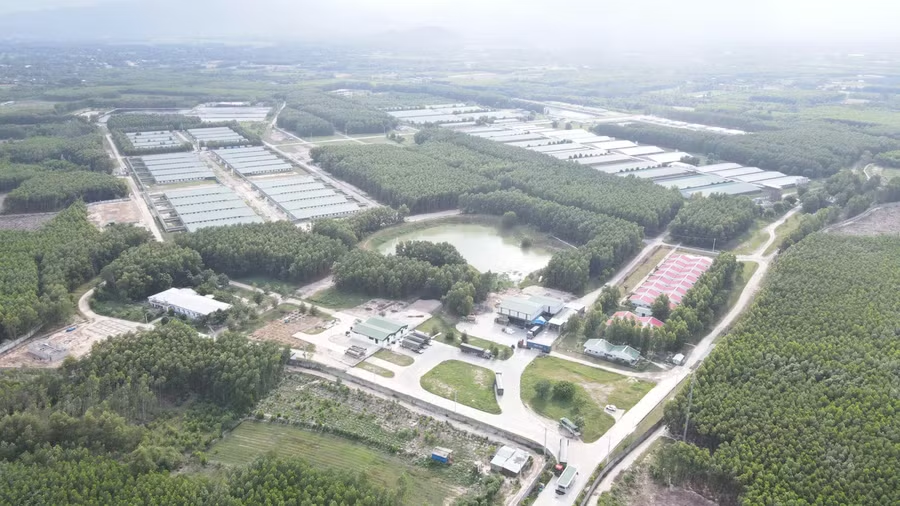
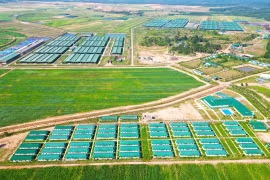
High-tech, integrated circular pig breeding and meat production farm in Hoi Son commune, operated by THACO AGRI. Photo: Provided by the unit
* How is the province planning future livestock development?
- The Provincial People’s Committee has issued a Livestock Development Plan to 2030, with a vision to 2045, identifying seven key livestock zones aimed at creating safe and traceable raw material areas for consumption, processing and export.
The province is orienting livestock development towards efficiency, sustainability, circularity and climate adaptation. It plans to leverage its advantages in land and climate to develop key livestock species and local specialties linked to value chains, biosecurity and environmental protection.
By 2030, the province aims for the livestock sector to achieve annual growth of 6% to 6.5%, with production value reaching approximately VND 32,400 billion (around USD 1.25 billion). The sector is expected to contribute 7.5% to 8% of GRDP and create stable jobs for more than 20,000 workers.
Gia Lai is also targeting a herd of more than 860,000 cattle, about 5 million pigs and over 22 million poultry, while increasing the share of industrial and high-tech livestock farming.
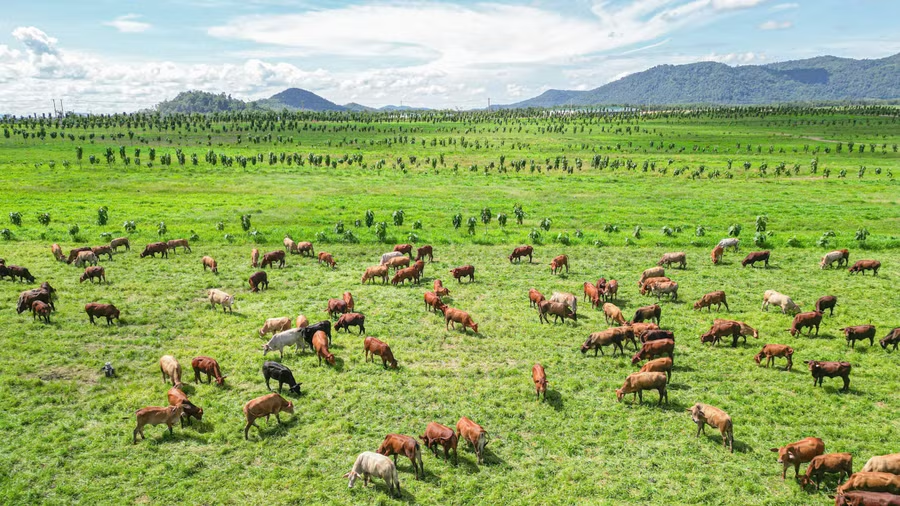
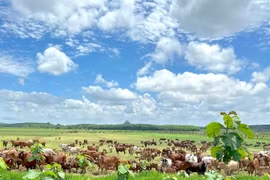
Cattle grazing on forestry plantation fields in Ia Puch commune. Photo: Provided by the unit
* What direction will Gia Lai take to attract sustainable livestock investment in the future?
- The province will prioritise large-scale livestock projects that are sustainable, circular and technology-driven. Authorities will focus on selecting capable investors and requiring environmentally friendly farming processes.
At the same time, Gia Lai will continue developing key livestock sectors, including cattle, pigs and poultry, through concentrated large-scale farming models.
The Department has proposed that the Provincial People’s Committee stop approving pig farming projects with fewer than 36,000 pigs per production cycle.
In the coming years, the province plans to expand high-tech and organic livestock farming aimed at commodity production, while promoting digital technologies in management, disease monitoring, food safety and environmental protection.
Gia Lai will also strengthen inspections of existing livestock facilities and take action against projects that are delayed, use land inefficiently or fail to meet environmental standards.
Vietnam’s Gia Lai province is seeking to deepen ties with Australian investors in renewable energy, transport infrastructure, seaports and logistics as it looks to capitalize on its expanded development space and strategic location.
Gia Lai province recorded 2,739 newly established enterprises in the first nine months of 2026, up about 19.13% from the same period last year, with total registered capital reaching VND 40,154 billion (about US$1.52 billion), an increase of approximately 135%.
Gia Lai is exploring cooperation opportunities with French partners in education, sports, renewable energy and high-tech agriculture following a meeting between Professor Co Minh Duc and the Gia Lai Provincial Business Association on September 28.
Gia Lai coffee brands are gaining a foothold in the United States as producers shift from exporting raw beans to processed, branded products aimed at a demanding consumer market.
Gia Lai Urban Works Joint Stock Company on September 22 broke ground on a construction waste treatment and recycling plant with an investment of more than VND 57.5 billion (about US$2.18 million), designed to process 480 tonnes of waste a day.
(GLO) – Green transformation, digitalization, enhanced connectivity, and the development of logistics chains are emerging as key requirements for Vietnam’s seaport industry. These topics are the focus of discussion at the 2026 Annual VPA Conference held in Gia Lai.
Gia Lai is stepping up efforts to attract foreign direct investment by improving infrastructure, streamlining administrative procedures and providing direct support to investors, while facilitating projects that have already received investment approval.
Import-export turnover through Le Thanh International Border Gate reached $264.362 million as of September 18, up 69% from the same period last year, according to the Provincial Economic Zone Management Board.
The People’s Committee of Gia Lai Province has approved the investment policy for a sustainable agricultural development project by Thaco Agri, with total investment capital of nearly VND 3.82 trillion ($145 million), in Po To Commune.
Gia Lai is seeking to establish a direct agricultural export route to China through the Ta Lung International Border Gate in Cao Bang province, as local authorities and businesses look to reduce logistics costs, strengthen processing capacity and increase the value of key agricultural products.
Gia Lai aims to expand medicinal plant cultivation from nearly 1,500 hectares currently to more than 7,486 hectares by 2030, with a focus on growing herbs under forest canopies while conserving natural resources and supporting local livelihoods.
Gia Lai Province is seeking to expand investment, trade and tourism cooperation with Portuguese businesses, as it stepped up economic engagement with the city of Guarda following the signing of a cooperation agreement between the two local authorities.
Localities across Gia Lai province are turning to livestreaming to promote specialty and OCOP products, helping producers reach wider markets while building skills in online marketing, sales and customer engagement.
Gia Lai province is seeking to expand investment and trade cooperation with Taiwanese businesses, with a focus on manufacturing, technology, agriculture, renewable energy, logistics and tourism.
Gia Lai is stepping up efforts to expand markets for agricultural products and build stable production-processing-consumption chains, as authorities seek to reduce reliance on seasonal sales across nearly 977,000 hectares of agricultural land.
Gia Lai Province and France’s Normandy region have agreed to explore stronger cooperation in investment, trade, tourism, renewable energy, education, science and technology during a working visit by a Gia Lai delegation.
Gia Lai is simultaneously revising its provincial master plan and the master plans for four major urban centers as it seeks to create a more interconnected development network spanning coastal, highland and border areas.
Gia Lai is stepping up investment in transport and logistics infrastructure to position itself as a key logistics hub for Vietnam’s Central Highlands, linking major agricultural production zones with border gates, seaports and international markets.
Vietnam’s Phu Tai Joint Stock Company plans to invest $950,000 to establish a subsidiary in Texas, United States, to expand its trading and distribution of stone and wooden furniture products.
(GLO) – Following the merger, Gia Lai is better positioned to reorganize its economic landscape, linking raw material production with processing, logistics, commerce, and market access.
Vietnam’s Gia Lai province is expanding high-tech farming, certified production and processing to raise the value of key agricultural products and meet stricter domestic and export market requirements.
Gia Lai aims to generate more than $17 billion in export turnover between 2026 and 2030, as the province seeks to help businesses and cooperatives expand internationally, strengthen brands and secure positions in global supply chains.
Young people returning to Gia Lai are finding new ways to increase the value of local agricultural products, combining technology, processing skills, market experience and storytelling to bring products closer to consumers.
A Facebook-based digital marketplace launched in Đak Pơ is helping local farmers and small traders reach customers beyond the commune, with young people providing hands-on support to promote agricultural products and local specialties online.