The expansion follows the implementation of 35 rice cultivation models using alternate wetting and drying (AWD) irrigation techniques. The province's total low-emission rice area has grown well beyond the original target of 500-600 hectares outlined in Provincial People's Committee Plan No. 158/KH-UBND.
Issued on April 24, 2026, the plan sets a long-term vision through 2035 to develop low-emission agricultural production linked to centralized raw material zones for five key crops, rice, sugarcane, coffee, cassava and banana, across 41 communes and wards.
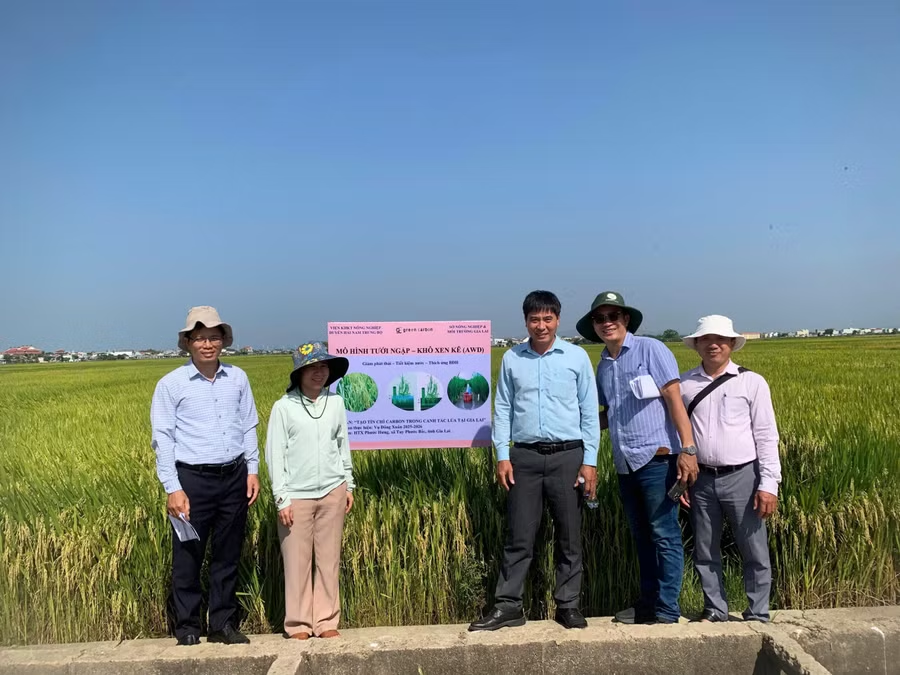
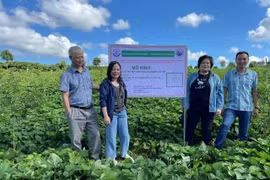
Beginning with the 2025-2026 Winter-Spring crop, the Department of Agriculture and Environment, working with local authorities, cooperatives and businesses, established 17 low-emission rice cultivation models covering 688.1 hectares in Bình Khê, Tuy Phước Bắc, Tuy Phước Đông, An Nhơn Nam, An Nhơn, Bình An and Phù Mỹ Tây.
The programme expanded further during the 2026 Summer-Autumn and Main crop seasons with an additional 18 models covering 1,010.8 hectares, bringing the province's total low-emission rice cultivation area to nearly 1,700 hectares.
As of June 3, 42 of the province's 132 communes and wards had issued low-emission crop production plans for the 2026-2035 period, with a vision extending to 2050.
Trần Xuân Khải, Head of the Sub-Department of Crop Production and Plant Protection under the Department of Agriculture and Environment, said effective implementation of AWD irrigation with monitored and quantified emission reductions requires close coordination among government agencies, technical units, cooperatives and farmers.
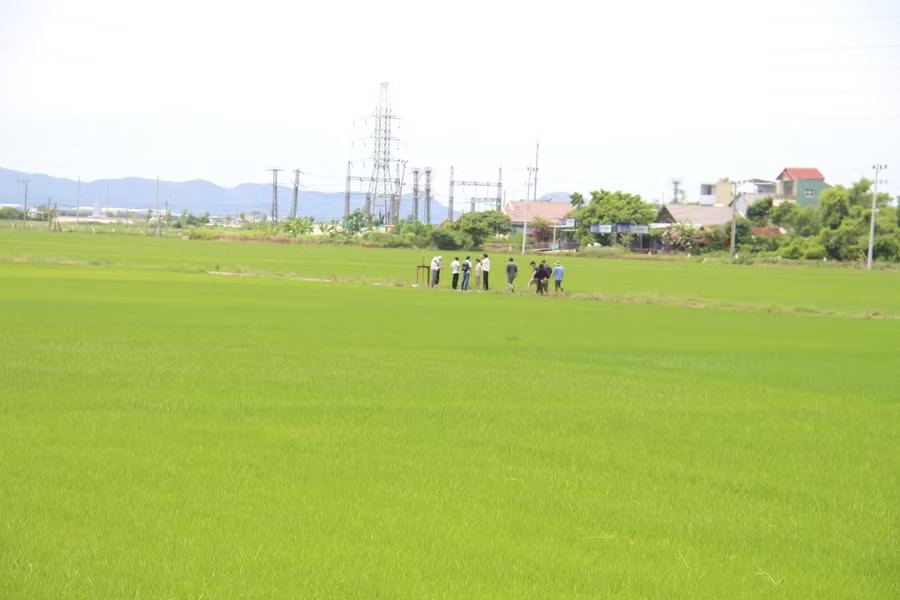
He said the results from the latest Winter-Spring crop demonstrate the province's capacity to establish large-scale low-emission rice production zones that combine economic returns with environmental sustainability.
Khải said the sub-department will continue expanding technical training, promoting low-emission cultivation practices, encouraging the use of organic fertilizers and water-saving irrigation, improving awareness among local officials, cooperatives and farmers, and strengthening inspection, evaluation and reporting systems.
Phạm Vũ Bảo, Deputy Director of the South Central Coastal Science and Technology Institute, which is directly involved in the project, said monitoring results confirmed that AWD irrigation applied across 688.1 hectares in seven eastern communes and wards is well suited to local rice-growing conditions, particularly where irrigation infrastructure and centralized water regulation are well developed.
According to the institute's findings, the AWD model reduced irrigation water use by an average of 2,314 cubic metres per hectare each crop, equivalent to a 22.7% reduction compared with conventional cultivation methods. Farmers also reduced irrigation frequency by an average of four applications per crop.
Despite lower water use, rice yields remained stable and averaged 0.6 quintals per hectare higher than control fields, supporting AWD as an effective water management method that conserves resources while maintaining production efficiency.
The project also demonstrated substantial greenhouse gas emission reductions compared with continuous flooding cultivation. Emission measurements showed significant declines both per hectare and per unit of production.
Officials said these results provide a scientific foundation for establishing a Measurement, Reporting and Verification (MRV) system to quantify emission reductions and support the gradual development of carbon credits in Gia Lai's rice sector.
In An Nhơn Nam ward, Deputy Head of the Economic, Infrastructure and Urban Affairs Office Bạch Nhơn Tân said 104.3 hectares of low-emission rice cultivated with AWD during the 2025-2026 Winter-Spring season achieved yields of 8.07 tonnes per hectare, 0.64 tonnes higher than comparison fields.
The ward is continuing the programme during the Summer-Autumn crop across 85.3 hectares using high-quality rice varieties including TBR-1, TBR97, ĐV108, VNR20, BC15, Khang Dân đột biến, ĐB6, Đài Thơm 8 and Hương Thơm 1.
Farmer Nguyễn Ngọc Tân, who participated in the project in An Nhơn Nam ward, said rice grown under AWD management experienced fewer pest and disease problems, lowered irrigation costs and maintained, or in some cases exceeded, the yields achieved through traditional farming methods. He has registered to continue using the technique during the current Summer-Autumn season.
Nguyễn Thị Tố Trân, Deputy Director of the Department of Agriculture and Environment, said Gia Lai aims to establish at least 8,000 hectares of low-emission rice production by 2035 through value chain development and greater business participation, enabling the province to meet the requirements for domestic and international carbon credit markets.
She said achieving that target will require continued support from government agencies, businesses and carbon development organisations to build emission databases, complete MRV procedures and strengthen the role of cooperatives in production management, water regulation and data collection needed for carbon credit verification.