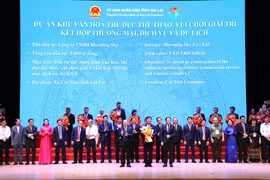
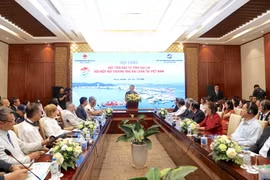
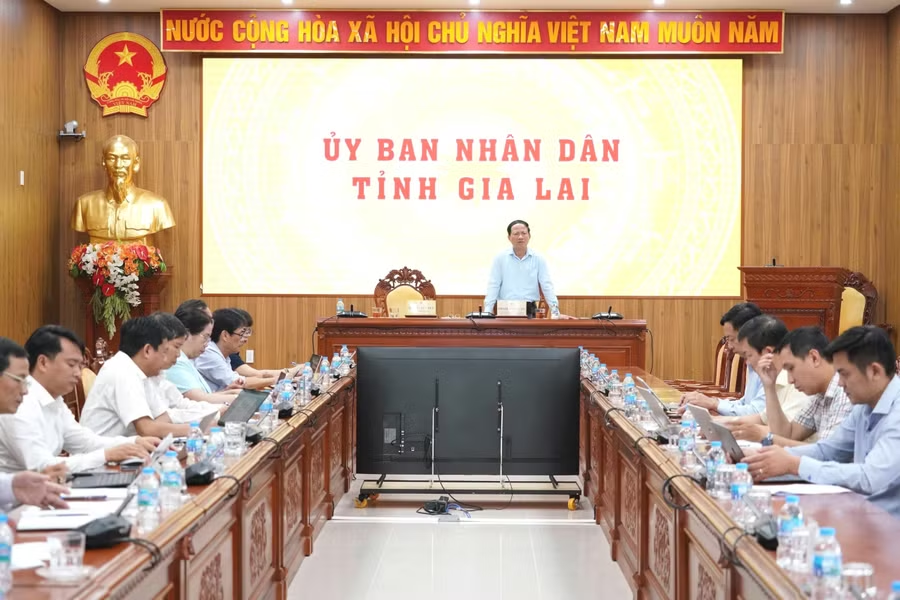
The meeting, held on July 7, was chaired by Phạm Anh Tuấn, Member of the Party Central Committee, Deputy Secretary of the Provincial Party Committee, Chairman of the Provincial People's Committee and Head of the Steering Committee. Vice Chairman of the Provincial People's Committee Nguyễn Hữu Quế and other committee members also attended.
Officials reviewed the implementation of Politburo Resolution No. 68-NQ/TW on private sector development over the past six months while setting priorities for the remainder of 2026.
According to the report presented at the meeting, Gia Lai completed all six key tasks outlined in the resolution during the first half of the year. Provincial authorities also continued institutional reforms aimed at strengthening property rights, ownership protection, business freedom, fair competition and contract enforcement for private enterprises.
The province expanded support measures to improve private businesses' access to land, legal capital and skilled workers, while introducing practical assistance for small businesses, micro-enterprises and household businesses.
By the end of June 2026, Gia Lai had issued business registration certificates to 2,075 newly established enterprises, an increase of about 38% from the same period a year earlier. Total registered capital reached VND29,504 billion (approximately US$1.13 billion), up about 153% year-on-year. During the same period, 65 household businesses were converted into enterprises.
Investment attraction also strengthened significantly. The province approved 168 investment projects, achieving 98.82% of the annual target set by the Provincial People's Committee. Total registered investment capital reached VND164,912 billion (approximately US$6.34 billion), representing a 147.06% increase in the number of newly approved projects and a 221.51% rise in registered investment capital compared with the first half of 2025.
Of the newly approved projects, 166 were domestic investments with combined registered capital exceeding VND164,596 billion (approximately US$6.33 billion), while two foreign direct investment projects accounted for nearly VND316 billion (approximately US$12.1 million).
The province also stepped up investment promotion for technology-focused projects, including the FPT Software Research, Production and Technology Expert Training Center Complex, valued at more than VND2,759 billion (approximately US$106 million); the Artificial Intelligence Center and Supporting Urban Area, with investment exceeding VND4,362 billion (approximately US$168 million); and the TMA Innovation Park, valued at more than VND220 billion (approximately US$8.5 million).
Credit support for businesses continued to expand. As of June 30, 2026, total outstanding loans in Gia Lai reached VND262,600 billion (approximately US$10.1 billion), up 2.8% from the end of 2025. Loans to the private sector totaled VND253,000 billion (approximately US$9.7 billion), accounting for 96.3% of all outstanding credit and increasing 1.9% over the same period.
In his closing remarks, Chairman Phạm Anh Tuấn praised the efforts of provincial departments and agencies while calling for further simplification of administrative procedures to reduce costs and save time for businesses.
He also urged enterprises to strengthen compliance with Environmental, Social and Governance (ESG) standards and emphasized prioritizing investment in clean technologies, low-emission industries and projects capable of joining green supply chains. The province will continue implementing comprehensive support policies for small and medium-sized enterprises.
The chairman also called for new mechanisms to reduce regulatory compliance costs and provide accounting and administrative support to encourage more household businesses to become formally registered enterprises. He emphasized developing a group of leading businesses capable of expanding into global markets while reviewing production costs to improve competitiveness and attract additional investment.
The meeting also proposed revising provincial policies to make them more transparent and open, with particular emphasis on breakthrough measures supporting innovative businesses and digital transformation.
The State Bank of Vietnam's Region 11 Branch was assigned to direct credit institutions to further simplify lending procedures, improve businesses' access to financing and prioritize credit for production, business expansion and green economic sectors.