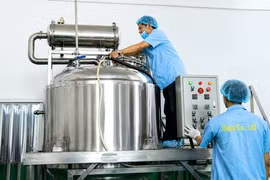
Inside a sprawling 60,000-square-metre complex of laboratories and greenhouses, millions of acacia and eucalyptus seedlings grow under fluorescent lights in sterile glass jars.
Inside a sprawling 60,000-square-metre complex of laboratories and greenhouses, millions of acacia and eucalyptus seedlings grow under fluorescent lights in sterile glass jars.
At the centre of it all is Thái Xuân Biên, director of Thái Xuân Biên Forestry Biotechnology Joint Stock Company, whose journey into biotechnology began with the sale of his family’s only piece of farmland.
Using an initial investment of 300 million VND (about $11,500), the 40-year-old entrepreneur from Cửu An Commune entered a field in which he had no formal experience. Six years later, his company produces around 19 million seedlings annually.
Biên says his path into forestry biotechnology was shaped by years spent working in timber and sugar factories, where he saw the challenges faced by forest growers relying on inconsistent and disease-prone seedlings.
Thái Xuân Biên, Director of Thái Xuân Biên Forestry Biotechnology Joint Stock Company. Photo: T.Lợi
* In 2019, when you decided to sell your land to start a business, many must have called it a gamble. What gave you enough confidence to stake your family’s entire assets on a field you’d never worked in before?
- I spent years working in timber and sugar factories. The more I traveled, the more I saw how hard life was for forest growers, low efficiency due to inconsistent, disease-prone seedlings.
When I returned home to open a small nursery, I realized that producing quality seedlings made it easier to sell, and it eased the burden for farmers.
My initial capital of 300 million VND (about $11,500) came from selling my family’s only plot of farmland. If you don’t dare to change, you’ll be stuck in poverty forever. I accepted that risk.
* The leap from a small nursery to tissue culture technology is a big one. How did you approach this technology?
- I reached out to the Institute of Forest Tree Breeding and Biotechnology under the Vietnam Academy of Forest Sciences. We collaborated through the project “Development of Forest Tree Varieties for Economic Plantation”.
From there, I gradually mastered the process of propagating acacia and eucalyptus through plant cell tissue culture. I believe this is the future of Vietnam’s forestry sector, as the government has identified this technology as one of ten strategic technology groups.
* What was the most difficult moment in your entrepreneurial journey?
- It wasn’t a lack of money; it was the fear of letting down those who believed in me.
Back then, Võ Thành Triền followed me from the days of the small nursery, enduring all kinds of hardships. There was also Huỳnh Thị Xuân Thương, the first tissue culture technician I trained myself, learning and working without fear of difficulty.
They believed in me when I had nothing to show. That pressure was greater than any number.
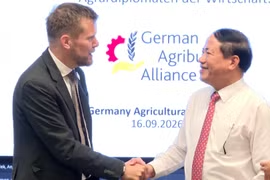
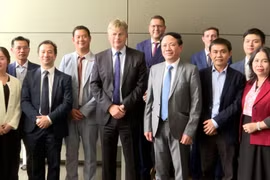
Thái Xuân Biên (right) participating in cooperation programs with international partners. Photo: Provided by subject
* And then, what changed?
- The first tissue-cultured seedlings succeeded. When I saw those tiny plants move from glass jars to the greenhouse and grow strong, I was truly moved.
For many, it was just a seedling. For me, it was proof that farmers can do high-tech if they are determined enough. From then on, I never doubted my path again.
Biên says the company’s tissue-cultured seedlings now achieve survival rates above 95% and yields between 15% and 30% higher than traditional varieties.
In 2025, the Intellectual Property Office granted the trademarks “Tissue-cultured Acacia” and “Tissue-cultured Eucalyptus” under the Thái Xuân Biên name, reinforcing the company’s growing reputation in the forestry sector.
* From revenue of 4.2 billion VND (about $161,000) in 2023 to 22 billion VND (about $844,000) in 2025, what is your secret to growth?
- Trust.
When Japanese partners and Quy Nhơn Afforestation Co., Ltd. choose our seedlings, it’s not just a contract, it’s validation of quality. Forestry customers won’t stick with low-quality products.
When they see their forests thriving, they come back and refer others. Our seedlings are now present in Khánh Hòa, Nghệ An, Quảng Bình, Quảng Ninh, Đắk Lắk, Đồng Nai and Cà Mau.
Many nurseries use our seedlings as foundation stock for further propagation, that’s what truly creates a ripple effect.
* Can you tell us about a special customer who believed in your seedlings from the very beginning?
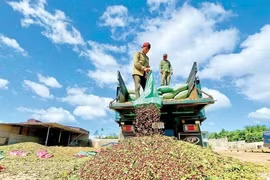
Tissue-cultured acacia nursery. Photo: Provided by subject
- The person I’m most grateful to is Phan Chí Thành, owner of a nursery in Khánh Hòa.
At that time, our products were virtually unknown in the market. But Mr. Thành dared to buy in large quantities, even paying in advance so the company could maintain production. He also proactively introduced us to many other customers.
For a startup, that trust is worth far more than the value of any order. On this journey, meeting someone who believes in you during tough times is a rare blessing.
The company has also introduced digital management systems to monitor production batches, including variety source codes, sampling dates, contamination rates, rooting rates and nursery survival rates.
* Your company has also implemented digital transformation in production management…
- We’ve built a data system to track every production batch, including source code of the variety, date of sampling, culture medium formula, contamination rate, rooting rate and survival rate after moving to the nursery.
Customer information, shipping dates and field feedback are all digitized and integrated into a central system. Inventory of materials, chemicals, electricity and irrigation water are also tightly monitored through data.
Soon, we’ll install surveillance cameras, electronic logs and automated reporting so management can monitor all operational indicators from anywhere.
For us, digital transformation isn’t just about looking modern, it’s about ensuring no mistakes slip through in the seedling production process.
Biên says he regularly visits customers’ forests to gather field data and evaluate the performance of his seedlings under real conditions.
* The “Thái Xuân Biên High-Tech Agriculture Project” you’re seeking investment approval for, how does it differ from what you already have?
- Our current facility has achieved a lot, but it’s still limited in infrastructure and capacity.
Once approved and fully operational, expected in 2029, the project will standardize all laboratory infrastructure, expand production capacity and become a centre for research and technology transfer of forestry seedlings for the Central Highlands and South Central Coast.
The goal is stable annual revenue of about 150 billion VND (around $5.75 million) and jobs for more than 500 local workers.
Japanese and Chinese partners have already engaged and highly rated our technology, not because we’re cheap, but because we deliver results.
* More broadly, in your view, what does high-tech agriculture in Vietnam still lack to develop more strongly?
- We don’t lack potential or people willing to act; what’s missing most is synchronized linkage between science and technology, investment capital and sustainable market access.
Many farmers want to apply technology, but initial costs are high, and access to capital and technical transfer remains difficult. Quite a few models have had to stop due to unstable markets.
For high-tech agriculture to truly break through, there needs to be stronger connections between the State, businesses, scientists and farmers.
More importantly, Vietnam must invest in mastering core technologies instead of relying on imports. Only when we master technology can Vietnamese agriculture compete internationally.
* Nominated by Cửu An Commune as an “Outstanding Vietnamese Farmer,” what message do you want to send to rural youth standing at a crossroads?
- I’ve learned that your starting point doesn’t determine your future.
I began with 300 million VND (about $11,500) from my family’s only plot of land, no university degree, no research experience, but if you know what problem you’re solving and for whom, and you work with true integrity, technology becomes a tool, not a barrier.
Today’s agriculture is no longer about “selling your face to the earth, your back to the sky.” The land is the same, but the way we work with it has completely changed.
Thái Xuân Biên has been awarded a Certificate of Merit by the Chairman of the Provincial People’s Committee for outstanding achievements in the “Excellent Farmer in Production and Business” movement (2017–2022); recognized as a “National Excellent Farmer Household” (2017–2021).
In 2025, his company entered the Top 20 Vietnam Gold Brands, received exclusive trademarks for “Tissue-cultured Acacia” and “Tissue-cultured Eucalyptus,” and achieved ISO 9001:2015 certification for its 60,000 m² production system. He has also received certificates of merit from the Provincial Farmers’ Association (2024, 2025) and the Vietnam Fatherland Front Committee of the province (2025), among others.
Gia Lai province is seeking to expand investment and trade cooperation with Taiwanese businesses, with a focus on manufacturing, technology, agriculture, renewable energy, logistics and tourism.
Gia Lai is stepping up efforts to expand markets for agricultural products and build stable production-processing-consumption chains, as authorities seek to reduce reliance on seasonal sales across nearly 977,000 hectares of agricultural land.
Gia Lai Province and France’s Normandy region have agreed to explore stronger cooperation in investment, trade, tourism, renewable energy, education, science and technology during a working visit by a Gia Lai delegation.
Gia Lai is simultaneously revising its provincial master plan and the master plans for four major urban centers as it seeks to create a more interconnected development network spanning coastal, highland and border areas.
Gia Lai is stepping up investment in transport and logistics infrastructure to position itself as a key logistics hub for Vietnam’s Central Highlands, linking major agricultural production zones with border gates, seaports and international markets.
Gia Lai is seeking to increase the value of its agricultural sector by expanding deep processing, strengthening production linkages and building closed value chains, as the province looks to retain more value within its major raw material areas.
Gia Lai is accelerating investment in irrigation infrastructure to secure water supplies amid increasingly complex climate change, while improving agricultural productivity and developing concentrated raw material production zones.
The Gia Lai Provincial People’s Committee has approved the investment policy for the Sê San 4 Hydropower Plant Expansion Project, with Vietnam Electricity (EVN) selected as the investor for the 120MW project.
Vietnam’s Phu Tai Joint Stock Company plans to invest $950,000 to establish a subsidiary in Texas, United States, to expand its trading and distribution of stone and wooden furniture products.
Young people returning to Gia Lai are finding new ways to increase the value of local agricultural products, combining technology, processing skills, market experience and storytelling to bring products closer to consumers.
A Facebook-based digital marketplace launched in Đak Pơ is helping local farmers and small traders reach customers beyond the commune, with young people providing hands-on support to promote agricultural products and local specialties online.
Banks in Gia Lai are rolling out large-scale credit packages and cutting lending rates by up to 2 percentage points a year as they seek to improve access to capital for businesses and households.
Gia Lai is stepping up enforcement against illegal, unreported and unregulated (IUU) fishing, tightening vessel controls, electronic monitoring and seafood traceability as authorities seek to have the “yellow card” warning lifted in 2026, towards a more transparent and sustainable fisheries sector.
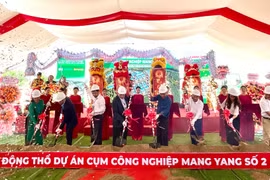
Hoang Anh Gia Lai Joint Stock Company broke ground on the VND 400 billion (about $15.3 million) Mang Yang No. 2 Industrial Cluster in Hra commune on August 12, a 74.5-hectare project expected to create stable jobs for more than 4,500 workers.
Gia Lai is planning a major expansion and upgrade of irrigation infrastructure in its western region, where only 8.94% of agricultural land currently has access to proactive irrigation and the annual water shortfall exceeds 1.234 billion cubic metres.
Gia Lai province is stepping up efforts to accelerate public investment disbursement after spending more than VND 9.322 trillion by the end of July 2026, as authorities seek to address delays affecting major projects and hold agencies accountable for meeting spending targets.
Industrial promotion programs are accelerating technology upgrades among rural businesses, cooperatives and production facilities, helping them improve product quality, strengthen brands and increase the value of locally made goods.
Gia Lai has sharply reduced administrative processing times for businesses, cutting company registration to a matter of hours and halving the time required for land allocation and leasing, as authorities seek to lower costs, accelerate investment projects and strengthen private sector growth.
After leaving his position as director of an agricultural enterprise in Ho Chi Minh City, Nguyễn Chất Sâm returned to Ia Ly commune to pursue organic farming, transforming degraded former rubber plantations into a 15-hectare durian farm that now generates about US$267,000 in annual profit.
Gia Lai is reshaping its foreign direct investment (FDI) strategy by prioritising high-tech, environmentally friendly projects with strong spillover effects over investment volume, as the province seeks to improve growth quality and strengthen its role in global supply chains.
Gia Lai authorities have ordered faster construction and site clearance across several major transport projects, setting firm deadlines for an expressway, a new airport runway and a coastal road as the province seeks to strengthen regional connectivity and support economic development.
Gia Lai is stepping up the use of artificial intelligence and digital technologies to promote destinations, preserve cultural heritage and improve visitor experiences, as authorities seek to strengthen the competitiveness of the local tourism industry.
Authorities in Gia Lai province are intensifying oversight of durian production as the region enters its peak harvest season, aiming to ensure products meet increasingly stringent export requirements on traceability, food safety and quality.
Gia Lai province's economy expanded 8.21% in the first six months of 2026 from a year earlier, with industry, construction and services driving growth despite ongoing economic challenges, provincial officials said on Tuesday.