Provincial ambitions are grounded in practical demands: stable incomes for farmers, a transparent investment climate, modern infrastructure capable of attracting large capital flows and an efficient, action-oriented public administration. Officials say global standards are increasingly seen as the benchmark for internal resilience and public trust.
Farmers seek stability as production scales up
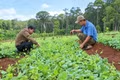
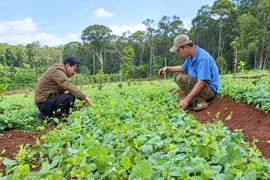
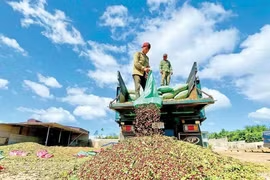
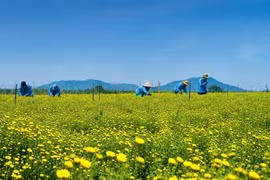
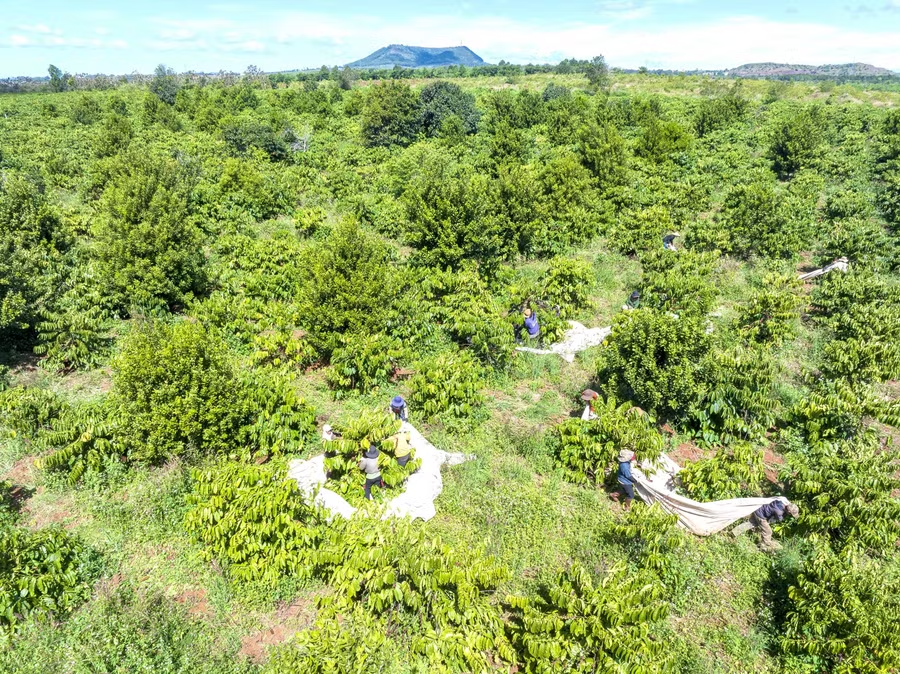
In Breng 3 village, Ia Hrung commune, nearly 300 households, half of them ethnic minorities, rely mainly on coffee, rice and livestock.
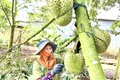
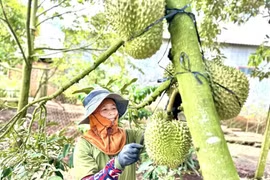
Ksor H’Yao, a local farmer, said technical training has helped boost productivity and improve living standards. His family tends around 400 coffee trees, has replanted another 400 and intercropped with durian. In 2025, after expenses, the household earned about 300 million VND (approximately $12,000).
The income reflects the gains from shifting production models, but market access and price volatility remain concerns.
“We hope the authorities will guide us on developing the family economy and ensure coffee prices remain stable so farmers can invest with confidence,” he said.
Higher production standards have raised investment costs and exposure to market risks. Without synchronized support policies and cohesive value chains, farmers risk bearing the brunt of any downturn.
Governance reforms deliver early results
In the border commune of Ia Dom, Party Secretary Tran Ngoc Phan described 2025 as a year of measurable administrative reform. After eight months under a two-tier local government model, officials have shifted toward a results-driven mindset, he said.
The rate of overdue administrative documents has dropped sharply and procedures have become more transparent. All 23 socio-economic targets were met or exceeded, while the poverty rate fell to 2.7% from 4.6%.
Budget revenue has also outperformed expectations. While the 2026 target was set at 7.5 billion VND (about $300,000), collections reached 8.5 billion VND (about $340,000) in the first month alone, or 118% of plan.
Phan said the challenge now is sustaining progress while balancing national defense and security with infrastructure development and investment attraction.
Exporters raise standards to meet global rules
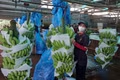
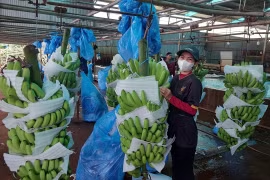
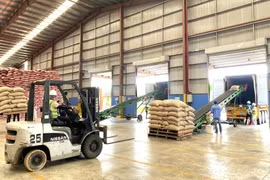
In agriculture, Thai Nhu Hiep, director of Vinh Hiep Co., Ltd., said the company has invested in traceability systems and sustainable standards to comply with the European Union’s EUDR regulation, while implementing biodiversity conservation projects in its raw material zones.
With extensive sourcing areas across the Central Highlands and links to farmers and cooperatives, he said local products can meet stringent international requirements if standards are applied systematically.
“When we do things right and systematically, Vietnamese agricultural products can confidently enter the global market,” Hiep said.
Tourism ambitions face capacity constraints
Gia Lai is set to host National Tourism Year 2026 under the theme “Gia Lai – The Great Forest Meets the Blue Sea,” with more than 244 activities planned and a target of 15 million visitors.
Hoang Phuong, director of Le Pleiku Tourism Media Co., Ltd., said the opportunity is significant but warned of bottlenecks, including a limited service workforce, insufficient accommodation for large-scale events and underdeveloped nightlife offerings.
He said infrastructure and services must keep pace with promotional efforts to ensure lasting gains.
Infrastructure and investment in focus
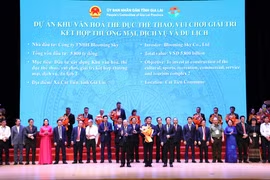
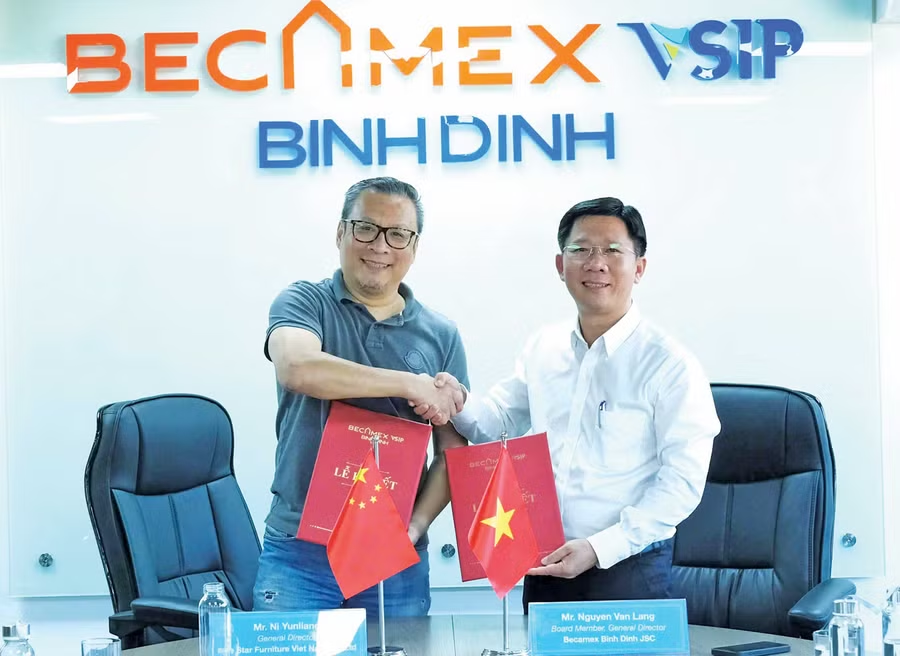
Nguyen Van Lang, general director of Becamex Binh Dinh Joint Stock Company, investor in the Becamex VSIP Binh Dinh Industrial, Urban and Service Park in Nhon Hoi Economic Zone, said Gia Lai is entering a crucial development phase.
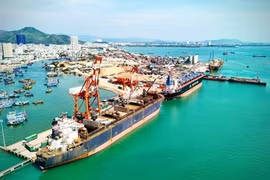
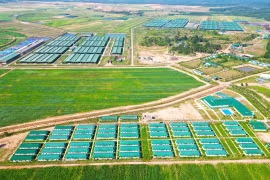
The province has identified five growth pillars: processing industry, tourism, high-tech agriculture, port and logistics services, and sustainable urban development.
Lang said opportunities would only materialize if technical and social infrastructure were developed in tandem, human resources prepared in time and policies maintained consistently over the long term.
Foreign direct investors, he added, increasingly prioritize policy predictability, administrative efficiency and inter-agency coordination over incentives alone. Gia Lai’s “one-stop, single-window” mechanism has helped cut transaction costs and administrative risks, but improvements in workforce quality, business support services and decision-making speed remain essential to attract high-quality capital.
2026 targets: growth with social and environmental balance
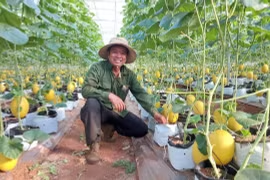
For 2026, the provincial agriculture sector aims to achieve 4% growth in gross regional domestic product for agriculture, forestry and fisheries; convert 8,150 hectares of low-yield crops; plant around 42,000 hectares of new forest; reduce the multidimensional poverty rate to 1.43%; and raise forest coverage to 45.54%.

The sector also targets clean water access for 41.5% of rural residents, waste collection rates of 92.4% in urban areas and 62.7% in rural areas, and stricter management of land, minerals and water resources under a “six clears” principle.
Cao Thanh Thuong, director of the Department of Agriculture and Environment, said 2026 marks the start of the 2026–2030 development plan, with the sector expected to remain central amid economic and climate challenges.
A shift in investment promotion
Nguyen Bay, director of the Provincial Investment Promotion Center, said attracting capital now requires more than showcasing potential. Investors conduct detailed comparisons across provinces and assess performance based on data transparency, processing speed and problem-solving capacity.
He outlined three priorities for 2026–2030: building a focused, prioritized project list aligned with planning and growth pillars; improving site clearance, infrastructure connectivity and legal documentation so projects can proceed immediately; and maintaining regular dialogue with businesses to prevent minor obstacles from escalating.
Gia Lai’s advantages, he said, include available land, reasonable costs and a stable social environment. But professionalism at every stage is essential to convert potential into tangible outcomes.
Balancing growth and identity
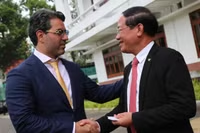
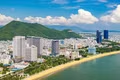
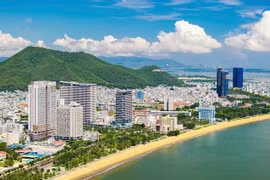
Charles Carlyle, an American visitor who has spent six months in Quy Nhon, described the area as a “precious gem,” citing its measured pace of life and the reliability of local people.
He sees long-term advantages in the province’s location between Da Nang and Nha Trang (Khanh Hoa), particularly for real estate and tourism development as international demand grows.
His observation underscores a broader theme emerging in Gia Lai’s development narrative: growth is measured not only in economic output, but also in preserved identity, institutional integrity and social trust.