Gia Lai province has revised its reforestation plan following heavy losses caused by Storm No. 13, raising the 2026 planting target and rolling out measures to improve forest quality and sustainability.
Reporters from Gia Lai Newspaper and Radio & Television interviewed Mr. Trương Thanh Hà, Acting Head of the Forest Protection Department (Department of Agriculture and Environment), on this issue.
▪ What specific solutions are being implemented to ensure the progress and quality of forest planting in 2026?
Mr. Trương Thanh Hà. Photo: N.N
- After Storm No. 13, about 25,000 hectares of planted forest in the province were severely damaged, significantly affecting forestry development plans.
Based on the targets set out in the Resolution of the First Provincial Party Congress, planting 125,000 hectares of forest during the 2026–2030 period, or an average of 25,000 hectares a year, the Forest Protection Department has advised the Department of Agriculture and Environment to develop a plan to plant 42,500 hectares of forest in 2026.
Of this total, 25,000 hectares will meet the Resolution’s annual target, while 17,500 hectares will be reforested to replace areas damaged by the storm.
To achieve this goal, the Department will continue to strictly implement policies and directives from the Party Central Committee and the Government on forest management, protection and development, while resolutely safeguarding 100% of existing natural forest areas as the foundation for sustainable forestry.
At the same time, the Department will advise on the formulation and completion of support policies for local people and forest owners to replant damaged areas, and promote forest care, zoning and natural regeneration to improve productivity and quality.
In addition, we will continue to research and propose thematic resolutions, strengthen Party leadership, and mobilise the entire political system in forest protection and development.
▪ With forestry land shrinking and weather patterns becoming more complex, how will the Department enhance forest cover effectiveness and sustainability?
- The Department will comprehensively implement the 2026 forest protection and development plan, along with forest fire prevention and control measures. Patrols and inspections will be intensified to promptly detect and strictly handle violations of forestry laws, minimising encroachment on forest resources.
We will also advise and guide forest zoning and natural forest restoration, while promoting the conversion of small timber plantations into large timber forests to improve forest quality and establish stable raw material zones for deep processing.
For forest land-use conversion, the Department will strengthen inspection, supervision and appraisal, and will only advise competent authorities to consider projects that fully meet the requirements of the Forestry Law and related regulations, with the aim of minimising reductions in forest area and coverage.
In parallel, we will review the current forest status, adjust forestry planning, and propose converting upstream areas, steep terrain, reservoir buffer zones and key transport corridors into the forest protection.
Looking ahead, the Department will promote the application of information technology, remote sensing, digital transformation and artificial intelligence in forest monitoring, resource management and fire prevention, with the goal of raising Gia Lai’s forest cover to 46.5% by 2030.
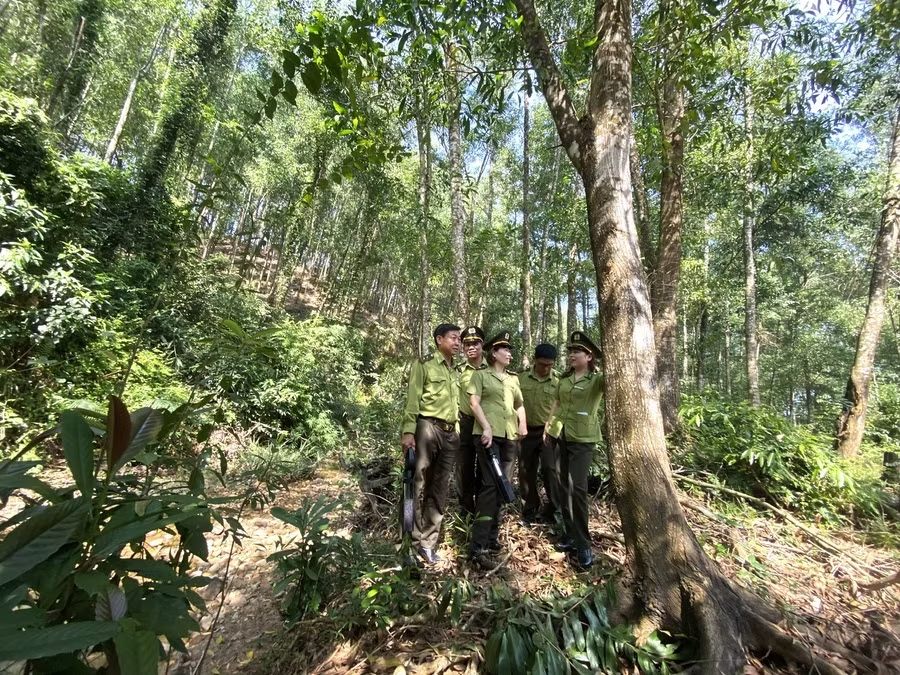
The forest protection force continues to be strengthened and its capacity enhanced to ensure sustainable forest protection and development. Photo: N.N
▪ What measures will be taken to mobilise local authorities, forest owners and the public for sustainable forest development?
- We will continue to innovate coordination methods, communication and technical support in a practical and effective manner. A key focus will be on improving capacity and applying technology in forest seedling production, including the development of high-quality tissue-cultured seedlings that are pest-resistant and adaptable to climate change.
At the same time, we will intensify communication efforts to encourage people, businesses and forest owners to shift from planting small timber forests to large timber forests, thereby increasing economic value and long-term engagement with forestry.
The Department will implement the Large Timber Tree Development Project for 2026–2030, with a vision to 2050, and advise the Department of Agriculture and Environment to propose that the Provincial People’s Committee assign large timber planting targets to forestry companies and management boards of protection and special-use forests.
We will also review encroached forestry land for recovery and allocation to large timber planting with suitable species, and orient replacement afforestation projects towards large timber species.
In addition, inspection and supervision of large timber forest planting will be strengthened, alongside guidance on converting small timber forests to large timber business models based on practical effectiveness.
The Department will continue to consolidate its organisational structure, enhance the capacity of the forest protection force, intensify dissemination of forestry laws, improve management capacity at the commune level, and advise on support and incentive policies for forest owners, contributing to sustainable forestry development.
Gia Lai province is seeking to expand investment and trade cooperation with Taiwanese businesses, with a focus on manufacturing, technology, agriculture, renewable energy, logistics and tourism.
Gia Lai is stepping up efforts to expand markets for agricultural products and build stable production-processing-consumption chains, as authorities seek to reduce reliance on seasonal sales across nearly 977,000 hectares of agricultural land.
Gia Lai Province and France’s Normandy region have agreed to explore stronger cooperation in investment, trade, tourism, renewable energy, education, science and technology during a working visit by a Gia Lai delegation.
Gia Lai is simultaneously revising its provincial master plan and the master plans for four major urban centers as it seeks to create a more interconnected development network spanning coastal, highland and border areas.
Gia Lai is stepping up investment in transport and logistics infrastructure to position itself as a key logistics hub for Vietnam’s Central Highlands, linking major agricultural production zones with border gates, seaports and international markets.
Gia Lai is seeking to increase the value of its agricultural sector by expanding deep processing, strengthening production linkages and building closed value chains, as the province looks to retain more value within its major raw material areas.
Gia Lai is accelerating investment in irrigation infrastructure to secure water supplies amid increasingly complex climate change, while improving agricultural productivity and developing concentrated raw material production zones.
The Gia Lai Provincial People’s Committee has approved the investment policy for the Sê San 4 Hydropower Plant Expansion Project, with Vietnam Electricity (EVN) selected as the investor for the 120MW project.
Vietnam’s Phu Tai Joint Stock Company plans to invest $950,000 to establish a subsidiary in Texas, United States, to expand its trading and distribution of stone and wooden furniture products.
Young people returning to Gia Lai are finding new ways to increase the value of local agricultural products, combining technology, processing skills, market experience and storytelling to bring products closer to consumers.
A Facebook-based digital marketplace launched in Đak Pơ is helping local farmers and small traders reach customers beyond the commune, with young people providing hands-on support to promote agricultural products and local specialties online.
Banks in Gia Lai are rolling out large-scale credit packages and cutting lending rates by up to 2 percentage points a year as they seek to improve access to capital for businesses and households.
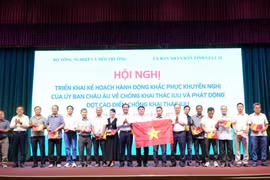
Gia Lai is stepping up enforcement against illegal, unreported and unregulated (IUU) fishing, tightening vessel controls, electronic monitoring and seafood traceability as authorities seek to have the “yellow card” warning lifted in 2026, towards a more transparent and sustainable fisheries sector.
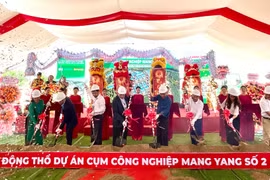
Hoang Anh Gia Lai Joint Stock Company broke ground on the VND 400 billion (about $15.3 million) Mang Yang No. 2 Industrial Cluster in Hra commune on August 12, a 74.5-hectare project expected to create stable jobs for more than 4,500 workers.
Gia Lai is planning a major expansion and upgrade of irrigation infrastructure in its western region, where only 8.94% of agricultural land currently has access to proactive irrigation and the annual water shortfall exceeds 1.234 billion cubic metres.
Gia Lai province is stepping up efforts to accelerate public investment disbursement after spending more than VND 9.322 trillion by the end of July 2026, as authorities seek to address delays affecting major projects and hold agencies accountable for meeting spending targets.
Industrial promotion programs are accelerating technology upgrades among rural businesses, cooperatives and production facilities, helping them improve product quality, strengthen brands and increase the value of locally made goods.
Gia Lai has sharply reduced administrative processing times for businesses, cutting company registration to a matter of hours and halving the time required for land allocation and leasing, as authorities seek to lower costs, accelerate investment projects and strengthen private sector growth.
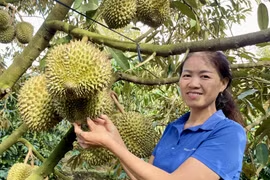
After leaving his position as director of an agricultural enterprise in Ho Chi Minh City, Nguyễn Chất Sâm returned to Ia Ly commune to pursue organic farming, transforming degraded former rubber plantations into a 15-hectare durian farm that now generates about US$267,000 in annual profit.
Gia Lai is reshaping its foreign direct investment (FDI) strategy by prioritising high-tech, environmentally friendly projects with strong spillover effects over investment volume, as the province seeks to improve growth quality and strengthen its role in global supply chains.
Gia Lai authorities have ordered faster construction and site clearance across several major transport projects, setting firm deadlines for an expressway, a new airport runway and a coastal road as the province seeks to strengthen regional connectivity and support economic development.
Gia Lai is stepping up the use of artificial intelligence and digital technologies to promote destinations, preserve cultural heritage and improve visitor experiences, as authorities seek to strengthen the competitiveness of the local tourism industry.
Authorities in Gia Lai province are intensifying oversight of durian production as the region enters its peak harvest season, aiming to ensure products meet increasingly stringent export requirements on traceability, food safety and quality.
Gia Lai province's economy expanded 8.21% in the first six months of 2026 from a year earlier, with industry, construction and services driving growth despite ongoing economic challenges, provincial officials said on Tuesday.