The department reported that its digital transformation initiatives have enabled faster processing, improved transparency, and more effective prevention of tax losses. Revenue for 2025 is expected to exceed the central government’s target by 40.1 percent, surpass the provincial People’s Council’s goal by 21.3 percent, and rise 26.8 percent from the previous year.
At the core of the transformation is a suite of digital applications developed and deployed alongside nationwide platforms of the General Department of Taxation. These include a new version of the electronic information portal (gialaitax.vn), business household management tools, invoice monitoring applications, work-deployment systems, and platforms for aggregating and tracking tax declaration dossiers.
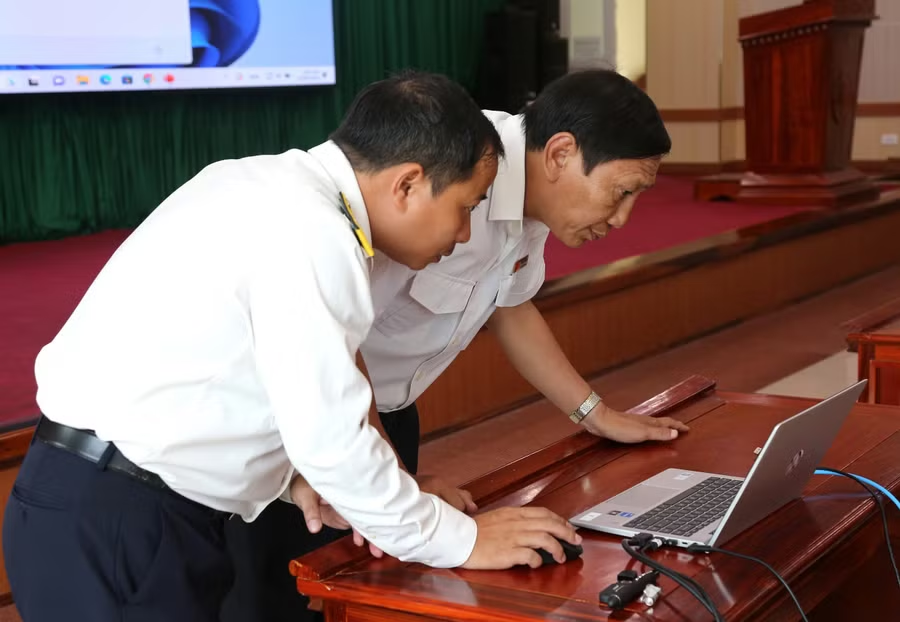
According to provincial officials, the upgraded information portal has improved connectivity and communication, enabling taxpayers to receive timely and accurate guidance, particularly after administrative mergers and the shift to a two-tier local government model. The portal also facilitates coordination with commercial banks on tax debt enforcement, e-commerce oversight, and activities on digital platforms outside formal marketplaces.
The business household management tool supports updates on thousands of households in 135 newly established communes and wards. The system strengthens oversight and assists households transitioning from lump-sum taxation to declaration-based payments under Politburo Resolution No. 68-NQ/TW on private sector development.
Meanwhile, the invoice management platform allows tax authorities to monitor input and output invoices, detect illegal invoice circulation, and issue real-time risk alerts. Officials say this helps taxpayers avoid violations, reinforce credibility, and improve competitiveness.

Additional applications for work deployment and dossier monitoring have helped supervise taxpayer filings, track eTax Mobile registrations and payments, and oversee risks in invoicing and e-commerce operations. Deputy Head of the Provincial Tax Authority Trần Hữu Danh noted that these tools form a “complete digital ecosystem” spanning communication, support, administration, and collection.
The department has also integrated multiple public services with banks and provincial agencies, connecting them to the National Public Service Portal to enable fully electronic submission and tracking of tax documents. Communication channels via Fanpage, Zalo, and Gmail ensure that tax support policies reach all taxpayers promptly.
As a result, all businesses in Gia Lai now file, pay, and receive tax refunds electronically. Province-wide, 46,765 out of 46,893 business households have adopted the eTaxMobile application.
Business leaders say the shift is irreversible. Vũ Hồng Quân, CEO of Mỹ Quang Construction Materials Joint Stock Company, said digital interaction with tax authorities allows firms to access support policies more quickly and execute business plans with greater confidence.
Tax officials emphasize that digital transformation helps uphold the sector’s service-oriented approach while strengthening governance. Provincial Tax Authority Head Lê Minh Nhựt said the department will continue advancing an open technology-based management model anchored in four pillars: support, warning, transparency, and dialogue. The goal, he said, is to better protect taxpayers’ legal rights while closing loopholes to ensure accurate and fair collection.