The National Assembly’s adoption of Resolution No. 253/2025/QH15 on December 11, 2025, outlining mechanisms and policies for national energy development for the 2026-2030 period, is being regarded as a timely and strategically important decision.
As Vietnam targets GDP growth of more than 10% in the 2026–2030 period, demand for energy, particularly electricity for production, is expected to rise sharply.
Mr. Trần Thúc Kham, Deputy Director of the Department of Industry and Trade, talks about the significance and expected impact of the resolution.
* Why is Resolution No. 253/2025/QH15 considered essential at this time?
Mr. Trần Thúc Kham. Photo: Provided by the interviewee
- Vietnam is entering a new phase of development with ambitious growth goals, aiming to become a modern industrialized nation with upper-middle-income status by 2030. This trajectory will drive rapid and uninterrupted increases in energy consumption, especially electricity.
However, the existing legal framework has not kept pace with emerging realities, particularly new energy models such as offshore wind power, direct power purchase agreements (DPPA), and post-investment electricity price bidding mechanisms.
Resolution No. 253/2025/QH15, which takes effect on March 1, 2026, establishes a clearer and more stable policy foundation. It helps resolve institutional bottlenecks, ensures safe and sustainable electricity supplies, and reinforces national energy security amid soaring demand.
* What are the key highlights of this resolution?
-Resolution No. 253/2025/QH15 updates several strategic mechanisms and policies. Notably, it allows adjustments to power development planning and provincial grid development plans to meet practical needs, as long as major objectives and orientations remain unchanged and total generation capacity does not exceed approved limits.
The resolution also promotes renewable energy development, especially offshore wind power, expands new electricity trading models, enhances post-bidding pricing mechanisms, and builds a more transparent, stable investment environment for both domestic and foreign investors.
Significantly, investment projects in power grid infrastructure already included in the power development plan will no longer require investment policy approval, helping shorten project timelines.
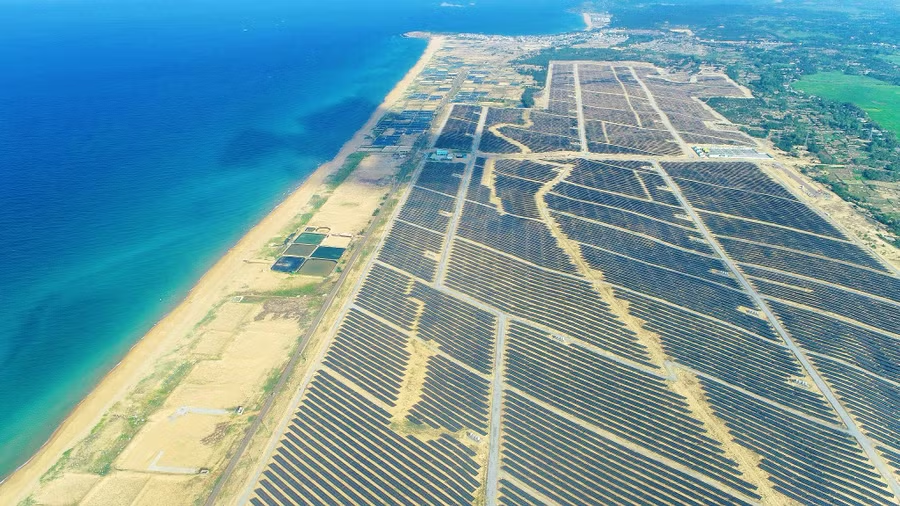
The solar power project of Phu My Clean Energy Vision Development Joint Stock Company in Phu My Dong commune. Photo: Hải Yến
* In your view, what breakthroughs in energy development thinking does this resolution introduce?
- This is the first time the National Assembly has issued a thematic resolution on medium-term mechanisms and policies for energy development. It reflects a major shift from administrative management to development facilitation, recognizing energy as foundational infrastructure for growth and national security.
The resolution moves beyond the traditional goal of merely “ensuring sufficient electricity supply” toward building a sustainable, diversified, modern energy sector aligned with the green transition and international commitments.
It also expands policy space for new energy models by establishing legal foundations where none previously existed, a critical step for keeping pace with global energy market trends.
* How will Gia Lai apply this resolution, given its strong renewable energy potential?
-Once the resolution takes effect, Gia Lai will apply it flexibly to adjust and update elements of the power development plan and provincial grid plan. All adjustments will comply with the Constitution and laws, align with Party guidelines, ensure energy security and power system safety, and support energy transition goals.
We place strong emphasis on transparency, strict power control, anti-corruption, anti-waste, and preventing the resurgence of “ask–give” mechanisms.
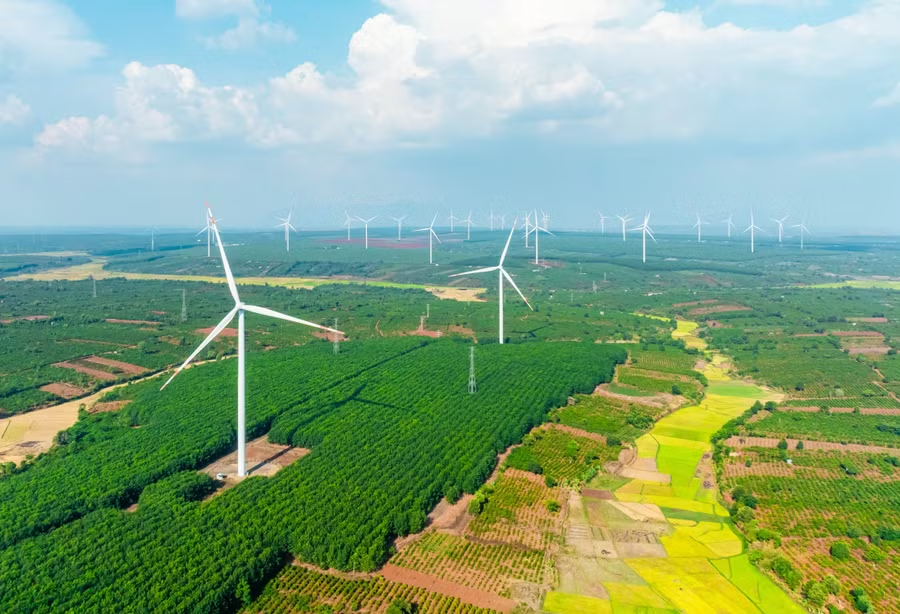
Wind power fields in Ia Bang commune. Photo: Phạm Quý
*Could you share how the implementation of the adjusted Power Development Plan VIII is progressing locally?
-The Department of Industry and Trade has advised the Provincial People’s Committee to report to the Ministry of Industry and Trade on the progress of power source and grid projects under the adjusted Power Development Plan VIII. We have also provided data to support the proposal for adjusting the national power plan for 2021-2030, with a vision to 2050.
Under Government Resolution No. 233/NQ-CP on addressing obstacles for renewable energy projects, three projects with a combined capacity of 132 MW are already operational. Two additional projects totaling 250.5 MW are awaiting appraisal and licensing by the Electricity Regulatory Authority and are expected to come online soon.
The province has conducted a five-year review of Politburo Resolution No. 55-NQ/TW, reviewed the installation of wind measurement towers in its western region, and monitored investment registration and progress of wind and grid-connected solar projects.
Based on these evaluations, we have advised the Provincial People’s Committee to propose that the Government and Ministry of Industry and Trade include Gia Lai’s power source and grid projects in the adjusted Power Development Plan VIII and to issue plans for investor selection for renewable energy projects.
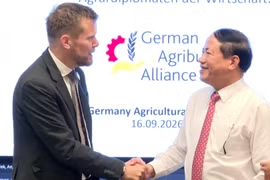
Gia Lai is seeking to deepen investment ties with German businesses, with a focus on agriculture, processing, technology transfer and green development, as the Vietnamese province looks to attract foreign investment.
Gia Lai is seeking to establish a direct agricultural export route to China through the Ta Lung International Border Gate in Cao Bang province, as local authorities and businesses look to reduce logistics costs, strengthen processing capacity and increase the value of key agricultural products.
Gia Lai aims to expand medicinal plant cultivation from nearly 1,500 hectares currently to more than 7,486 hectares by 2030, with a focus on growing herbs under forest canopies while conserving natural resources and supporting local livelihoods.
Gia Lai Province is seeking to expand investment, trade and tourism cooperation with Portuguese businesses, as it stepped up economic engagement with the city of Guarda following the signing of a cooperation agreement between the two local authorities.
Localities across Gia Lai province are turning to livestreaming to promote specialty and OCOP products, helping producers reach wider markets while building skills in online marketing, sales and customer engagement.
Gia Lai province is seeking to expand investment and trade cooperation with Taiwanese businesses, with a focus on manufacturing, technology, agriculture, renewable energy, logistics and tourism.
Gia Lai is stepping up efforts to expand markets for agricultural products and build stable production-processing-consumption chains, as authorities seek to reduce reliance on seasonal sales across nearly 977,000 hectares of agricultural land.
Gia Lai Province and France’s Normandy region have agreed to explore stronger cooperation in investment, trade, tourism, renewable energy, education, science and technology during a working visit by a Gia Lai delegation.
Gia Lai is simultaneously revising its provincial master plan and the master plans for four major urban centers as it seeks to create a more interconnected development network spanning coastal, highland and border areas.
The Gia Lai Provincial People’s Committee has approved the investment policy for the Sê San 4 Hydropower Plant Expansion Project, with Vietnam Electricity (EVN) selected as the investor for the 120MW project.
Vietnam’s Phu Tai Joint Stock Company plans to invest $950,000 to establish a subsidiary in Texas, United States, to expand its trading and distribution of stone and wooden furniture products.
(GLO) – Following the merger, Gia Lai is better positioned to reorganize its economic landscape, linking raw material production with processing, logistics, commerce, and market access.
Vietnam’s Gia Lai province is expanding high-tech farming, certified production and processing to raise the value of key agricultural products and meet stricter domestic and export market requirements.
Gia Lai aims to generate more than $17 billion in export turnover between 2026 and 2030, as the province seeks to help businesses and cooperatives expand internationally, strengthen brands and secure positions in global supply chains.
Young people returning to Gia Lai are finding new ways to increase the value of local agricultural products, combining technology, processing skills, market experience and storytelling to bring products closer to consumers.
A Facebook-based digital marketplace launched in Đak Pơ is helping local farmers and small traders reach customers beyond the commune, with young people providing hands-on support to promote agricultural products and local specialties online.
Banks in Gia Lai are rolling out large-scale credit packages and cutting lending rates by up to 2 percentage points a year as they seek to improve access to capital for businesses and households.
Gia Lai is stepping up enforcement against illegal, unreported and unregulated (IUU) fishing, tightening vessel controls, electronic monitoring and seafood traceability as authorities seek to have the “yellow card” warning lifted in 2026, towards a more transparent and sustainable fisheries sector.
Industrial promotion programs are accelerating technology upgrades among rural businesses, cooperatives and production facilities, helping them improve product quality, strengthen brands and increase the value of locally made goods.
Gia Lai has sharply reduced administrative processing times for businesses, cutting company registration to a matter of hours and halving the time required for land allocation and leasing, as authorities seek to lower costs, accelerate investment projects and strengthen private sector growth.
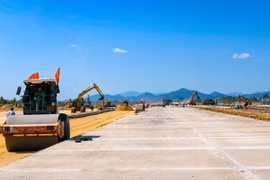
The construction of Runway No. 2 and associated airfield facilities at Phu Cat Airport has entered its final stage, with contractors working around the clock to complete the project on schedule while maintaining stringent quality standards ahead of commissioning.
Gia Lai province is restructuring its agricultural sector by replacing fragmented local branding with regional-scale agricultural brands linked to specialized production areas and integrated value chains, aiming to improve competitiveness, attract investment and expand export opportunities.
Agricultural producers in Gia Lai are strengthening quality, traceability and supply chain management as they seek greater access to Vietnam’s modern retail networks, where requirements on consistency and long-term supply remain major barriers despite the province’s strong agricultural base.
After leaving his position as director of an agricultural enterprise in Ho Chi Minh City, Nguyễn Chất Sâm returned to Ia Ly commune to pursue organic farming, transforming degraded former rubber plantations into a 15-hectare durian farm that now generates about US$267,000 in annual profit.