Gia Lai province has rolled out an ambitious plan to accelerate the transition of household businesses into enterprises, positioning the private sector as a core engine of economic growth.
Under Plan No. 21/KH-UBND, issued on 20 January 2026, the province targets the creation of 7,000 new enterprises by the end of 2026, including up to 3,275 converted from household businesses. The initiative aligns with national directives emphasising the private sector’s role in driving development and strengthening social security.
* Resolution No. 68-NQ/TW affirms the private sector as a key driver of growth, yet development remains below potential. How is the private sector performing in Gia Lai?
Mr. Đinh Hữu Hòa, Deputy Director of the Department of Finance. Photo: T.Sỹ
- Between 2021 and 2025, Gia Lai averaged 1,575 newly established enterprises each year, an increase of 990 per year compared with the 2016, 2020 period. In 2025 alone, the province recorded 3,185 new enterprises, up more than 47% from 2024, with total registered capital reaching 28 trillion VND (≈1.12 billion USD), a rise of over 43%.
Today, Gia Lai has nearly 19,000 enterprises and around 66,000 household businesses, contributing about 80% of local GRDP and generating jobs for 94% of the province’s workforce. This reflects strong private-sector expansion and its central role in socio-economic development.
However, most firms remain small or micro-sized, with limited financial resources, modest management capacity and low innovation. They are vulnerable to operational risks, and many face persistent barriers in accessing credit, land and skilled labour—constraints that continue to hold back competitiveness and long-term growth.
* Plan No. 21/KH-UBND aims to promote the conversion of household businesses into enterprises. What are the province’s objectives under this plan?
- Plan No. 21 identifies household-to-enterprise conversion as a priority task to strengthen private-sector development in a rapid, sustainable and efficient manner. The Provincial People’s Committee has set a target of 7,000 new enterprises by the end of 2026, including 3,050 to 3,275 household businesses converting to enterprise status.
Beyond numerical targets, the province aims to improve the overall quality and scale of the private sector, paving the way toward a broader goal of reaching about 65,000 enterprises by 2030. This shift is expected to enhance business performance and boost provincial budget revenues.
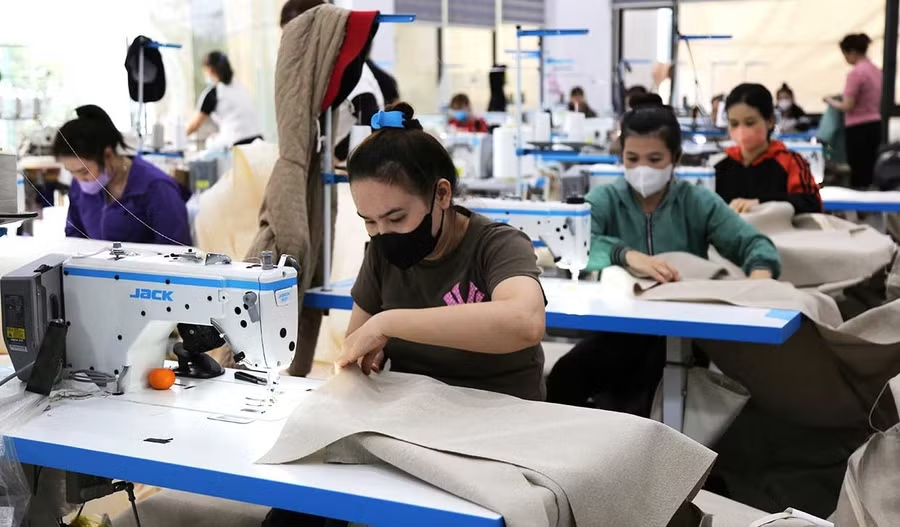
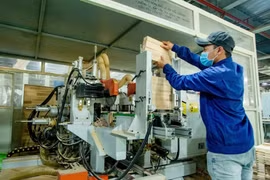
The province’s multi-faceted support will drive private sector development. - In the photo: Garment production at Hoang Trang Trading and Service Co., Ltd. (Long Mỹ Industrial Park, Quy Nhơn Tây Ward). Photo: T.Sỹ
* As the lead agency, what key measures is the Department of Finance prioritising to implement the plan?
- We follow the principle that “enterprise satisfaction is the measure of effectiveness.” To that end, we have streamlined business-registration procedures by digitising administrative processes, reducing the time for issuing new business-registration certificates from three days to about three working hours, and applying digital signatures to all registration results.
These reforms have delivered early gains: in January 2026, we issued certificates to 602 newly established enterprises—an increase of around 300% year-on-year—with registered capital reaching 4.058 trillion VND (≈162 million USD), up roughly 495%. New enterprises are exempt from registration fees, appraisal costs and initial licensing for conditional business sectors.
In parallel, we are working with other departments and local authorities to review household-business data and identify those eligible for conversion. We have issued coordination documents and are preparing guidance materials explaining registration procedures and the advantages of converting to enterprise status. Local People’s Committees are being advised to set up support teams to assist businesses in transition.
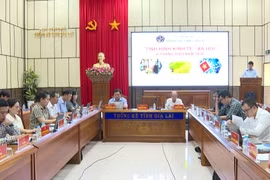
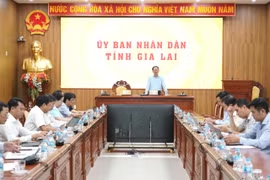
On 3 February, the Department of Finance, together with the Department of Industry and Trade and the Provincial Tax Department, met with authorities and businesses in Quy Nhơn and Quy Nhơn Nam wards to assess progress and gather feedback to refine upcoming support measures.
From the second quarter of 2026, we will guide the use of state-budget funds to provide free shared accounting software and training on business management, accounting and tax compliance. Management-skills courses will be organised for small and medium-sized enterprises that have converted from household businesses. We will continue urging relevant units to execute Plan No. 21 and report regularly to the Provincial People’s Committee.
Our goal is for 100% of household businesses to receive information and support on enterprise conversion, and for all newly converted enterprises to complete tax and registration procedures electronically quickly and conveniently.
Gia Lai aims to generate more than $17 billion in export turnover between 2026 and 2030, as the province seeks to help businesses and cooperatives expand internationally, strengthen brands and secure positions in global supply chains.
Young people returning to Gia Lai are finding new ways to increase the value of local agricultural products, combining technology, processing skills, market experience and storytelling to bring products closer to consumers.
A Facebook-based digital marketplace launched in Đak Pơ is helping local farmers and small traders reach customers beyond the commune, with young people providing hands-on support to promote agricultural products and local specialties online.
Banks in Gia Lai are rolling out large-scale credit packages and cutting lending rates by up to 2 percentage points a year as they seek to improve access to capital for businesses and households.
Gia Lai is stepping up enforcement against illegal, unreported and unregulated (IUU) fishing, tightening vessel controls, electronic monitoring and seafood traceability as authorities seek to have the “yellow card” warning lifted in 2026, towards a more transparent and sustainable fisheries sector.
Hoang Anh Gia Lai Joint Stock Company broke ground on the VND 400 billion (about $15.3 million) Mang Yang No. 2 Industrial Cluster in Hra commune on August 12, a 74.5-hectare project expected to create stable jobs for more than 4,500 workers.
Gia Lai is planning a major expansion and upgrade of irrigation infrastructure in its western region, where only 8.94% of agricultural land currently has access to proactive irrigation and the annual water shortfall exceeds 1.234 billion cubic metres.
Gia Lai province is stepping up efforts to accelerate public investment disbursement after spending more than VND 9.322 trillion by the end of July 2026, as authorities seek to address delays affecting major projects and hold agencies accountable for meeting spending targets.
Industrial promotion programs are accelerating technology upgrades among rural businesses, cooperatives and production facilities, helping them improve product quality, strengthen brands and increase the value of locally made goods.
Agricultural producers in Gia Lai are strengthening quality, traceability and supply chain management as they seek greater access to Vietnam’s modern retail networks, where requirements on consistency and long-term supply remain major barriers despite the province’s strong agricultural base.
After leaving his position as director of an agricultural enterprise in Ho Chi Minh City, Nguyễn Chất Sâm returned to Ia Ly commune to pursue organic farming, transforming degraded former rubber plantations into a 15-hectare durian farm that now generates about US$267,000 in annual profit.
Gia Lai is reshaping its foreign direct investment (FDI) strategy by prioritising high-tech, environmentally friendly projects with strong spillover effects over investment volume, as the province seeks to improve growth quality and strengthen its role in global supply chains.
Gia Lai authorities have ordered faster construction and site clearance across several major transport projects, setting firm deadlines for an expressway, a new airport runway and a coastal road as the province seeks to strengthen regional connectivity and support economic development.
Gia Lai is stepping up the use of artificial intelligence and digital technologies to promote destinations, preserve cultural heritage and improve visitor experiences, as authorities seek to strengthen the competitiveness of the local tourism industry.
Authorities in Gia Lai province are intensifying oversight of durian production as the region enters its peak harvest season, aiming to ensure products meet increasingly stringent export requirements on traceability, food safety and quality.
Gia Lai province's economy expanded 8.21% in the first six months of 2026 from a year earlier, with industry, construction and services driving growth despite ongoing economic challenges, provincial officials said on Tuesday.
Gia Lai has reported strong progress in implementing its private economic development strategy, with a sharp increase in new business registrations and investment projects during the first half of 2026.
Construction of a key coastal road linking National Highway 1D and the new National Highway 19 is gathering pace after overcoming geological, material and construction challenges, with authorities targeting completion and operation by the end of 2026.
Lê Tấn Hòa, a lecturer at the Faculty of Electronics and Informatics of Quy Nhon College of Technology and Engineering, has spent nearly 17 years developing practical training models and educational equipment designed to better prepare vocational students for real-world industrial environments.
Rooftop solar power is gaining momentum across wards of Quy Nhơn, East Quy Nhơn, North Quy Nhơn, South Quy Nhơn and West Quy Nhơn in Gia Lai, as more households and businesses invest in self-produced electricity to reduce energy costs and improve power reliability.
Gia Lai has introduced a new policy framework aimed at accelerating science, technology and innovation by addressing practical obstacles faced by businesses, particularly cooperatives and small and medium-sized enterprises (SMEs), under Resolution No. 10/2026/NQ-HĐND.
Authorities and Youth Union organizations in Gia Lai are stepping up efforts to support ethnic minority in starting businesses and developing sustainable livelihoods, helping young people access trainin and preferential loans to improve incomes and contribute to local economic growth.
Decree No. 180/2026/NĐ-CP on forest carbon sequestration and storage services is being viewed as a major milestone for the development of Vietnam’s forest carbon market.
The rapid growth of cross-border e-commerce is opening new opportunities for businesses in Gia Lai to bring local products directly to international consumers, helping them adopt modern export models and deepen integration into global value chains.