Historians and archaeologists have long sought to validate the origins of the Hung Kings, believed to be descendants of the Lac and Hong lineages. Whether grounded in historical fact or myth, the site remains a powerful symbol of national identity and unity.
According to ancient texts such as Lĩnh Nam Chích Quái, Vietnam’s earliest ruler was Kinh Dương Vương, whose lineage continued through Lạc Long Quân and Âu Cơ. Legend holds that Âu Cơ gave birth to one hundred sons, marking the origin of the Vietnamese people. Their eldest son became the first Hùng Vương, founding the state of Văn Lang and establishing its capital at Phong Châu, in present-day Phu Tho Province.
Today, the temple complex stands as a focal point of remembrance for more than 4,000 years of nation-building and defense.
Located about 100 kilometers from Hanoi, the journey to the ancestral land leads visitors through Vietnam’s midland landscapes to Nghia Linh Mountain, rising modestly to 175 meters but commanding deep cultural reverence. The surrounding region, dotted with nearly 100 hills, is traditionally seen as a sacred formation honoring the ancestral land.
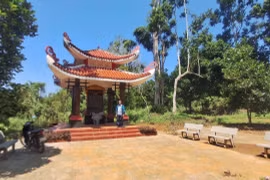
At the summit lies the Upper Temple and the tomb of a Hung King, where rituals are performed to honor both Heaven and the legendary rulers. The site also commemorates deities and figures such as Saint Gióng, a mythical hero credited with defending the nation.
Further down the mountain, the Middle Temple once served as a resting and meeting place for the kings and their court. The Lower Temple, associated with the legend of Âu Cơ’s hundred eggs, remains a key spiritual landmark. Nearby stands a pagoda and, at the foot of the mountain, the Well Temple, home to the Ngọc Well, linked to royal princesses of the Hung era.
Historical records suggest that the Hung Kings’ lineage spans 18 generations over nearly three millennia. While much of the original architecture has deteriorated, surviving structures date largely from the Later Lê and Nguyễn dynasties. Major restoration efforts in the early 20th century, supported by communities across northern Vietnam, helped preserve the site, which continues to undergo conservation and expansion.
Despite the absence of formal royal titles conferred upon the temple throughout Vietnam’s feudal history, likely due to its sacred status, the Hung Kings Temple has remained a central place of worship. Records from as early as the 10th century confirm continuous rituals and offerings conducted by successive dynasties.
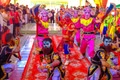
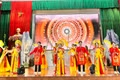
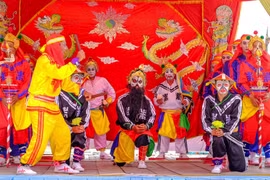
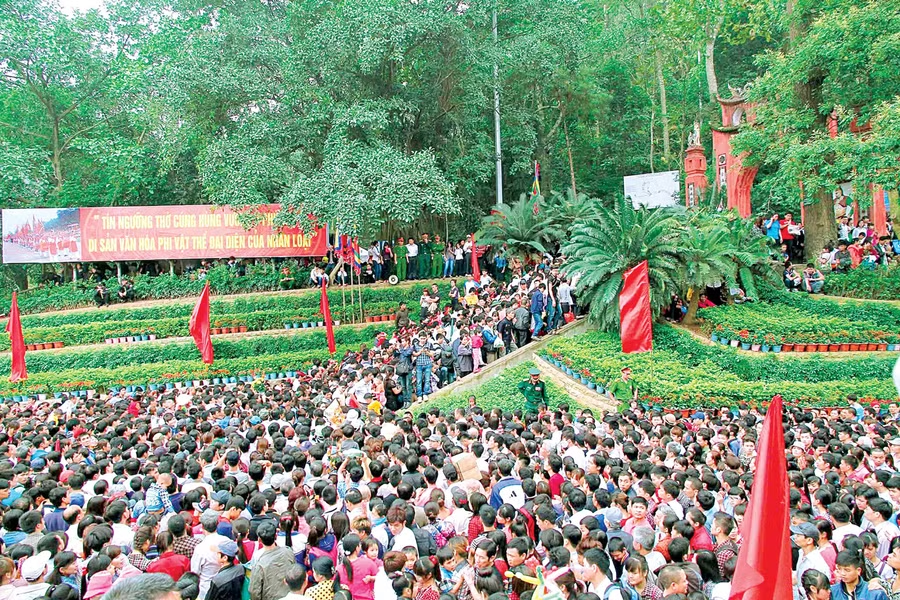
Each year, on the 10th day of the third lunar month, Vietnamese people commemorate the Hung Kings’ death anniversary, reaffirming a shared cultural heritage. Even those unable to attend the festival often mark the occasion in spirit, reflecting a deeply rooted tradition of honoring their ancestors.
The enduring reverence for the Hung Kings underscores a broader cultural ethos: as birds return to their nests, so too do people remember their origins.