Across diverse creative spaces, Vietnamese artist Nguyễn Văn Chung has continuously sought his own visual language, with woodcut printmaking emerging as a defining medium. Deeply rooted in the Central Highlands, his works reflect a profound attachment to the region’s land, people, and environment.
* Could you share how you first came to pursue a career in fine arts?
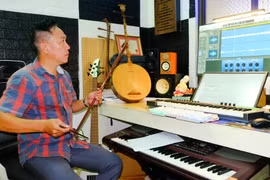
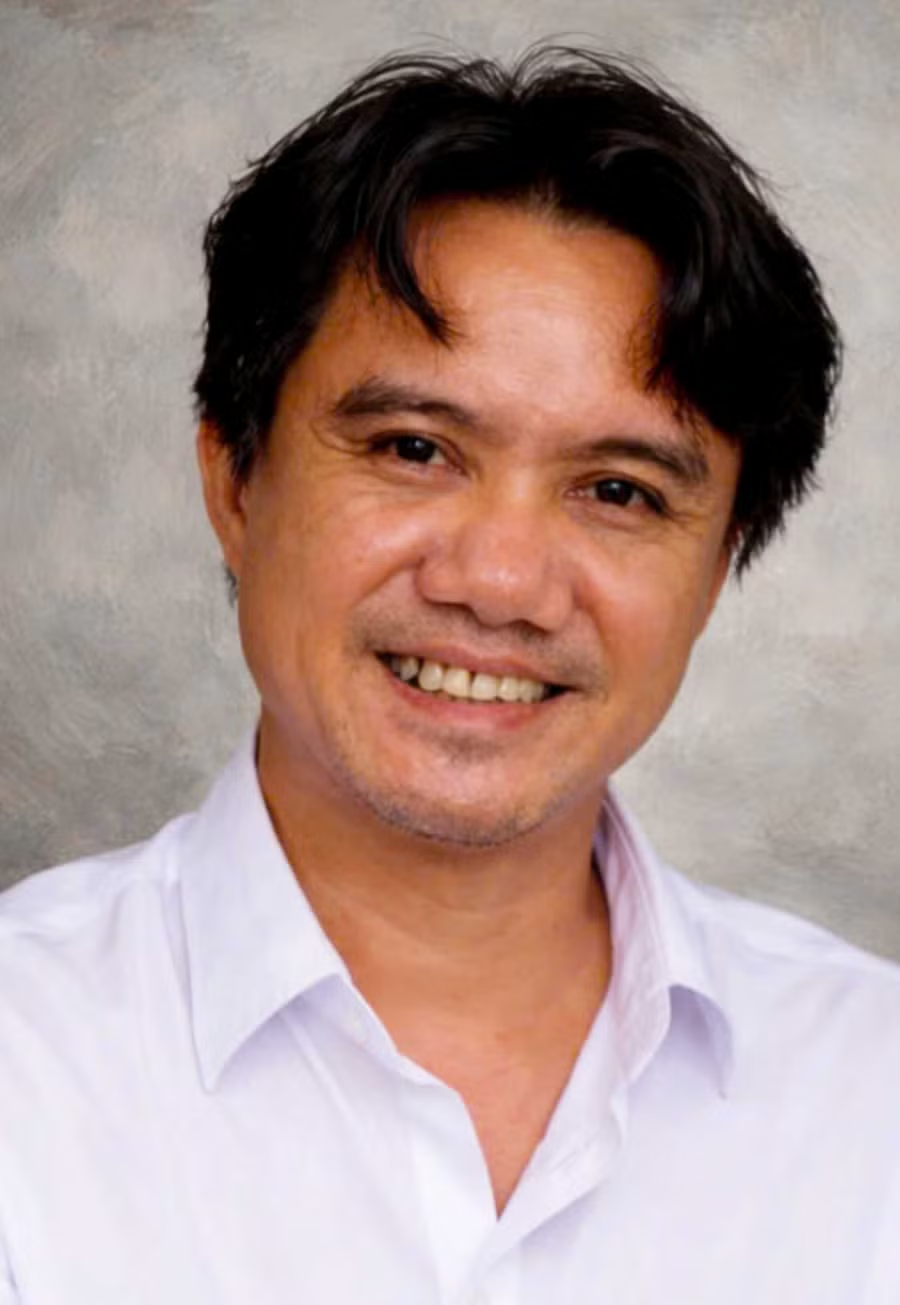
Artist Nguyễn Văn Chung. Photo: Provided by the artist
- My passion for painting began in childhood. A turning point came when my uncle, sculptor Nguyễn Văn Hàm, recognized my talent and encouraged me to study Art Education.
My early artistic foundation was shaped by my teacher, artist Nguyễn Văn Điền. I vividly remember being captivated by his gouache landscape sketches of the Central Highlands.
From those early experiences, the cultural identity, land, and people of the Bana and Jrai gradually became integral to my artistic thinking and later works.
* At what point did you enter the world of professional fine arts?
- I began engaging in professional art activities in 2007, participating in the Gia Lai Provincial Fine Arts Exhibition with two works: “Chiều Tây Nguyên” (oil on canvas) and “Chạy mưa” (gouache).
Since then, I have balanced teaching with artistic creation, taking part in numerous regional and national exhibitions.
"Lệ rừng" (Forest Tears, woodcut print) by artist Nguyễn Văn Chung (Exhibited at the 2024 ASEAN Graphic Art Exhibition, Encouragement Prize at the 2025 Literary and Artistic Awards of the Vietnam Association of Literature and Arts of Ethnic Minorities). Photo: N.Phong
* What motivates you to experiment with various materials instead of focusing on a single technique?
- During my studies, I mainly used watercolor, gouache, and oil paint. It was only after entering professional practice that I expanded into other materials.
Exposure to exhibitions, travel, and exchanges with fellow artists encouraged me to explore new forms of expression. For me, each idea requires its own visual language. Materials are not just tools but essential elements in conveying the spirit of a work.
* Which medium best defines your artistic identity?
- Woodcut printmaking. I am entirely self-taught in this medium, developing my approach through experimentation. I work with both carved woodblocks and printed woodcuts in color and black-and-white. The bold, rustic qualities of woodcut align naturally with themes of the Central Highlands, allowing me to express their essence more effectively. Some of my works, such as “Sức sống đại ngàn,” (Vitality of the Great Forest) “Khát…!,” (Thirst…!) and “Lệ rừng”, (Forest Tears) have received recognition at regional, national, and international exhibitions.
"Lời ru của rừng" (The Forest's Lullaby, mixed media) by artist Nguyễn Văn Chung (C Prize, 2024 Literary and Artistic Awards of the Vietnam Association of Literature and Arts of Ethnic Minorities). Photo: N.Phong
* How has living in the Central Highlands shaped your creative inspiration?
- Being born and raised here, the region’s identity, culture, and people are deeply embedded in me. The landscapes, architecture, and rich cultural heritage of ethnic groups such as the Jrai and Bana provide endless inspiration. This connection forms the core direction of my artistic career.
* You create many works about the forest. What draws you to this subject?
- I see the forest as a living entity, almost a central character that embodies human emotion. Rather than depicting it realistically, I try to capture its spirit. My field trips, including visits to grave house areas of the Jrai and Bana, revealed a deeply rooted “forest culture.” These experiences inspired works like “Lời ru của rừng.”
At the same time, the destruction of forests has left a strong impression on me. Images of barren hills and dead trees have driven me to create works such as “Khát…!,” “Lũ sắp về,” and “Lệ rừng,” as both warnings and calls for greater environmental responsibility.
* Looking back, what dreams do you still hold for your artistic journey?
- I continue to study and explore new themes, including the sea and islands, cultural heritage, Champa art, and traditional performing arts. I hope to organize solo exhibitions based on these themes, starting in my home province as a way of expressing gratitude, and eventually expanding to major cities such as Ho Chi Minh City and Da Nang.
SOME NOTABLE AWARDS OF ARTIST NGUYỄN VĂN CHUNG:
"Âm sắc đại ngàn (1)" (Tones of the Great Forest (1), woodcut print) by artist Nguyễn Văn Chung (C Prize, 2023 Region V Fine Arts Exhibition). Photo: N.Phong
- Young Author Award from the National Committee of the Vietnam Union of Literature and Arts Associations in 2010, 2011, and 2014.
- Two B Prizes at the 3rd (2010–2015) and 4th (2016–2021) Gia Lai Provincial Literary and Artistic Awards.
- B Prize at the 2017 Region V Fine Arts Exhibition; A Prize at the Region V Fine Arts Exhibitions in 2020 and 2021.
- Third Prize at the 2021 Vietnam Fine Arts Association Awards; C Prize at the Region V Fine Arts Exhibitions in 2022 and 2023; awards from the Vietnam Association of Literature and Arts of Ethnic Minorities in 2023, 2024, and 2025, among others.
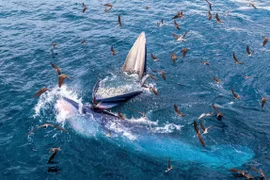
Three Bryde’s whales spotted hunting off Vũng Bồi in Gia Lai have highlighted the ecological richness of the Đề Gi estuary while underscoring the fishing communities’ longstanding culture of respecting and protecting the sea.
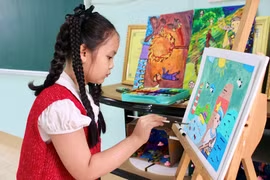
Dương Kim Thiên An, a second-grade student at Nguyen Van Troi Primary School in Gia Lai Province, has won four national art awards in 2026, marking a promising start to her journey in painting.
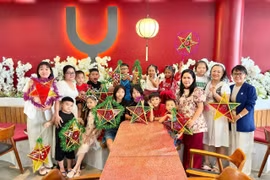
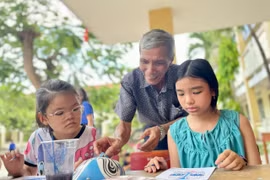
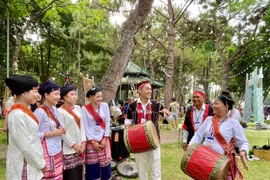
Traditional culture is being brought closer to children in Gia Lai through hands-on activities that allow them to experience gong music, xoang dances and hát bội art rather than simply learn about them through lessons.
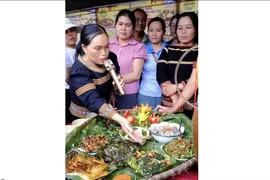
Bitterness is the defining taste of traditional Jrai cuisine in Phu Tuc, where forest leaves, bitter vegetables and distinctive cooking methods have shaped dishes closely tied to the community’s way of life.
Gia Lai is seeking to shift its approach to culture from preservation alone towards sustainable promotion of heritage values, with provincial leaders calling for cultural resources to be transformed into distinctive products that support socio-economic development.
Gia Lai has significant potential to turn its centuries-old connections between the Central Highlands and the sea into a new source of economic growth, with maritime heritage, tourism and cultural industries forming part of an integrated development strategy.
Gia Lai artists have emerged as leading contributors to the 30th Regional Fine Arts Exhibition for Region V - South Central and Central Highlands, accounting for three of the nine award-winning artists and the largest number of works submitted by any participating locality.
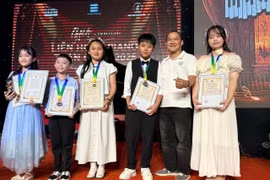
Two young pianists from Gia Lai won gold medals at the finals of the 2026 National Piano Festival, held in Buon Ma Thuot Ward, Dak Lak Province, from August 4 to 9.
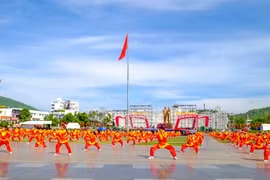
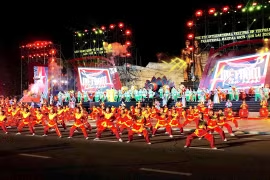
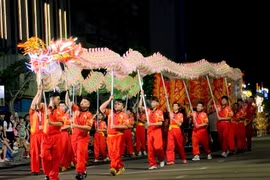
Hundreds of martial artists gathered at Nguyen Tat Thanh Square in Quy Nhon Ward on Sunday to perform synchronized demonstrations of Vietnamese traditional martial arts as part of the 9th International Vietnamese Traditional Martial Arts Festival - Gia Lai 2026.
(GLO) – Foreign Trade University beauty queen Le Phuong Nghi (an alumna of Hung Vuong High School for the Gifted, Gia Lai province) has officially advanced to the preliminary round of the Miss Vietnam 2026 pageant.
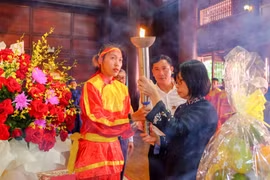
The 9th International Vietnamese Traditional Martial Arts Festival officially began on Sunday with an incense offering ceremony and a sacred flame procession, bringing together martial arts delegations from across the country and overseas for the opening of the 4-day cultural and sporting event.
The 9th International Vietnamese Traditional Martial Arts Festival officially opened on Sunday at Nguyen Tat Thanh Square in Quy Nhon Ward, bringing together martial arts masters, practitioners from Vietnam and abroad in a celebration of traditional martial arts and its international presence.
Nearly 20 artists from across Gia Lai Province are taking part in a 10-day lacquer painting workshop, where they are learning traditional techniques, exchanging creative ideas and deepening their appreciation for one of Vietnam's most enduring artistic mediums.
The FLC Quy Nhon Flower Festival 2026 will be held from Aug. 15 to Sept. 15 at the FLC Quy Nhon Resort Complex as part of the National Tourism Year - Gia Lai 2026, organized by FLC Group Joint Stock Company in coordination with the provincial People's Committee.
The HV Music Club of Hung Vuong High School for the Gifted held its ninth annual minishow, titled "Thăng" (Ascend), on the evening of July 21 in Pleiku Ward, bringing together student performers and guest artists in an event that also supports the club's annual charitable activities.
Musician Trần Kim Vân has been awarded a Certificate of Merit for his outstanding contributions at the 2026 National Three-Region Folk Singing and Instrumental Festival.
Phu Tuc Commune in Gia Lai Province will host its first Ethnic Minority Cultural and Sports Festival alongside an Agricultural Market introducing local OCOP products on August 8, marking the first anniversary of the commune's establishment.
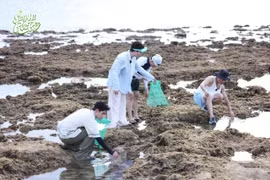
After a demanding first day of challenges on Cù Lao Xanh island, the artists of the reality show “Say Hi Rực Rỡ” turned their attention to preparing dinner, creating a mix of humorous moments and relaxing experiences against the island’s coastal backdrop.
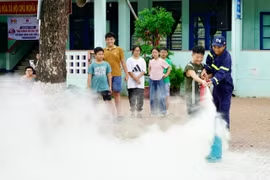
Summer activities organised by Youth Union and Young Pioneer organisations across Gia Lai province are combining recreation with practical education, offering children opportunities to develop life skills, learn about the law and explore traditional culture through a range of interactive programmes.
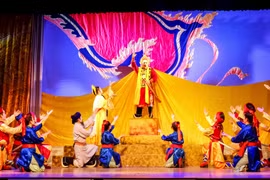
Public art troupes from Gia Lai won two gold medals, six silver medals and two certificates of merit at the 2026 National Three-Region Folk Singing and Instrumental Performance Festival, which concluded in Hue City on Tuesday.
Hidden beneath the dense forest canopy of the Bích Kê mountain range, the Phú Hà ancient stone rampart is emerging as an important archaeological site that researchers believe dates to the early 19th century and once served as a storage and collection point for agricultural goods.
Students in Gia Lai province are using digital technology, QR codes, audiobooks and online libraries to promote reading and expand access to books, as the 2026 Provincial Reading Culture Ambassador Contest encourages contestants to combine traditional reading with digital innovation.
As rapid urban development continues, two centuries-old Jrai villages, Ơp in Pleiku Ward and Pleiku Roh in Diên Hồng Ward, continue to safeguard their cultural identity, preserving traditions, communal life and heritage despite expanding roads, new residential areas and growing urbanisation.


 by artist Nguyễn Văn Chung (Exhibited at the 2024 ASEAN Graphic Art Exhibition, Encouragement Prize at the 2025 Literary and Artistic Awards of the Vietnam Association of Literature and Arts of Ethnic Minorities). Photo: N.Phong")
 by artist Nguyễn Văn Chung (C Prize, 2024 Literary and Artistic Awards of the Vietnam Association of Literature and Arts of Ethnic Minorities). Photo: N.Phong")
" (Tones of the Great Forest (1), woodcut print) by artist Nguyễn Văn Chung (C Prize, 2023 Region V Fine Arts Exhibition). Photo: N.Phong")