Rubber forests across Gia Lai are reaching the height of their annual leaf-shedding season, transforming vast highland areas into sweeping vistas of yellow, red and brown beneath the rotating blades of nearby wind turbines.
Rows of rubber trees stand in perfect alignment, their fallen leaves carpeting the path, signaling the arrival of the year’s end. Photo: Hoàng Hoài
The spectacle, which typically begins in late December and lasts until March, sees entire forests shift from lush green to autumn-like tones. Fallen leaves blanket the ground, forming one of the region’s most distinctive year-end landscapes.
The road winding through the rubber forest during leaf-shedding season offers a sense of tranquility and peace in the Gia Lai highlands. Photo: Hoàng Hoài
The seasonal change marks the rubber trees’ biological dormancy, during which latex tapping is suspended to allow the trees to recover and grow.
With no activity from latex collection, the forests take on a quieter, more contemplative atmosphere, contrasting with their usual daily movement.
In recent years, the emergence of wind farms has amplified the scene’s visual impact.
White turbines rising above the color-changing canopy create images reminiscent of fall landscapes in South Korea or Japan, adding a modern backdrop to a long-standing natural cycle in the Central Highlands.
Wind turbines stand out amidst the leaf-shedding rubber forests. Photo: Hoàng Hoài To fully appreciate the beauty of the leaf-shedding season, one must weave through each plot of rubber trees. Photo: Hoàng Hoài
In the soft glow of the afternoon sun, the rubber forests in leaf-shedding season appear as a contemplative painting of the highlands at year’s end. Photo: Hoàng Hoài Rubber forests in leaf-shedding season beneath the wind farms in Gia Lai. Photo: Hoàng Hoài Beyond its poetic scenery, this landscape also reflects Gia Lai’s transformation and development. Photo: Hoàng Hoài Gia Lai’s leaf-shedding season is not only beautiful for its scenery but also for the clean energy values spreading across the red basalt soil. Photo: Hoàng Hoài
Mesmerizing beauty of the rubber leaf-shedding season beneath the wind farms in Gia Lai. Video: Hoàng Hoài - Phương Loan
The five-day National Day holiday from August 29 to September 2 offers travelers an opportunity to explore Gia Lai through a journey linking its forests, cultural heritage and coastline.
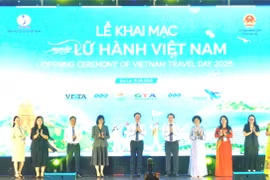
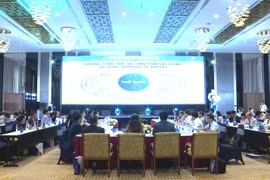
The 2nd Vietnam Travel Day 2026 opened in Gia Lai on August 15, bringing together tourism authorities, associations and businesses from Vietnam and overseas to strengthen market connections, develop new products and showcase the province’s evolving tourism landscape.
Hundreds of domestic and international tourism businesses surveyed attractions, cultural experiences and facilities in Gia Lai on August 14, exploring opportunities to develop new travel programs and partnerships in the province.
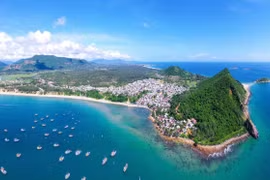
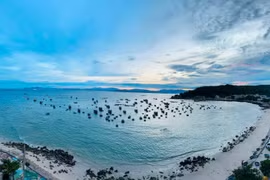
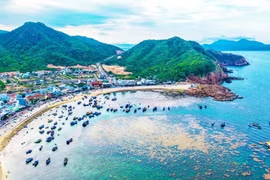
Mui Vi Rong, a dramatic rocky promontory jutting into the East Sea, is attracting a growing number of visitors to Phu My Dong, bringing new tourism opportunities to the centuries-old fishing community of Tan Phung.
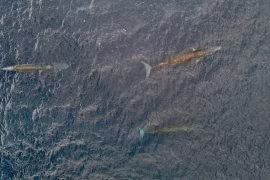
Three whales were spotted simultaneously hunting for food off the coast of Vũng Bồi in An Lương commune at around midday on August 5, marking a rare wildlife sighting that has attracted widespread public attention.
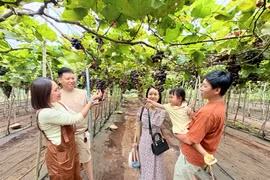
A 1.2-hectare organic vineyard in Gia Lai province has evolved into a leading agritourism destination, attracting between 20,000 and 30,000 visitors annually while demonstrating how organic farming and experiential tourism can generate sustainable rural livelihoods.
Cù Lao Xanh is leveraging its abundant marine resources and distinctive seafood cuisine to strengthen island tourism, while promoting sustainable fishing practices and protecting its coastal ecosystem.
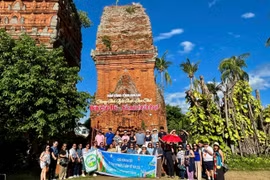
Gia Lai's Department of Culture, Sports and Tourism, in coordination with Hanatour Vietnam Co., Ltd., conducted a familiarization (famtrip) tour on July 26 to assess cultural and natural attractions in the province's western region to develop a new tourism route for South Korean travelers.
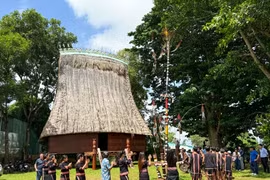
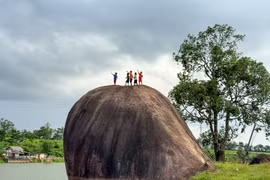
As the only Xê Đăng village on the Gia Lai plateau, Ea Lũh village (Bien Ho commune) boasts a unique beauty amid the Bien Ho tea region, with ancient rock formations of various shapes scattered from the lakeshore deep into the village at the foot of the mountain.
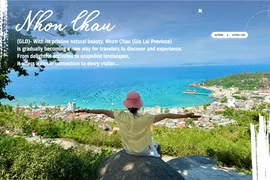
Nhơn Châu island commune is reshaping its tourism strategy by focusing on authentic cultural experiences, environmental protection and community participation, as it seeks to create a distinctive destination while preserving its natural and cultural heritage.
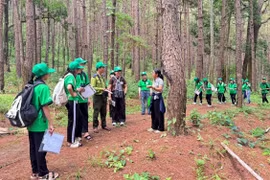
Deep inside the Kon Ka Kinh forest, students are leaving behind mobile phones and internet access to learn practical outdoor skills through immersive experiences as Kon Ka Kinh National Park develops a new school tourism program focused on life skills and nature conservation.
The People's Committee of Gia Lai Province has approved a 12-month pilot program for jet skiing and motorized paragliding in Quy Nhon Ward as part of efforts to promote marine tourism development. The pilot will begin once the activities receive official authorization to operate.
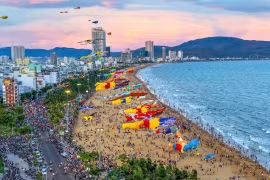
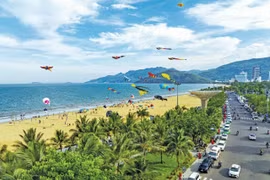
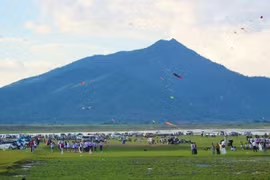
Hundreds of colorful kites, including giant whale, crocodile and stingray designs, filled the skies above Xuan Dieu Beach during the 2026 Quy Nhon-Gia Lai Artistic Kite Festival, drawing thousands of residents and tourists and adding to the city's summer tourism appeal.
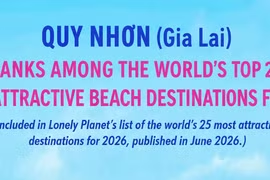
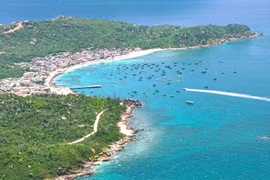
Quy Nhon, located in Gia Lai province, has been recognized as Vietnam's sole representative among the ideal destinations for beach exploration journeys, according to a recent announcement by Lonely Planet.
Authorities in Gia Lai Province have reviewed proposals to develop ecotourism, resort and entertainment projects at Kon Ka Kinh National Park and Kon Chư Răng Nature Reserve through 2030, with a long-term vision extending to 2045.
Tourism is steadily reshaping life on Cu Lao Xanh, a small island commune about 20 kilometers off Vietnam’s coast, as fishermen and their families diversify their livelihoods while local authorities seek to build a sustainable tourism industry around the island’s natural attractions.
Gia Lai Province officially launched the “Gia Lai Welcomes Summer 2026” Tourism Festival on June 20 with a large-scale arts programme that combined traditional culture, contemporary music and tourism promotion, drawing residents and visitors to Nguyen Tat Thanh Square in Quy Nhon Ward.
Gia Lai province has strengthened cooperation with tourism authorities and industry partners across Vietnam as it seeks to develop cruise tourism and establish Quy Nhon Port as a key destination on regional cruise itineraries.
Authorities in Quy Nhon have launched a dedicated passenger pick-up and drop-off point at Mui Tan Wharf for tourist boats serving Nhon Chau Island, replacing the previous departure point at Ham Tu fishing port as part of efforts to improve service quality, enhance safety and tourism management.
The 6th Cham Ethnic Cultural Festival will be held in Khanh Hoa Province from June 26 to 28, 2026, bringing together Cham communities from seven provinces and cities across Vietnam to celebrate and promote their cultural heritage.
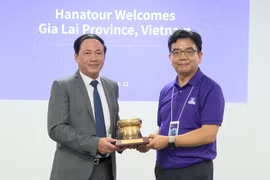
Gia Lai is seeking closer cooperation with South Korea’s leading travel company HanaTour to expand tourism links and promote charter flight services, as the province prepares to host Vietnam’s National Tourism Year 2026 and increase international visitor arrivals.
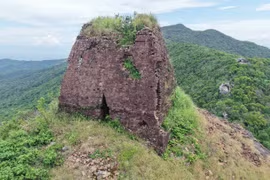
After a nearly 10-hour trek covering more than 8 kilometres through dense forest, visitors were only able to approach within just over 10 metres of Hon Chuong Tower before thick fog obscured the solitary Cham structure perched atop Hon Chuong Mountain in De Gi Commune, Gia Lai Province.
Gia Lai is well positioned to become a leading sports tourism destination in Vietnam’s central and highland regions, experts said at a national scientific conference held on June 5 in Quy Nhon Ward.
The Tien Son alluvial ground in Bien Ho commune has become a popular weekend destination for families, students and young people seeking outdoor recreation, fresh air and scenic views in Gia Lai Province.