With the motto “Discipline, Professionalism - Breakthrough, Creativity - Efficiency, Sustainability,” Hanoi has reaffirmed its determination to take bold, pioneering action, leveraging its central role to create new momentum for national development in the coming era.
On the occasion of the opening of the 14th National Congress of the Communist Party of Vietnam, Politburo member and Secretary of the Hanoi Party Committee Nguyễn Duy Ngọc spoke to Hà Nội Mới Newspaper about the capital’s achievements during the past term and its readiness to shoulder a leading political role in translating the Party’s strategic vision into reality.
▪ Looking back at the 13th Party Congress term and 40 years of Đổi mới (Renovation), how do you assess Hanoi’s contributions to the nation’s overall achievements?
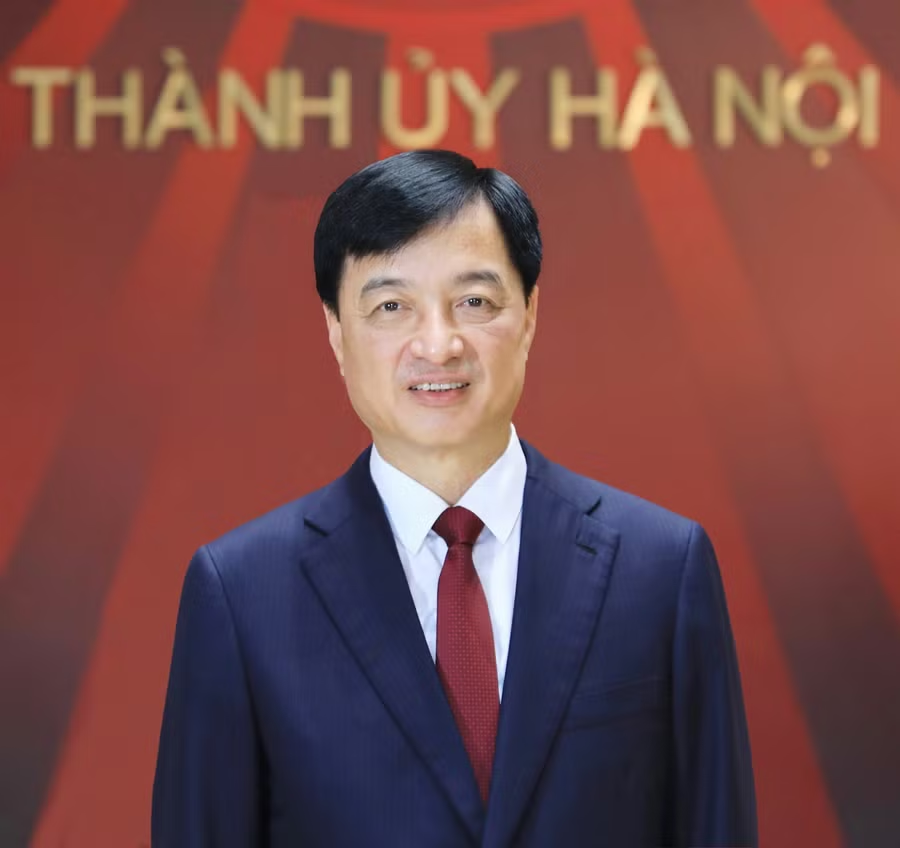
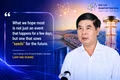
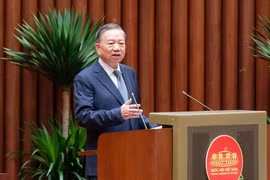
Politburo Member, Secretary of the Hanoi Party Committee Nguyễn Duy Ngọc. Photo: PNO
- The 13th Party Congress term and four decades of Đổi mới represent a period of profound, comprehensive and breakthrough development for the country, demonstrating the resilience, intellect and aspiration for progress of the Vietnamese nation.
As the capital and heart of the country, Hanoi has always been acutely aware of its pioneering and exemplary responsibility in implementing the Party’s policies and resolutions, particularly the strategic directions of the Politburo, the Secretariat and the General Secretary, thereby creating positive spillover effects nationwide.
By fully leveraging its potential and strengths, and drawing on a tradition of unity, resilience and creativity, the Party Committee, government and people of Hanoi have overcome numerous challenges to effectively implement the Resolution of the 17th Hanoi Party Congress for the 2020–2025 term.
The year 2025 marks a major breakthrough. Hanoi has taken the lead in restructuring its administrative apparatus, implementing a two-tier local government model, and consolidating 526 wards, communes and townships into 126 administrative units.
The two-tier local government model is now operational, gradually removing institutional bottlenecks and pioneering decentralisation, administrative reform and digital transformation. This has ushered in a new development mindset, improved governance effectiveness and enhanced service quality for residents and businesses.
Despite undertaking many unprecedented tasks simultaneously, the city has maintained stable operations, met key development objectives and safeguarded three core pillars: strong economic growth, national defence and security, and social welfare.
For the first time in many years, Hanoi met or exceeded all 24 key socio-economic targets. GRDP growth reached 8.16%, surpassing the 8% target and significantly higher than the 6.52% recorded in 2024.
The city’s economic scale reached approximately USD 63.5 billion. Per capita income stood at USD 7,200. State budget revenue totalled 711 trillion VND (about USD 28.4 billion), equivalent to 138.4% of the estimate and the highest level in recent years. Public investment disbursement reached nearly 90 trillion VND (around USD 3.6 billion), or 106.8% of the plan assigned by the Prime Minister.
▪ The 14th National Party Congress, held in Hanoi, is seen as a milestone opening a new era. How has the capital prepared itself for this role?
- Hanoi is currently experiencing an intense political atmosphere, as the entire Party, people and armed forces look toward the 14th National Party Congress—a historic event that will define the country’s strategic vision and action framework for a new development phase.
For Hanoi, hosting the Congress is both an honour and the highest political responsibility before the Party and the people nationwide.
After 40 years of Đổi mới, Vietnam has accumulated sufficient strength and resources to enter a new phase of robust advancement. As the heart of the nation, Hanoi must be the place where the spirit, vision and renewal requirements set out by the 14th Congress are most clearly and promptly realised.
Across the city’s political system and among its people, the prevailing mindset can be summed up in two words: readiness and pioneering. “Readiness” to ensure the Congress is organised safely, thoughtfully and solemnly; and “pioneering” in swiftly translating the Congress’s resolutions into practice with the highest effectiveness.
From the first weeks and months of 2026, Hanoi has proactively implemented key political tasks, translating the Central Committee’s orientations into concrete action programmes.
Upholding the directive spirit of the General Secretary - “Hanoi says what it does, does it quickly, correctly, effectively and to the end”, the city’s leadership and entire political system are demonstrating strong determination, proactive leadership, bold thinking and decisive action, taking the lead in realising the Party’s strategic vision and transforming national aspirations into tangible benefits for the people.
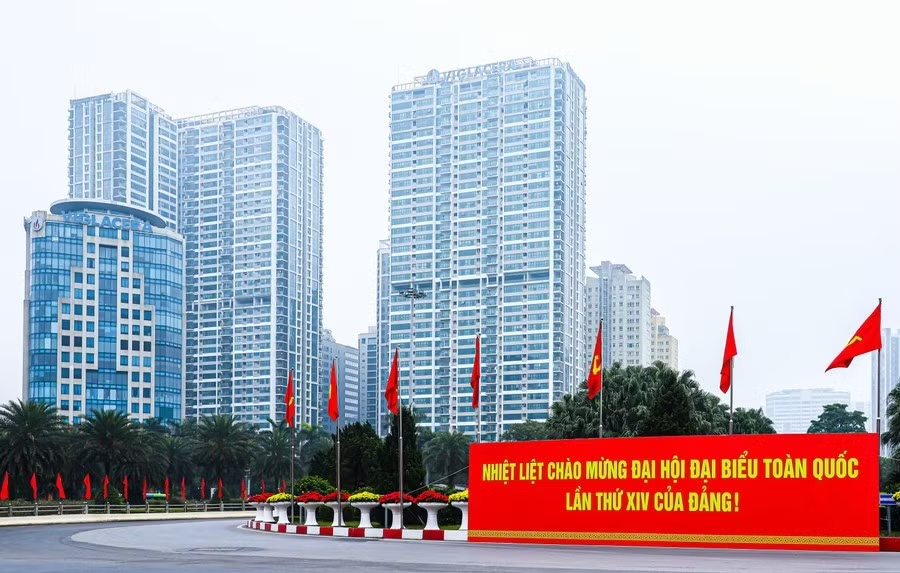
Streets across Hanoi are adorned with flags, flowers, banners, and slogans to welcome the 14th National Party Congress. Photo: Hà My
▪ The Hanoi Party Committee recently focused on the ‘trinity’ of institutions, a 100-year vision plan and a development model. Is this a systematic preparation for the new era?
- Yes. To advance in the new era, alongside other key political tasks, the Hanoi Party Committee has agreed to focus on three long-term strategic priorities: proposing a new resolution to replace Resolution No. 15-NQ/TW dated May 5, 2022, on capital development; amending the Capital Law; and formulating a comprehensive master plan for the capital with a 100-year vision.
This “three-legged stool” will create a synchronised institutional foundation, unlock new development space and shape a modern growth model, providing strong momentum for Hanoi’s breakthrough development in the coming period.
The 100-year master plan goes beyond spatial planning. It defines the capital’s long-term stature, identity and socio-economic structure, positioning Hanoi in close connection with the capital region, the nation and the world.
On that basis, the institutional framework, centred on the Politburo’s resolution and the Capital Law, serves as a political and legal pillar to remove longstanding bottlenecks, while creating robust mechanisms to turn strategic visions into concrete, sustainable drivers of growth.
Accordingly, Hanoi’s development model is shifting decisively from resource-based and extensive investment growth to growth driven by science and technology, innovation, digital transformation and high-quality human resources.
Under the motto “Breakthrough action, widespread results,” the city is developing scenarios to strive for double-digit growth of 11% or higher in 2026 and maintain stable growth thereafter, requiring substantial social investment capital estimated at about 730 trillion VND (approximately USD 29.2 billion) in 2026 alone.
To achieve this, Hanoi is accelerating digital infrastructure, smart urban projects, urban rail systems, and green, digital and circular economy models, while issuing an action plan to implement Resolution 57-NQ/TW dated December 22, 2024, on breakthrough development in science, technology, innovation and digital transformation in Hanoi in 2026.
This systematic preparation is intended not only to drive Hanoi’s own development, but also to enable the capital to act as a locomotive, leading the capital region and the entire country into the new era.
▪ How decisive are human resources and public unity in turning these strategies into reality?
- No matter how well-designed long-term plans or special mechanisms may be, they will remain theoretical without a capable and dedicated cadre of officials and the trust and support of the people.
Hanoi consistently regards personnel work as the “key of all keys,” aiming to build a contingent that is politically steadfast, ethically strong, professionally competent, innovative and courageous—willing to think boldly, act decisively and take responsibility for the common good, particularly amid digital transformation and deep international integration.
The reality of 2025 has shown that even tasks initially considered difficult or unfeasible can be accomplished when the city’s Party Committee demonstrates strong political will, the entire political system acts in unity and the people place their trust in the leadership.
These achievements reflect not only economic progress, but also the strength of social consensus and unity of purpose and action.
Entering 2026, the first year of implementing the Resolution of the 14th National Party Congress, Hanoi has set a clear action motto: “Discipline, professionalism – Breakthrough, innovation – Effectiveness, sustainability.” All levels and sectors are required to operate synchronously across four pillars—the Party, the People’s Council, the People’s Committee, and the Vietnam Fatherland Front and socio-political organisations, particularly in addressing difficult tasks, with clear accountability, regular supervision and performance assessment.
With strong political determination, broad public consensus and collective effort, Hanoi is confident it will gradually realise its goal of building a “Cultured - Civilised - Modern - Happy” capital, achieving sustainable and comprehensive development, becoming a liveable and globally connected city worthy of its role as the nation’s centre and growth locomotive.
Vietnam's top leadership called for more substantive and effective implementation of the country's strategy on science, technology, innovation and digital transformation, urging the entire political system to shift its focus from completing assigned tasks to creating measurable value for citizens.
In an era where credibility is increasingly defined by competence rather than seniority, young grassroots leaders are earning the confidence of their communities through practical initiatives that improve lives.
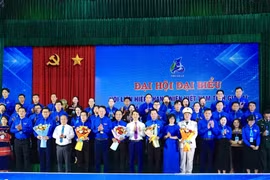
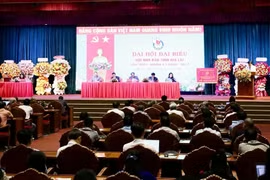
Đỗ Đức Thanh was elected Chairman of the Vietnam Youth Federation of Gia Lai Province on Monday as delegates at the organization's first provincial congress following the merger of the former Gia Lai and Bình Định chapters set priorities for the 2026-2029 term.
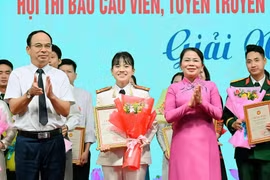
The 2026 Gia Lai Excellent Reporters and Propagandists Contest brought together the province's top grassroots spokespersons and propagandists, providing a platform to strengthen public communication skills, exchange professional experience and promote effective implementation of Party policies.
The Vietnam Youth Federation of Gia Lai has outlined an ambitious agenda for its 2026-2029 term, placing digital transformation, youth entrepreneurship and innovation, and broader engagement at the center of its strategy as the province enters a new stage of development following its recent merger.
Gia Lai's 22 state-owned enterprises are projected to generate over VND14.802 trillion ($567.5 million) in revenue and VND1.368 trillion ($52.5 million) in pre-tax profit during the 2026-2030 period, as the authorities push for sweeping reforms in governance, digital transformation and efficiency.
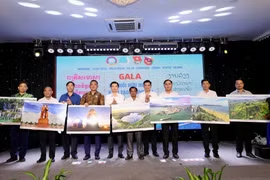
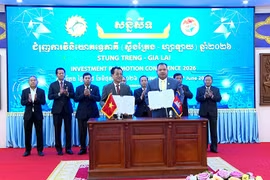
Stung Treng province in Cambodia and Gia Lai province moved to deepen economic and investment ties on June 18, with the two sides signing cooperation agreements and outlining priority sectors for future development during the Stung Treng - Gia Lai Bilateral Investment Promotion Conference 2026.
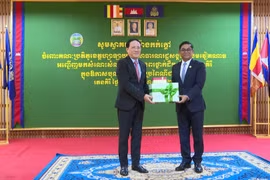
A delegation from Gia Lai province, led by Permanent Vice Chairman Nguyen Tuan Thanh, paid a courtesy visit to Stung Treng Governor Sor Soputra on Tuesday, reaffirming commitments to deepen bilateral cooperation and supporting preparations for the 2026 Business and Investment Promotion Conference.
Authorities across Gia Lai province are moving forward with plans to reorganize villages, hamlets and residential groups as part of a broader effort to streamline grassroots governance and improve public service delivery under Vietnam’s two-tier local government model.
Gia Lai Provincial Party Secretary Thai Dai Ngoc has called for accelerated construction of a large-scale boarding school project serving seven border communes, urging contractors to increase manpower and resources to ensure completion on schedule.
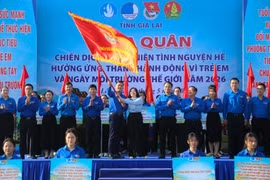
The Gia Lai Provincial Youth Union on May 18 held flower offering and flag-raising ceremonies across the province to commemorate the 136th anniversary of President Hồ Chí Minh’s birth, drawing the participation of nearly 1,000 union members and young people.
In an article written on the occasion of President Ho Chi Minh’s 136th birth anniversary (May 19, 1890 - 2026), the top Vietnamese leader affirmed that “Ho Chi Minh Thought serves as a guiding light along our development path.”
Along Vietnam’s western border, the villages of Triêl in Ia Pnôn Commune and Kloong in Ia O Commune have emerged as stable and thriving communities where most residents trace their origins to Cambodia.
Young people in Gia Lai province are marking Vietnam’s Reunification Day holiday with a distinctive display of patriotism, taking underwater photos with the national flag to promote pride in the country’s seas and islands.
More than five decades after April 30, 1975, the day marking Vietnam’s reunification continues to shape the nation’s identity, inspiring both those who experienced the war and younger generations building the country in peace.
Cát Tiến, once a strategic revolutionary base during the resistance war against the US army, is undergoing rapid transformation, emerging as a dynamic coastal hub in the province with modern infrastructure, expanding tourism, and steady economic growth.
Search teams in Vietnam’s Central Highlands have recovered the remains of 64 fallen soldiers from cave systems in the Chư Pa - Ia Kreng mountain area, as efforts intensify to locate those missing from the resistance war against the United States.
Authorities in Gia Lai have ordered decisive action against delayed and inactive real estate projects, as part of broader efforts to stabilise the market and accelerate social housing development.
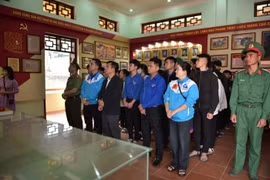
Youth organizations in Vietnam are revitalizing historic “red addresses”, transforming them from solemn memorials into dynamic spaces that inspire civic responsibility and connect younger generations with revolutionary traditions.
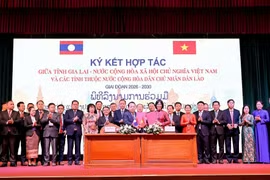
Gia Lai province in Vietnam has signed a cooperation agreement for the 2026 - 2030 period with four southern Lao provinces (Attapeu, Champasak, Salavan and Sekong), aimed at deepening ties across multiple sectors.
On the sidelines of the “Spring Friendship Tour” during the opening week of the National Tourism Year - Gia Lai 2026, Chinese Ambassador to Vietnam Xiong Bo shared his views on the province’s tourism potential and bilateral cooperation with local media.
Leaders of Gia Lai province hosted a delegation of foreign diplomats and international representatives on Friday as part of the “Spring friendship tour”, an event marking the opening of the National Tourism Year - Gia Lai 2026.
Effective grassroots mobilisation in An Lao commune, Gia Lai province, is helping unlock resources for infrastructure and economic development, as local authorities gain strong public backing for key projects.
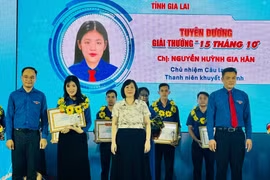
Outstanding young individuals in Gia Lai are being recognized for their contributions to science, culture, and community development, reflecting a broader drive among Vietnam’s youth to innovate while preserving tradition.