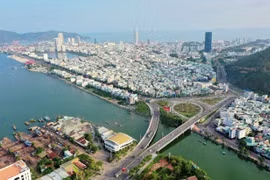
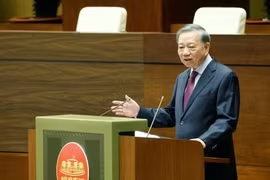
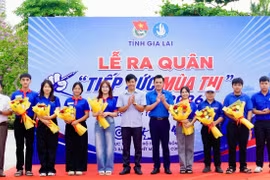
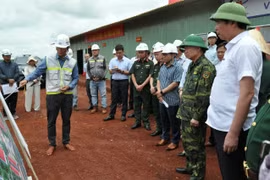
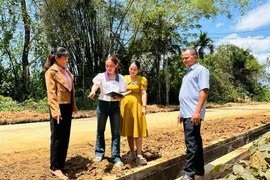
The year marked the completion of the 2021–2025 socio-economic development plan, the successful organisation of Party congresses at all levels and the establishment of the newly merged Gia Lai province, following the July 1 consolidation of the former Gia Lai and Binh Dinh provinces under a two-tier local government model.
Authorities said the transition has created a larger development space and new growth opportunities, laying the groundwork for the 2025–2030 period.
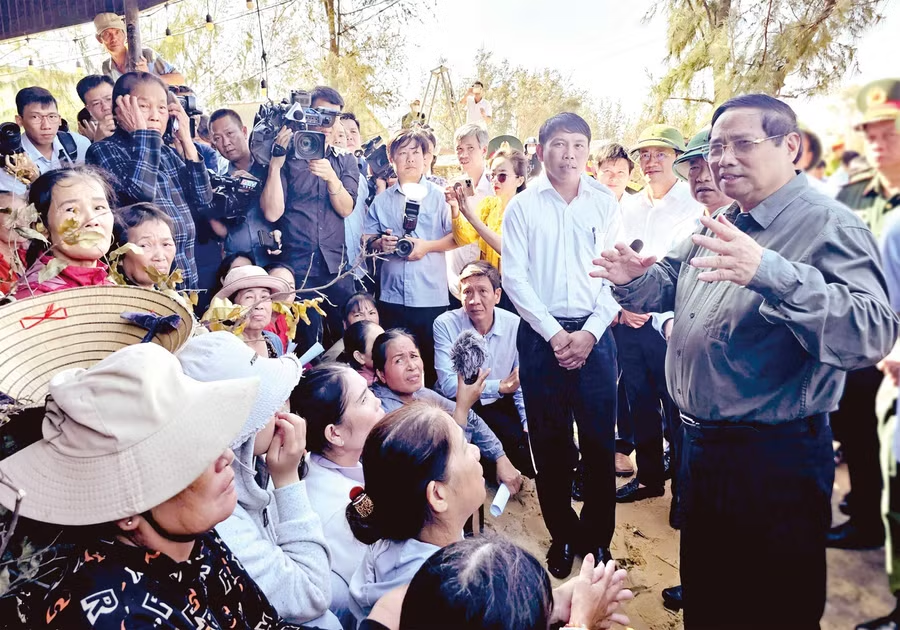
Storm damage tests resilience
Progress was tested in November when Typhoon Kalmaegi, followed by prolonged heavy flooding, caused serious damage to lives and property, disrupting economic activity and social life across the province.
Provincial leaders said coordinated action by the political system and local communities helped Gia Lai stabilise conditions, recover from the disaster and complete most key socio-economic targets.
Economic indicators improve
In 2025, Gia Lai’s gross regional domestic product (GRDP) was estimated to grow 7.2% year on year, ranking third among six localities in the South Central Coast–Central Highlands region. GRDP per capita reached about 85.9 million dong (around $3,370).
Industrial production rose 9%, while export turnover exceeded $3.447 billion. State budget revenue totalled 25.95 trillion dong (about $1.02 billion), and total social investment increased 8.8%. The province created 67,672 new jobs during the year.
Cultural, educational and healthcare services continued to improve, while national defence and public security were maintained. The two-tier local government system gradually became operational following the merger, authorities said.
Investment emerges as a bright spot
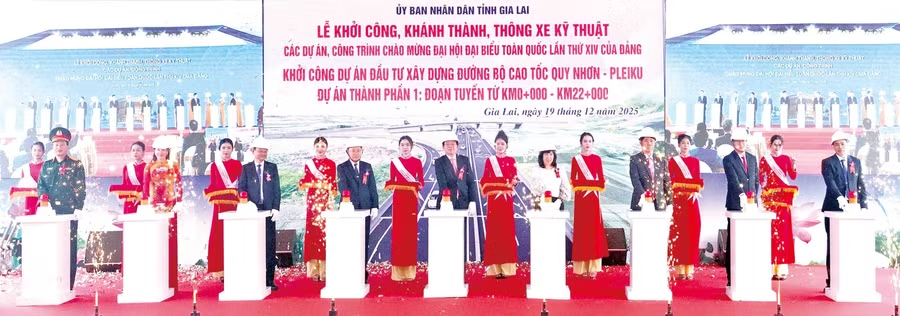
Investment attraction stood out as a key highlight. Gia Lai approved 180 new investment projects with total registered capital of more than 158.37 trillion dong (about $6.2 billion), reinforcing its appeal to domestic and foreign investors.
Foreign direct investment surged to around $1.4 billion, equivalent to 35.684 trillion dong. Nearly 3,000 new enterprises were established with combined registered capital of 27 trillion dong (about $1.06 billion), representing increases of 38% in number and 37% in capital from 2024.
Provincial chairman Pham Anh Tuan said the results reflected a more proactive and targeted investment promotion strategy, built on sustained efforts in previous years.
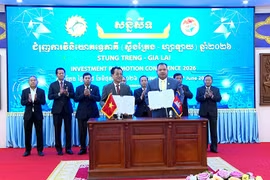
At an investment promotion conference in late August, investors registered 69 projects worth 119.7 trillion dong (over $4.6 billion). Of these, 27 projects, with capital exceeding 26.3 trillion dong (around $1.03 billion), received in-principle approval.
Industry accounted for the largest share, with 84 projects worth more than 42.725 trillion dong (about $1.68 billion), alongside growing investment in agriculture, forestry, fisheries, science and technology, services, tourism and infrastructure.
Authorities said the province would prioritise high-tech, environmentally friendly projects with strong value-added potential, while also courting medium-sized investors from Japan, South Korea, Thailand and Europe.
Governance gaps acknowledged
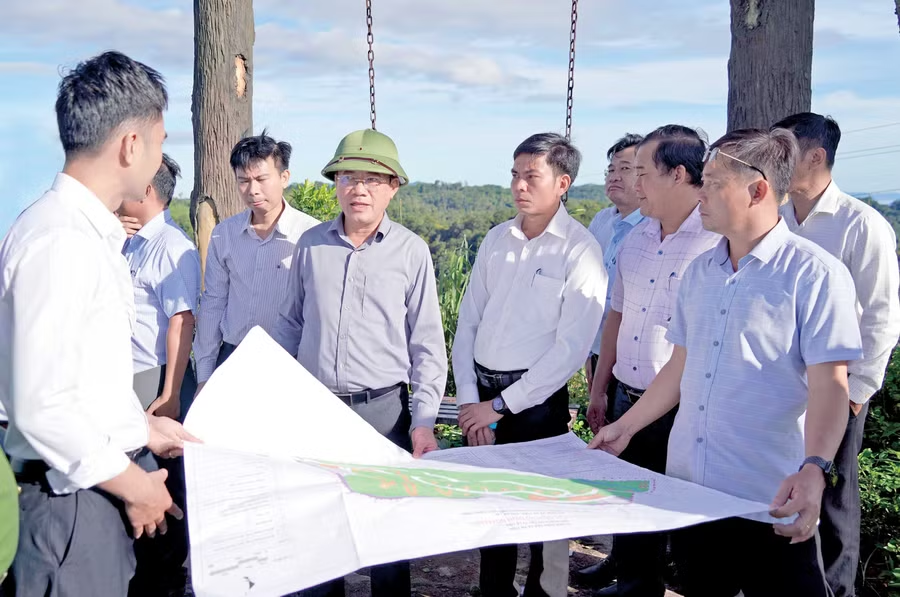
Despite progress, provincial leaders acknowledged shortcomings. Some socio-economic targets were missed, while post-merger governance and administrative performance remained uneven in certain localities. Administrative procedures in some sectors were still cumbersome, and implementation of major tasks lagged behind schedule.
Officials said identifying these issues would help sharpen solutions and accountability in the next phase.
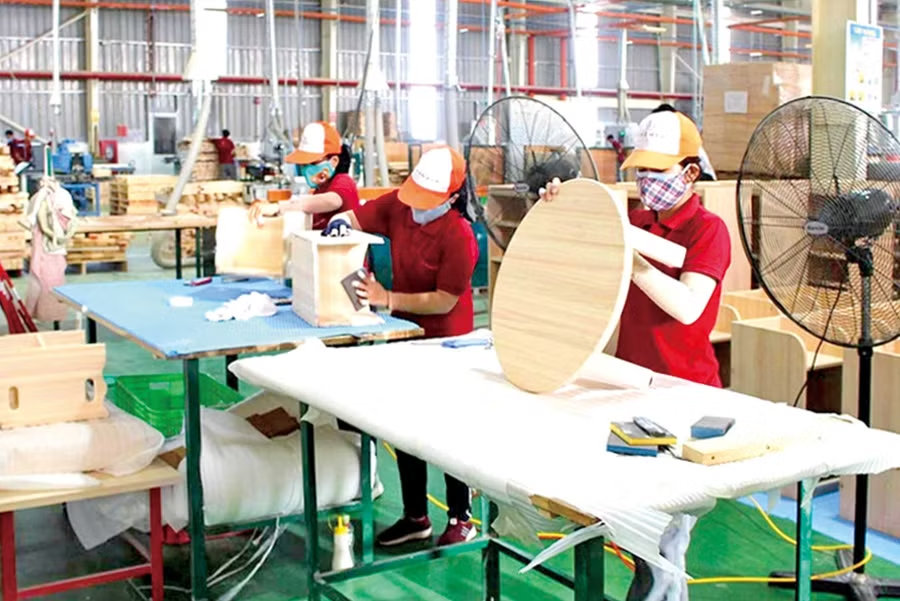
2026 growth target raised
Gia Lai has set a GRDP growth target of 8.8–9.4% for 2026, the first year of implementing the 2025–2030 provincial Party resolution and the new five-year development plan.
Pham Anh Tuan called on departments and localities to define clear priorities, assign responsibilities and accelerate execution, stressing a “no retreat, results-only” approach and greater use of artificial intelligence in management and governance.
Land clearance, compensation and resettlement were identified as decisive factors for project progress, with local leaders held directly accountable for delays.
Development priorities for key sectors
In 2026, agriculture will focus on developing large-scale raw material zones, shifting to higher-value crops and promoting concentrated, high-tech livestock farming linked to circular economy models.
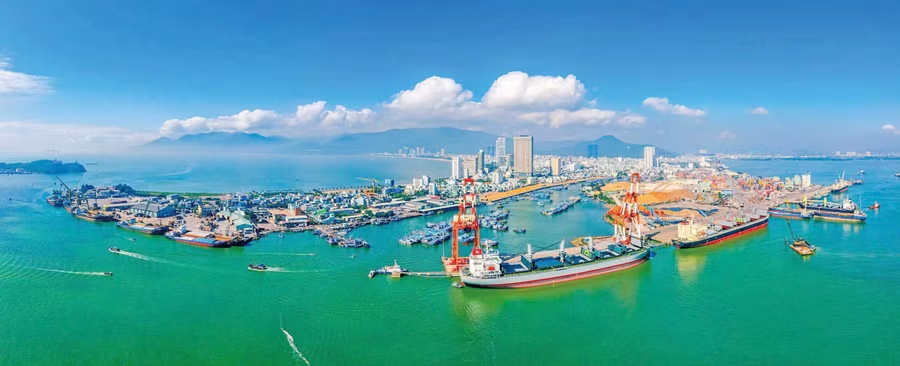
Forestry will prioritise large-timber plantations, while fisheries will move towards sustainable exploitation, reducing small-capacity vessels and expanding aquaculture in freshwater, brackish and marine environments, supported by modern fishing port infrastructure.
Industrial policy will emphasise stability and competitiveness, with manufacturing and processing as the economic backbone. Semiconductors and artificial intelligence are identified as breakthrough sectors, supporting Gia Lai’s ambition to become a regional hub for renewable energy, processing industries and the digital economy.
The province will also step up investment in renewable and clean energy, including onshore and offshore wind, solar, biomass, waste-to-energy and emerging fuels such as hydrogen and green ammonia.
Efforts will intensify to attract investors to industrial parks and economic zones, particularly the Le Thanh International Border Gate Economic Zone and the Becamex VSIP Binh Dinh Industrial–Urban–Service Complex.
Development priorities for key sectors
In 2026, agriculture will focus on developing large-scale raw material zones, shifting to higher-value crops and promoting concentrated, high-tech livestock farming linked to circular economy models.
Forestry will prioritise large-timber plantations, while fisheries will move towards sustainable exploitation, reducing small-capacity vessels and expanding aquaculture in freshwater, brackish and marine environments, supported by modern fishing port infrastructure.
Industrial policy will emphasise stability and competitiveness, with manufacturing and processing as the economic backbone. Semiconductors and artificial intelligence are identified as breakthrough sectors, supporting Gia Lai’s ambition to become a regional hub for renewable energy, processing industries and the digital economy.
The province will also step up investment in renewable and clean energy, including onshore and offshore wind, solar, biomass, waste-to-energy and emerging fuels such as hydrogen and green ammonia.
Efforts will intensify to attract investors to industrial parks and economic zones, particularly the Le Thanh International Border Gate Economic Zone and the Becamex VSIP Binh Dinh Industrial–Urban–Service Complex.