Local officials say rising incomes, improved infrastructure and increasing public consensus reflect the effectiveness of strong grassroots leadership.
Formed through the merger of the former An Thanh, An Tin and An Son communes, Van Duc now has 721 Party members across 24 cells. These cells have been tasked with linking resolutions to concrete actions, an approach credited with accelerating development across villages.
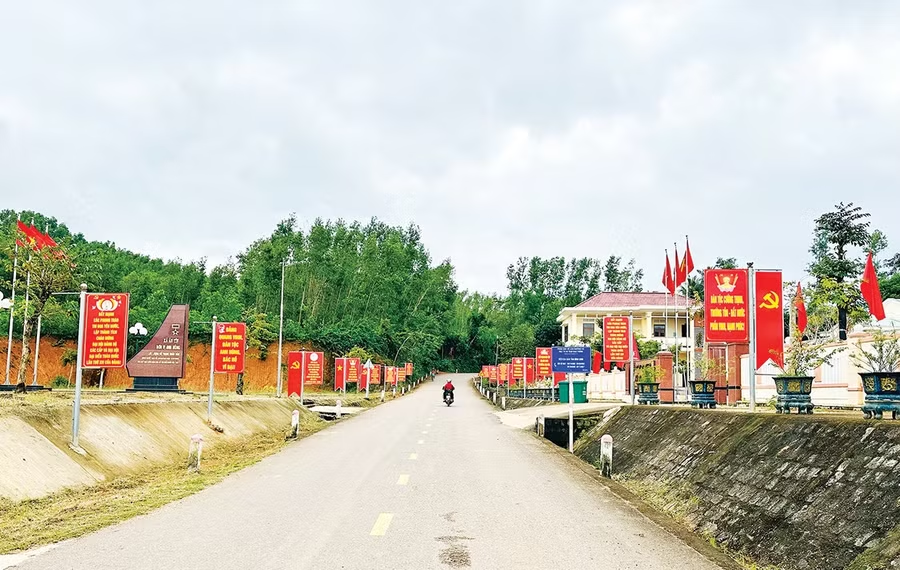
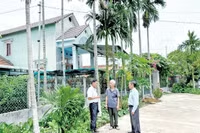
In Thanh Luong village, the Party cell’s renewed governance and planning have enhanced meeting quality, strengthened internal unity, and mobilised villagers to support rural infrastructure projects. Residents have donated land, contributed labour and funding, joined fire-prevention teams, and maintained flower-lined roads and security camera systems.
Pham Van Bang, Secretary of the Thanh Luong Party cell, said clear task assignments and a focus on activities directly affecting daily life have encouraged strong public participation.
Similarly, An Thuong 1 village has implemented the “Four Good Party Cell” model, assigning each Party member to household groups. This has led to 241 households registering for waste collection, the creation of two national flag roads spanning 2 km, and the construction of nearly 1.4 km of concrete roads funded by 720 million VND (approx. USD 29,000). Thousands of square metres of land were also donated for community facilities. The cell has been rated “excellent” for seven consecutive years.
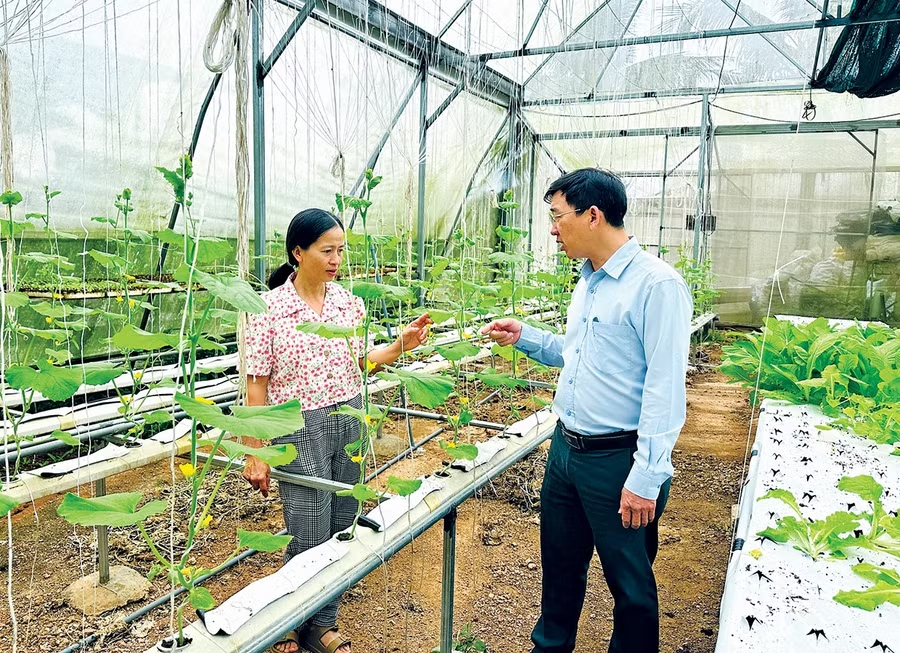
Alongside political strengthening, the commune has directed efforts toward sustainable economic development. Party cells have encouraged residents to shift from low-yield rice and acacia cultivation to higher-value fruit trees, free-range poultry and hydroponic farming.
In Hoi An village, Party guidance enabled households to borrow from the Social Policy Bank to invest in new agricultural models. A standout example is farmer Nguyen Thi Hien, who borrowed 100 million VND (approx. USD 4,000) to build two greenhouses for hydroponic vegetables, cultivate pepper vines and raise chickens. Her model now generates over 350 million VND (approx. USD 14,000) annually.
In An Thuong 1 village, residents converted 12 hectares of low-efficiency crops to fruit trees and replanted 55 hectares of acacia. Farmer Nguyen Thi Thom borrowed 100 million VND (approx. USD 4,000) to switch from acacia to growing 450 guava trees intercropped with 150 green-skinned grapefruit trees, earning a yearly profit of 130 million VND (approx. USD 5,200).
According to the commune People's Committee, average rice yields for 2024–2025 reached 7.18 tons per hectare, with total rice output hitting 12,137 tons — surpassing targets. Maize and other crops produced 3,564 tons, nearly 70 hectares of grapefruit were maintained and 201 hectares of crops were converted. Livestock and poultry numbers exceed 181,000. Average annual per-capita income is now 64 million VND (approx. USD 2,600). Poverty is projected to drop to 1.08% by 2025, with the near-poor rate reduced to 1.56%.
Nguyen Xuan Phong, Secretary of the commune Party Committee, said the results demonstrate that strong Party organisations drive socio-economic development and improved living standards. The commune aims to further strengthen grassroots political structures, promote close engagement with residents, expand crop conversion, and unlock local potential with the goal of achieving new rural status by 2028.