The initiatives aim to equip employees with stronger professional capabilities to meet rising labor-market demands.

This year, provincial authorities are providing more than 1.3 billion VND in financial support for skills training across 13 businesses. Of this, over 568 million VND is allocated to six enterprises in economic and industrial zones, while more than 800 million VND from vocational training support funds under Decree No. 80/2021/NĐ-CP is approved for seven small and medium-sized enterprises. The funding is helping companies reduce training costs and expand opportunities for young workers.

Tourism and service companies are among the most active investors in workforce development. ANYA Premier Hotel in Quy Nhơn Nam Ward is partnering with Miền Trung (Central) Training Co., Ltd. and Kim Cúc Tourism and Service Investment JSC to train staff in hospitality and culinary skills.
In 2025, Miền Trung training is conducting courses for 50 hospitality learners and 33 culinary trainees, while Thiên Thọ Co., Ltd., the parent company of Ohana Village Quy Nhơn, is training 23 workers in hospitality services. Businesses say the programs help raise service standards and strengthen brand competitiveness.
For many employees, the training is immediately applicable. Nguyễn Thị Mỹ Hằng, a housekeeping supervisor at ANYA Premier Hotel, said the course has taught her more efficient room-making techniques, customer-focused communication, and higher professional precision, skills she can directly apply in her management role.
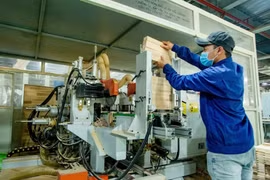
The industrial garment sector is also undergoing notable changes. In September 2025, Quy Nhơn College of Engineering and Technology and Sinh Phát VN Co., Ltd. launched a basic garment-making course for 200 workers to support production expansion into nearby districts including An Lão and Hoài Ân. It is the second year the company has collaborated with training institutions to upgrade employee skills.
Workers report clear improvements. Phan Thùy Linh, a garment employee at Sinh Phát VN Co., Ltd., said formal training has helped her sew faster and more accurately, reducing errors and boosting productivity compared with learning solely through experience.
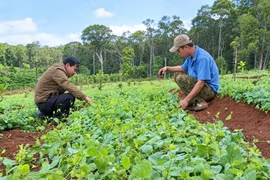
In agricultural mechanization, despite falling outside the sectors eligible for provincial subsidies, An Khê Agricultural Mechanization Enterprise under Quảng Ngãi Sugar JSC is partnering with the Central Highlands College of Electromechanics and Agro-Forestry to train 102 workers in operating, maintaining, and repairing agricultural machinery. The program is enhancing technical capacity and helping staff manage equipment more proactively.
Training institutions play a central role in designing programs aligned with production needs, ensuring workers not only perform tasks but perform them correctly. Instructors also benefit from exposure to real-world industrial environments and updated technologies.
According to lecturer Đặng Thị Quỳnh Hoa from Quy Nhơn College of Engineering and Technology, training must adapt to diverse learners. She noted that industry cooperation allows trainers to access new machinery, device programming languages, and practical production processes, experience that strengthens teaching quality.
Business leaders underscore the value of structured skills development. Ngô Thanh Hoàng of Kim Cúc Tourism and Service Investment JSC said standardized training significantly improves service quality and gives companies a competitive edge.
Across sectors, the positive changes observed among workers highlight the broader impact of vocational training: higher skills, increased confidence, stronger service quality, and improved productivity, contributing to the province’s overall human-resource development.