According to the Provincial Employment Service Center under the Department of Home Affairs, the programme prioritises stable, high-income labour markets, enabling workers to gain skills, international experience and sustainable pathways out of poverty.
Since the start of the year, the centre has rolled out comprehensive measures, focusing on reputable schemes such as Japan’s Technical Intern Training Program (IM Japan), South Korea’s Employment Permit System (EPS) and selected European labour markets.

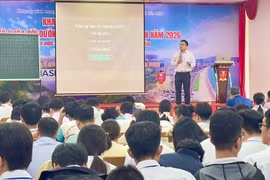
To secure a steady labour supply, the centre has formed seven specialised outreach teams, each comprising eight members led by a team leader. Each team is tasked with sending about 30 workers abroad annually. Outreach activities are conducted flexibly, with a focus on rural areas and ethnic minority communities where demand for employment and higher incomes is strongest.
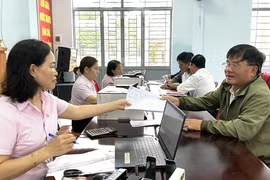
Alongside outreach, the centre provides counselling and organises interviews for hundreds of applicants. In 2025, nearly 200 workers were selected for overseas employment; almost 170 have already departed for Japan and South Korea, while the remainder are completing final procedures.
Nguyễn Thị Hương, Director of the Provincial Employment Service Center, said improving outreach and counselling quality was critical to building a sustainable labour pipeline. The centre, she said, guides workers towards high-income markets with favourable working conditions, helping them prepare through training and pre-departure orientation.

Priority destinations currently include Japan, South Korea, Taiwan and parts of Europe, offering monthly incomes of 20–50 million VND (about USD 820–2,040), depending on market and occupation. Recruitment spans nursing, caregiving, construction, mechanical engineering and high-tech agriculture, creating broad opportunities for young workers.
Working abroad under contract provides not only stable earnings but also professional skills, discipline and international exposure, forming a foundation for long-term development after workers return home.
Hoàng Trung Kiên, born in 1996 in Ia Grai commune, a mechanical engineering graduate who previously worked in Bình Dương, said he chose Japan to enhance his skills and income. “I hope the professional working environment in Japan will help me gain experience, accumulate capital and develop skills for a long-term career,” he said.
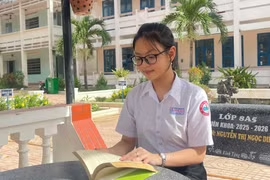
Similarly, Đỗ Thị Ngọc Linh, born in 2005 in Biển Hồ commune, studied Korean to join the EPS programme. After passing interviews, she is completing procedures to depart for South Korea in February 2026 for a planned five-year term. “I hope to earn a stable income to support my family while learning new skills and gaining work experience,” she said.
Enterprises involved in overseas labour placement say Gia Lai has a large, diligent and ambitious workforce. Nguyễn Văn Đức, Director of the Gia Lai branch of MD Vietnam Human Resources Supply Joint Stock Company, said demand for fixed-term overseas employment was rising, particularly in Japan, South Korea and Taiwan, helping poor and near-poor households and ethnic minorities achieve sustainable poverty reduction.
Over the past five years, Gia Lai has sent more than 10,000 workers abroad under contract. Many have returned to start businesses, strengthen household economies and contribute to local socio-economic development.
Phạm Trần Anh, Deputy Director of the Department of Home Affairs, said the province would step up coordination with agencies, local authorities, the employment service centre and enterprises to improve counselling, connect with labour markets and fully implement support policies, aiming to meet the 2026 target of about 2,000 overseas workers.