After five years of implementing the National Target Program (NTP) for socio-economic development in ethnic minority and mountainous areas for the 2021-2025 period, localities across Gia Lai have recorded marked progress, with living standards among ethnic minority communities.
Reporters from Gia Lai Newspaper and Radio & Television spoke with Mr. Trần Văn Thanh, Deputy Director of the Department of Ethnic and Religious Affairs, about key achievements and future directions.
* Mr. Thanh, during the 2021–2025 period, what have been the most notable outcomes of the National Target Program for socio-economic development in ethnic minority and mountainous areas?
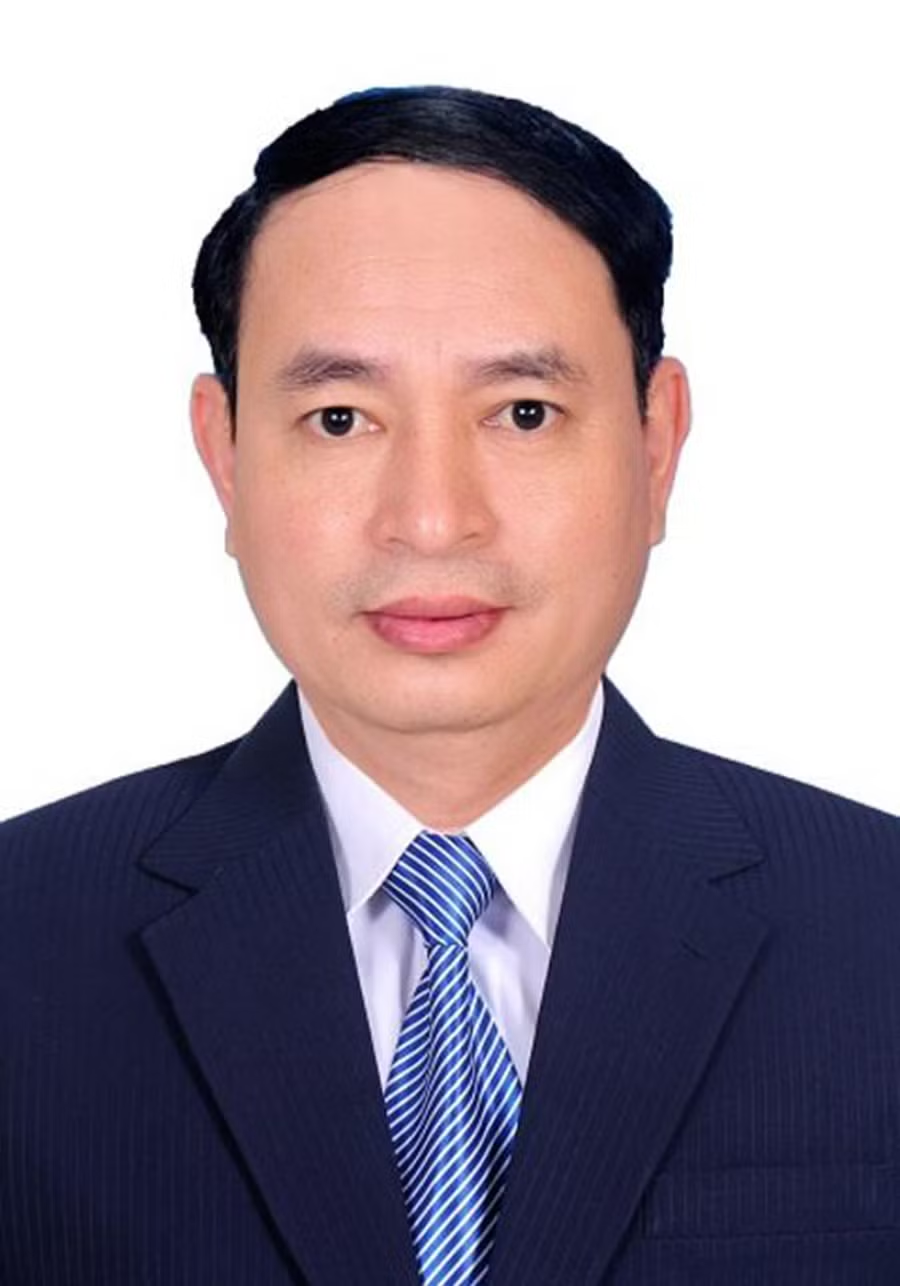
Mr. Trần Văn Thanh. Photo: NVCC
- During the 2021–2025 period, the National Target Program has delivered comprehensive and far-reaching changes across rural, mountainous, and disadvantaged areas.
The program has contributed to restructuring the local economy towards sustainability, supporting poverty reduction, and improving both material and spiritual living standards for residents.
The total state budget allocated to Gia Lai province for implementing the program exceeded VND 4,302 billion (approximately USD 176 million).
With these resources, authorities provided residential land for 234 households, housing support for 3,070 households, vocational transition assistance for 6,109 households, and decentralized clean water access for 9,505 households.
In addition, 19 centralized water supply projects were built, alongside investment in 21 projects for planning, resettlement, and population stabilization.
The program also included forest protection contracts covering 506,662 hectares, support for 513 livelihood diversification projects benefiting 8,146 households, investment in 535 rural transport projects, and maintenance of 268 infrastructure facilities, among other initiatives.
As a result, the poverty rate among ethnic minority households has declined by more than 4% annually. All communes now have asphalt or concrete roads leading to their centers; schools and health stations are solidly constructed and fully equipped; and every hamlet and village has a community cultural house. These outcomes have laid a strong foundation for sustainable development.
* During implementation, how has the NTP impacted the awareness and self-reliance of local people?
- Beyond tangible material support, the program has driven a clear shift in mindset and self-reliance among ethnic minority communities.
Through access to support policies and direct participation in projects, residents have gradually moved away from dependency and passivity towards greater initiative in economic development.
Many households have actively applied scientific and technological advances, shifted to crops and livestock better suited to local conditions, established production linkages, joined cooperatives and associations, and adopted a more market-oriented production approach.
More importantly, the program has strengthened the spirit of self-reliance and resilience, reinforced trust in ethnic policies, and created a solid platform for sustainable development in the next phase.
That said, challenges remain. Ethnic minority areas are extensive, with dispersed populations, difficult transport conditions, and linguistic and cultural differences that complicate communication and mobilisation. In some localities, implementation of sub-projects has been slow, disbursement rates remain low, regulatory obstacles persist, and beneficiary lists do not always fully reflect actual needs.
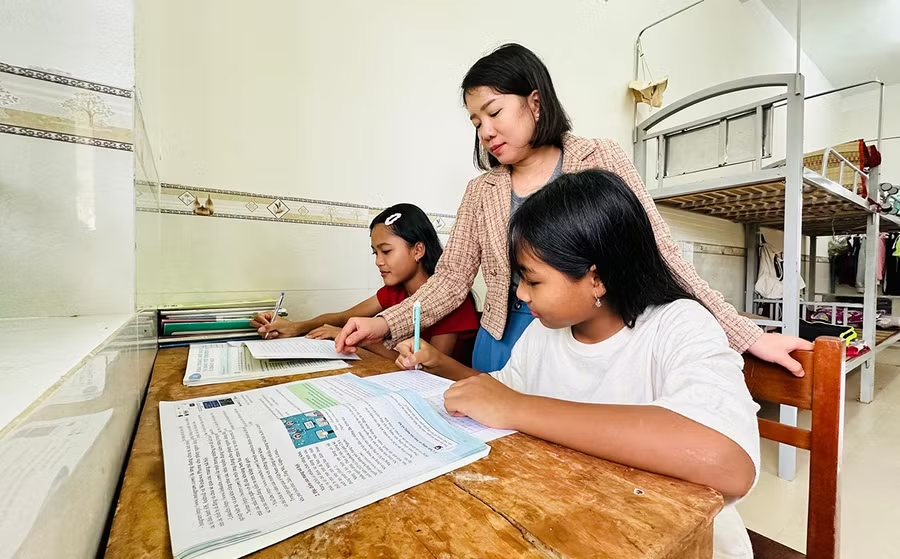
Thanks to funding from the National Target Program, students at Canh Liên Semi-Boarding School for Ethnic Minorities (Canh Liên commune) can study and live in spacious, clean dormitories. Photo: D.Đ
* On December 11, 2025, the National Assembly issued Resolution No. 257/2025/QH15 to integrate three National Target Programs into a single comprehensive program. How do you assess this decision?
- I consider the National Assembly’s Resolution No. 257/2025/QH15, which integrates the three National Target Programs into one unified framework for the 2026–2035 period, to be a strategic, breakthrough, and timely move.
Previously, the separate implementation of these programs led to fragmentation and overlap in objectives, policies, and resource allocation, reducing overall effectiveness. Integration will help unify goals, concentrate resources, and narrow development gaps between regions—particularly in ethnic minority and mountainous areas, which remain the country’s core poverty zones.
The integrated program will follow clear guiding principles: enriching the people, strengthening the nation, and ensuring a prosperous and happy life for all. Importantly, existing policies will not be reduced. Instead, investment will be more sharply focused on ethnic minority and mountainous areas, prioritising projects with direct impacts on livelihoods, infrastructure, education, healthcare, and daily life.
This presents a major opportunity for the program to act as a lever for improving quality of life, strengthening public trust, and promoting innovation in governance and the effective use of public investment.
* What key lessons should be carried forward to ensure the program’s effectiveness in the 2026–2035 period?
- To maximise the effectiveness of the program in 2026–2035, the Government and relevant ministries need to further refine mechanisms and policies to ensure coherence and practicality, streamline administrative procedures, and allocate resources in a more focused manner. Priority should be given to projects that deliver direct and long-term benefits to people’s livelihoods and living conditions.
At the same time, beneficiary localities should strengthen the capacity of grassroots officials, enhance inter-sectoral coordination, and promote the role of communities and residents as central actors in project implementation. This is a decisive factor in ensuring depth, sustainability, and lasting impact.
With the National Assembly’s strong policy direction and the determined involvement of the entire political system, I am confident that the 2026-2035 National Target Program will generate more substantial changes in ethnic minority and mountainous areas, steadily improving quality of life and further strengthening public trust in the Party and the State.
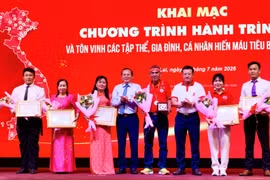
For more than a decade, Trần Duy Nhất and Võ Thanh Hưng have remained committed to voluntary blood donation, each giving blood more than 30 times in an effort to save lives and encourage others to contribute.
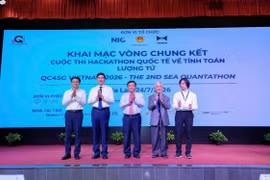
The International Hackathon on Quantum Computing for Social Good (QC4SG 2026) opened on July 24 at the International Center for Interdisciplinary Science and Education (ICISE), bringing together young researchers, scientists and technology entrepreneurs to develop solutions for challenges.
Hundreds of residents, students and science enthusiasts attended two free public lectures on astronomy and space at the Center for Science Discovery and Innovation in Quy Nhon Nam Ward, Gia Lai Province, on Saturday as part of the 2026 International Community Astronomy Week.
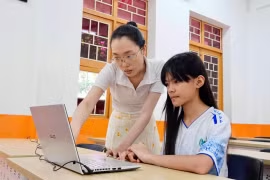
A free community summer program in Gia Lai is providing young people with practical opportunities to develop physical fitness, creative thinking and digital skills through classes in Vovinam martial arts, graphic design and artificial intelligence applications.
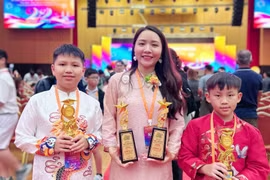
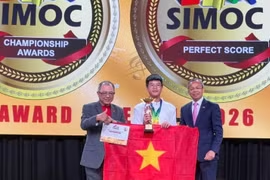
Two students from Vietnam's Gia Lai province secured top honors at the Singapore International Mathematical Olympiad Challenge (SIMOC) 2026, with one earning a gold medal and one of the competition's highest overall distinctions.
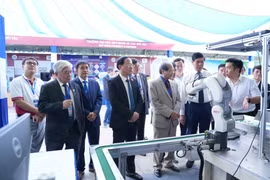
VCCA 2026, Control Automation Digital Transformation, technology transfer, smart automation, artificial intelligence, AI, Internet of Things, IoT, robotics, smart manufacturing, digital transformation, innovation.
Gia Lai will host a week-long series of international quantum technology events from July 23 to 29 under the Gia Lai Quantum Year programme, bringing together scientists, businesses and innovators from Vietnam and to strengthen collaboration and accelerate the application of quantum technologies.
Artificial intelligence may be transforming education and everyday life, but understanding the mathematics behind the technology is essential to using it effectively, educators and students at Vietnam’s 2026 Mathematics Summer School say.
Summer jobs are giving students in Gia Lai more than an opportunity to earn money for the new school year. For some, working during the school break has become a valuable introduction to adult responsibilities, practical skills and potential career paths.
Pleiku Traditional Medicine and Rehabilitation Hospital is strengthening its treatment capacity through specialist training and technology transfer from higher-level hospitals, allowing more patients to access advanced traditional medicine and rehabilitation services locally.
A mother and calf killer whale pair has been spotted hunting close to the shore off Vung Boi in An Luong Commune, Gia Lai Province, attracting large numbers of residents, tourists and wildlife enthusiasts over the past two days.
Doctors at Hoang Anh Gia Lai University of Medicine and Pharmacy Hospital have successfully performed the province's first Frey procedure to treat a patient with chronic pancreatitis caused by pancreatic duct stones, marking a milestone in the local adoption of advanced surgical techniques.
The International Community Astronomy Week 2026 will be held from July 24 to 26 at the Center for Science Discovery and Innovation in Quy Nhon Nam Ward, Gia Lai Province, under the theme "Gateway to the Stars".
Võ Đăng Tuệ, a Class 12A2 student at Chi Lăng High School in Gia Lai province, has emerged as the top scorer in Vietnam’s national high school graduation examination for the A0T subject group, crediting his achievement to a study approach focused on deep understanding.
Several students in Gia Lai province delivered outstanding performances in Vietnam’s 2026 National High School Graduation Exam, earning top provincial honors while highlighting the importance of disciplined study, perseverance and effective learning strategies.
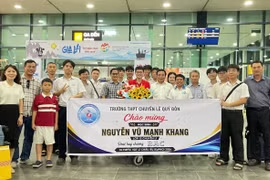
Winning a silver medal at the 2026 European Physics Olympiad (EuPhO), Nguyễn Vũ Mạnh Khang, a student at Lê Quý Đôn High School for the Gifted in Quy Nhơn Ward, Gia Lai Province, helped strengthen Vietnam's performance at one of Europe's leading international science competitions.
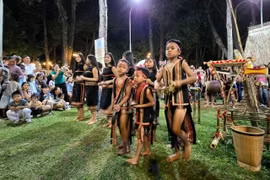
Families of Jrai artisans performed traditional gong music and xoang dances on Saturday as a special "Weekend Gong Show - Enjoy & Experience" celebrated the 25th anniversary of Vietnamese Family Day while highlighting the role of households in preserving indigenous cultural heritage.
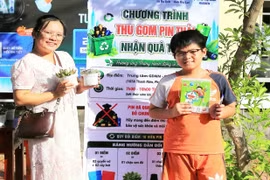
Community initiatives that exchange recyclable waste for environmentally friendly gifts are encouraging more households in Bình Định Province to adopt waste sorting at the source, helping promote recycling and strengthen environmental awareness across local communities.
Women’s Unions across Gia Lai province are strengthening long-term support programs for disadvantaged children, orphans, and vulnerable youth through sustained sponsorship initiatives, financial assistance, and community-based care during the Action Month for Children 2026.
Gia Lai authorities have intensified food safety inspections across the province as officials seek to strengthen public health protections and promote a safe, trustworthy image for visitors during the peak summer tourism season.
The central province of Gia Lai is advancing the conservation of biological genetic resources through digital technology and modern molecular biology techniques, aiming to improve biodiversity protection and support future socio-economic development.
Entrusted capital from the local budget currently accounts for 12.4% of the total capital managed by the Gia Lai Provincial Branch of the Vietnam Bank for Social Policies (VBSP), helping expand policy lending and support local development priorities.
ICISE has been ranked sixth in Vietnam in the field of Physical Sciences in the latest Nature Index assessment, covering the period from February 1, 2025, to January 31, 2026.
Winning first prize at the 2025–2026 Provincial Excellent Homeroom Teacher Contest for lower secondary schools marks another milestone in the career of Trần Thị Mỹ Long, a Literature teacher at Lê Hồng Phong Secondary School in Quy Nhơn Ward.