Hospital specialists said the new service is expected to reduce referrals to higher-level facilities and lower treatment costs for patients with health insurance.
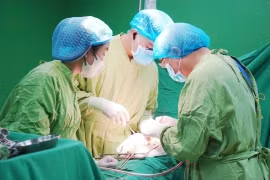
Two elderly patients were among the first to undergo the procedure. Rơ Lan Plip, 78, from Plei Đung hamlet in Ia Hrú commune, regained stable health after surgery on November 27 following weeks of being bedridden due to necrosis of the left femoral head. Doctors reported the operation was successful, and the patient is expected to walk normally again with continued rehabilitation.

Plip said he had endured pain since a September accident in which a child on an electric bicycle struck his left leg. Financial constraints prevented him from seeking early treatment. “After surgery, I feel much better, the pain has eased, and I can now practice walking with support”, he said.
Eighty-four-year-old Nay Phong from Chư Pưh commune also underwent partial hip replacement surgery after suffering a displaced, closed fracture of the left femoral neck that left him immobile for months. He credited health insurance coverage for reducing treatment costs and said he is optimistic about regaining mobility with consistent rehabilitation.

According to Dr. Dương Ngọc Sơn, Level II Specialist and Deputy Head of the Department of Orthopedic Trauma and Burns, both patients arrived with severe pain and an inability to stand or walk.
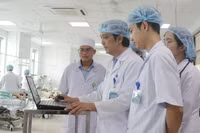
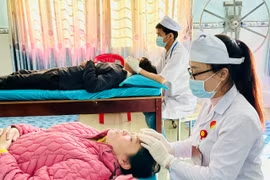
Clinical evaluations and imaging led the surgical team to recommend partial hip replacement to relieve pain rapidly, restore movement, and minimize complications. “Both surgeries went smoothly, and the patients are now undergoing functional rehabilitation with medical staff”, he said.
To prepare for routine hip replacements, the hospital sent medical personnel for training at higher-level institutions and signed professional support agreements that enabled specialists to transfer techniques. Provincial investment in equipment and machinery further allowed the hospital to implement the procedure regularly.
The hospital said that offering partial hip replacement locally helps elderly and low-income patients avoid costly transfers and benefit from insurance co-payment mechanisms that reduce financial pressure.