Local administrations have completed reviews and drafted restructuring plans, which have been submitted to provincial authorities. The next phase will involve collecting public feedback before the proposals are finalized in accordance with regulations.
Under Plan No. 206/KH-UBND issued by the Provincial People’s Committee, the restructuring process must comply with legal requirements while taking into account local geographical conditions, population distribution, historical and cultural characteristics, and practical governance needs.
The province aims to reduce the number of villages, hamlets and residential groups by 40-45% overall. The target reduction ranges from 50-55% in wards, 40-45% in lowland communes, and 30-35% in mountainous, ethnic minority and border areas.
Authorities are also linking the restructuring effort with broader reforms, including consolidating the grassroots political system, reorganizing part-time personnel and making more effective use of existing community facilities, cultural centers and infrastructure.
Biển Hồ Commune, formed through the merger of the former Biển Hồ, Nghĩa Hưng, Chư Đang Ya and Hà Bầu communes, currently has 40 villages and hamlets. Under the proposed plan, that number would be reduced to 25, representing a 37.5% decrease.
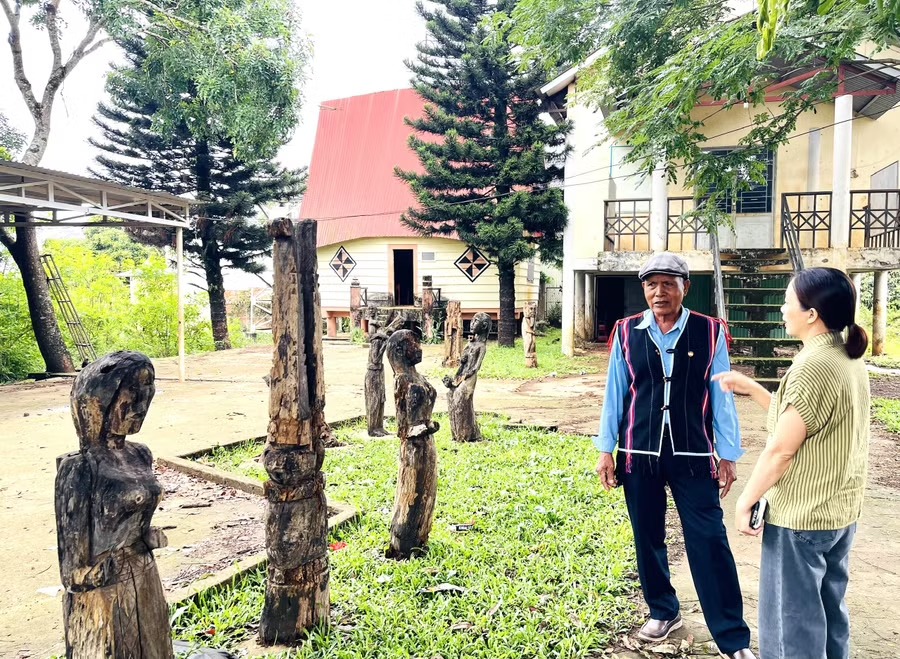
Đặng Khánh Toàn, Vice Chairman of the Biển Hồ Commune People’s Committee, said the proposal was developed following a review of population size, geographical conditions and residents’ living patterns, while preserving villages with distinctive characteristics.
Community leaders have largely supported the changes. Hmrik, village elder of Ia Nueng village, said merging Phung and Ia Nueng villages was appropriate because the two communities are adjacent and share similar cultural traditions and lifestyles.
In Đak Sơmei Commune, a Region III locality, authorities are seeking to balance administrative streamlining with the preservation of ethnic minority cultural identities.
Đinh Ơng, Chairman of the Đak Sơmei Commune People’s Committee, said the commune’s mountainous terrain, long distances between settlements and challenging transportation conditions, particularly during the rainy season, require careful consideration.
Many villages have relatively small populations but represent long-established communities closely linked to ethnic minority cultural traditions and communal spaces, he said.
Under the proposed plan, Đak Sơmei would reduce the number of villages and hamlets from 10 to eight while retaining five villages with unique characteristics. Two pairs of villages that do not meet household-size requirements would be merged.

Authorities also plan to retain Hamlet 18 and incorporate 90 Kinh households currently living within Tul Đoa village to establish a new Hamlet 18 with 308 households, a move intended to meet regulatory standards while maintaining community stability.
Pleiku Ward plans one of the province’s largest reductions. The locality currently has 40 residential groups and villages comprising 15,761 households and intends to reduce the number to 16 residential groups and one special village, a 57.5% decrease.
Nguyễn Xuân Phước, Secretary of the Ward Party Committee and Chairman of the Ward People’s Council, said the restructuring is designed to streamline administration, improve management efficiency and create conditions for future development.
Officials emphasized that the objective extends beyond reducing administrative units to improving governance quality and public services.

In Quy Nhơn Ward, which currently has 63 neighborhoods, 148 part-time officials and 259 people directly involved in neighborhood activities, authorities plan to reduce the number of administrative units to 22, a 65% decrease. The restructuring follows a requirement that each residential group contain at least 1,000 households.
An exception will be made for Neighborhood 9 on Hải Minh Peninsula, which has 565 households but will remain unchanged because of its isolated location, transportation conditions and specific management requirements.
Nguyễn Đức Toàn, Chairman of the Quy Nhơn Ward People’s Committee, said the ward is simultaneously developing plans to reorganize its part-time workforce to align with the new administrative structure.
“The goal is not only to reduce the number of administrative units but also to establish appropriately sized residential groups, improve management efficiency and better serve residents during the province’s new phase of development,” he said.
South Quy Nhơn Ward has also proposed reducing its neighborhoods from 33 to 16, a decline of 51.5%.
According to Đặng Mạnh Cường, Secretary of the Ward Party Committee, the restructuring will help streamline administrative operations, reduce the number of part-time officials, improve state management efficiency, concentrate resources for infrastructure development and enhance the use of grassroots cultural facilities.
Following the reorganization, the ward expects to accelerate population data digitization, improve management quality, enhance public services and facilitate investment in infrastructure and community facilities.
Under the provincial roadmap, the Department of Home Affairs will consolidate proposals submitted by communes and wards and advise the Provincial People’s Committee on a comprehensive province-wide restructuring plan.
Localities are required to complete proposals and gather public feedback by June 22, 2026. Commune-level People’s Councils are scheduled to review and approve restructuring resolutions by June 30, 2026.
Officials say the initiative is not merely an administrative adjustment based on household-size criteria. The broader objective is to establish a governance framework suited to the two-tier local government model, strengthen the effectiveness of the grassroots political system and improve public services for residents across the province.