Rejecting mass-produced powdered and liquid yeast, distillers in Cù Lâm hamlet, An Nhơn Tây commune, rely solely on traditional fermentation and copper stills to maintain quality and reputation.
The village currently supplies around 400,000 liters of liquor annually, with all products certified under the provincial OCOP (One Commune One Product) program.

According to Dương Văn Hành, Vice Chairman of the Bình Định Bàu Đá Liquor Production and Business Association, the association counts 29 members, 25 traditional households in Cù Lâm and four businesses across Bình Định and Quy Nhơn.
Over the past five years, producers have adopted copper stills made in Bắc Ninh’s Đại Bái bronze casting village. These stills, which cost several million Vietnamese đồng (about US$120–160), double production capacity, improve fuel efficiency, and ensure consistent quality comparable to the original hand-distilled liquor.
Local distiller Phạm Văn Anh explained that the meticulous process involves selecting premium rice, using traditional yeast tablets, and slowly distilling over firewood in copper pots to achieve the signature clarity and aroma. “Distilling liquor requires patience - no rushing,” he said.
Among the 29 producers, 12 have achieved OCOP three-star ratings and one four-star, while BIDIR Hoàng Long Co., Ltd., led by Mr. Hành, boasts three OCOP four-star products.
Producers are also developing new varieties, including rice-aged liquor (three years), underground-aged liquor (three years), and ceramic-jar-aged liquor (six months), while applying new technology to improve quality under the collective brand.

To safeguard authenticity, all facilities must source liquor exclusively from Bàu Đá village.
Bottling or distributing liquor made elsewhere under the brand name is strictly prohibited. Purchase contracts and detailed records are mandatory to ensure transparency and traceability.
“The reputation and quality of the liquor are the lifeblood of the Bàu Đá brand,” said Lê Văn Thưởng, Chairman of the association. “Any decline in quality would mean losing consumer trust.”
Nguyễn Huỳnh Nguyên, Vice Chairman of the An Nhơn Tây Commune People’s Committee, said households are integrating traditional production with experiential tourism.
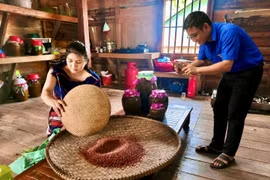
Visitors can tour distilleries, watch the distillation process, taste fresh liquor, and learn about the village’s heritage. “This is a sustainable path that enhances both the brand and local livelihoods,” he said.